
Yes, basketweave and stretcher bond can both be used on a driveway. Herringbone is often preferred where vehicles turn or manoeuvre, as its interlocking pattern helps resist movement. For charcoal block paving ideas in Cannock, choose a layout that suits how you use the drive, the look you want and the shape of the space.
It’s understandable to focus on colour and pattern first: they shape the look of your home every day. But block size, borders, ground preparation and upkeep matter too. This guide compares popular layouts, including basketweave and stretcher bond, and explains how charcoal pairs with other colours, which blocks suit different uses and what affects the cost. You’ll also find practical maintenance advice to help you choose a finish that looks right and works well for your driveway.
Key Takeaways
- Compare basketweave, stretcher bond and herringbone to find a layout that suits your driveway’s appearance and vehicle use.
- See how charcoal paving, contrasting borders and kerb stones can define the edges and complement your home.
- Learn what to consider when choosing block size and material, and how preparation and laying choices affect project costs.
- Get practical guidance on maintaining block paving and see when another driveway surface, such as tarmac, may suit your needs.
Decorative borders, edging patterns and kerb stones
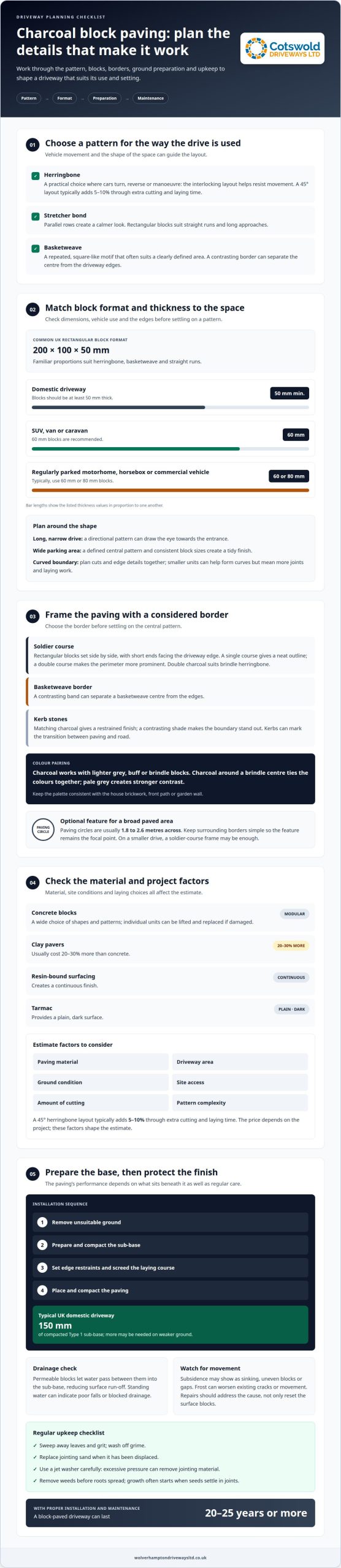
Charcoal pairs well with lighter grey, buff or brindle blocks, adding contrast without a bright accent. For a brindle herringbone surface, a double charcoal soldier-course border creates a clear frame. A soldier course uses rectangular blocks set side by side, with their short ends facing the driveway edge.
Choose the border before settling on the central pattern. A single course gives a neat outline; a double course makes the perimeter more prominent. Charcoal blocks around a brindle centre tie the colours together, while a pale grey border creates stronger contrast. Keep the palette consistent with the house brickwork, front path or garden wall.
- Soldier course: Set blocks in a straight line around the paving to define its edge. The double charcoal version suits brindle herringbone.
- Basketweave border: Use a contrasting band to separate a basketweave centre from the driveway edges.
- Kerb stones: Choose matching charcoal for a restrained finish, or a contrasting shade to make the boundary stand out.
Edging adds detail and helps hold paving in place, particularly where blocks meet a lawn, path or planted bed. Plan the boundary around the driveway’s shape, then align the border so cuts sit neatly at corners and changes in direction. Kerb stones can also create a clear transition between the paving and road, while working with garden teams such as Handy Landscapes can ensure the new surface integrates cleanly with surrounding lawns and borders.
For a feature within a broad paved area, a circle can break up straight lines without crowding the entrance. Paving circles are usually 1.8 to 2.6 metres across. Keep surrounding borders simple so the feature remains the focal point. On a smaller drive, a clean soldier-course frame may give enough definition without adding another pattern.
Block paving materials, costs, and maintenance
Charcoal concrete blocks offer a wide choice of shapes and patterns, while clay pavers usually cost 20 to 30 per cent more than concrete. Resin-bound surfacing creates a continuous finish, and tarmac provides a plain, dark surface. Concrete paving blocks give a modular finish, so individual units can be lifted and replaced if damaged.
Costs depend on the paving material, driveway area, ground condition, access and amount of cutting. Pattern complexity also matters: a 45° herringbone layout typically adds five to ten per cent through extra cutting and laying time. The price depends on the project and is given after a quote request, with these factors shaping the estimate.
Good installation starts below the visible blocks. Remove unsuitable ground, prepare and compact the sub-base, set edge restraints, then screed the laying course before placing and compacting the paving. A typical UK domestic driveway needs 150 mm of compacted Type 1 sub-base, with more on weaker ground. Permeable block paving allows water to pass between blocks into the sub-base, reducing surface run-off.
In Staffordshire, standing water can indicate poor falls or blocked drainage, while frost may worsen existing cracks or movement. Subsidence can show as sinking, uneven blocks or gaps where the ground has shifted. Correct drainage, a stable base and secure edges help limit these problems. Repairs should address the cause, not just reset the surface blocks.
Maintenance is straightforward but regular. Sweep away leaves and grit, wash off grime, and add jointing sand when it has been displaced. Use a jet washer carefully, since excessive pressure can remove jointing material. Weed growth often begins when seeds settle in joints, so remove it before roots spread. A properly installed and maintained block-paved driveway can last 20 to 25 years or more.
For guidance on planning a paving project, consider how the material, base and drainage work together before settling on a finish.
Block sizes and formats
The common UK rectangular block format measures 200 × 100 × 50 mm. Its familiar proportions suit straight runs, herringbone layouts and basketweave patterns. For charcoal paving, the rectangular shape creates clear, orderly lines, while the chosen laying direction changes the overall effect.
Thickness matters as much as the surface dimensions. UK domestic driveways should use blocks at least 50 mm thick. For a driveway used by an SUV, van or caravan, 60 mm blocks are recommended. Regularly parked motorhomes, horseboxes or commercial vehicles typically call for 60 mm or 80 mm blocks.
Match the block format to the driveway’s shape before choosing a pattern. Rectangular blocks suit a long, straight approach, while curved edges need carefully cut pieces. Smaller units can make curves and intricate details easier to form, but usually mean more joints and laying work. For a broad, uncomplicated entrance, standard rectangles give a balanced appearance.
- Long, narrow drive: Lay rectangular blocks in a directional pattern to draw the eye towards the entrance.
- Wide parking area: Use a defined central pattern and consistent block sizes for a tidy finish.
- Curved boundary: Plan the cuts and edge details together to avoid awkward slivers at the perimeter.
Block format also affects how a pattern looks at the kerb. Herringbone’s angled lines can make a compact space feel more active, while stretcher bond creates calmer parallel rows. Basketweave forms a repeated, square-like motif, so it often suits a clearly defined area. These are visual choices; block thickness should still suit the vehicles using the surface.
Before settling on charcoal blocks, compare a sample with the house frontage and other paving in daylight. Check the blocks’ actual face dimensions, thickness and surface texture, and consider how they work with your chosen pattern. A consistent format helps courses meet neatly, especially beside borders and around drainage covers.
What charcoal block paving styles and patterns are popular for driveways in Cannock?
Herringbone is a practical choice for a driveway where cars turn or reverse. Its interlocking layout helps resist movement under vehicle use. Choose a 45-degree arrangement for a dynamic look, or set the blocks at 90 degrees for straighter lines. Either option gives charcoal paving a strong, structured appearance.
Basketweave is a traditional pattern made from pairs of blocks that alternate direction, creating a repeated woven effect. On a broad driveway, a charcoal basketweave centre can look balanced with a contrasting border. A smaller entrance may suit a simpler layout, which keeps the pattern from feeling too busy.
Stretcher bond uses parallel rows, with each block offset from the next. It gives a calmer, more linear finish than herringbone or basketweave. Consider the direction of the rows: running them lengthways can lead the eye towards the house, while a crosswise layout can emphasise the width. Both work with rectangular blocks.
For charcoal block paving ideas in Cannock, start with the house frontage and driveway shape. A square entrance can take a centred motif, while a long, narrow drive often looks cleaner with a continuous pattern. Keep details such as circles or contrasting bands to one area, so they complement rather than compete with the main layout.
- Choose herringbone for an interlocking pattern suited to turning and manoeuvring.
- Choose basketweave for a decorative, traditional effect across a defined area.
- Choose stretcher bond for orderly rows and a more understated finish.
Before deciding, sketch the driveway outline and mark the entrance, parking spaces and any curves. This helps reveal where pattern cuts will fall at edges and around features. You can plan your block paving design around the layout you use every day.
Wolverhampton Driveways: Tarmac Driveways
Wolverhampton Driveways Ltd can help you compare driveway options and plan a finish around your home and how you use the space. If you like charcoal block paving ideas Cannock but want a more uniform surface, tarmac driveways offer an alternative. Block paving suits patterned designs with defined borders, while resin bound driveways offer another surface option.
Discuss the driveway’s shape, parking needs, preferred appearance and any existing surface issues. These details can help determine whether you need a new surface or driveway cleaning and repairs for paving that needs attention. Arrange a free, no-commitment quote to discuss the work you have in mind.
Contact Wolverhampton Driveways Ltd to discuss your driveway project.
Turn your driveway plan into a clear next step
Use charcoal block paving ideas in Cannock as a starting point, then shape the design around how you arrive, park and move through the space. Before committing, decide what matters most: a strong first impression, a simple layout or a finish that sits quietly alongside the house. That priority will help keep your choices focused.
Bring your preferences together in a short brief: note the overall look you want, how the driveway needs to function and any existing issues that could affect the project. This gives the design conversation a practical focus and helps you move from browsing ideas to planning work that suits your home.
Wolverhampton Driveways Ltd can discuss the direction you have in mind and the surface options that fit your project. Contact Wolverhampton Driveways today to start shaping a driveway that feels right for your home.
Frequently Asked Questions
Can I lay basketweave or stretcher bond on a driveway?
Yes, basketweave and stretcher bond can both be laid on a driveway. Choose a pattern that suits the parking layout, and plan where it meets thresholds, drains and the road entrance. For example, align it across the garage entrance to avoid an awkward change in direction. Paving strength also depends on suitable blocks, a stable base and secure edge restraints.
What pattern suits a small or narrow driveway?
A simple, uninterrupted layout often suits a small or narrow driveway better than several competing features. Stretcher bond creates a clean appearance, while a restrained charcoal border defines the edge without dominating the space. Before choosing, mark the vehicle’s parking position and walking route. This helps you avoid placing a decorative feature where a parked car would hide it.
How much does charcoal block paving cost per square metre in Cannock?
Project cost depends on the work involved. For an estimate per square metre, key factors include the selected blocks, existing ground, excavation and sub-base requirements. A plain layout usually needs less cutting than a detailed design, while difficult access can affect material handling. Ask for your quote to clarify which preparation and finishing work it covers.
What is the typical total cost to install a charcoal block paving driveway in Cannock?
Total project cost reflects the driveway’s measured area, removal of the existing surface, ground condition, drainage work, block choice and design detail. A border or curved edge may require extra cutting; a straightforward rectangular layout may involve less. The full project scope, rather than area alone, determines the cost. Wolverhampton Driveways Ltd provides free, no-commitment quotes.
How can charcoal block paving be maintained, cleaned and protected from weeds?
Sweep the surface regularly and remove leaves before they settle into the joints. For weed control, carefully remove growth and top up joints with suitable kiln-dried sand after cleaning. Rinse ordinary dirt away with water and a stiff brush; use a pressure washer cautiously to avoid disturbing jointing sand. Check low spots after rain, as lingering water can signal a drainage issue.
Which local Cannock contractors install charcoal block paving, and what do their reviews say?
Wolverhampton Driveways Ltd offers block paving. The stated average rating for block-paving services in Cannock is 10 out of 10, based on 145 customer reviews.