
A circular patio can look striking, but a perfect circle is not always the best fit for your garden. With circular patio design Dudley homeowners need to balance appearance with usable space, comfortable access and how rainwater will drain away.
If you are unsure whether a curve will suit your garden’s size and shape, start by looking at how you use the space. The layout, paving choice and finished edges all affect how practical the patio feels and how well it sits alongside the house, lawn and paths.
This guide compares circular layouts and paving considerations, explains which site details to check, and suggests questions to ask a patio installer before requesting a quote. Whether you want a focal point or a seating area, careful planning can help you make good use of your Dudley garden without losing the character of a curved design.
Key Takeaways
- Check whether a full circle, semicircle or circle with a path will fit your garden and how you plan to use it.
- Compare paving options by colour, surface texture, joint appearance and upkeep before choosing a finish.
- For circular patio design Dudley, consider how the curved footprint will affect access, garden space and drainage.
- Note site access, existing levels, boundaries and where water gathers so you can discuss them with an installer.
- Use your preferred layout and material ideas to guide a site assessment and a clearer patio quote.
Could a Circular Patio Design Suit Your Dudley Garden?
A curved patio can create a focal point and soften the straight lines of a house or garden. The shape needs to work for everyday use as well as look good in a plan. For circular patio design Dudley homeowners should consider how much space the patio needs, how people will reach it and what they want to do there.
A circular patio is a paved outdoor area arranged around a full or partial curve. It may suit a garden when the shape leaves enough practical space for furniture, movement and access. The paving might form a complete circle, a half circle or simply a curved edge. Patio surfaces can use a range of materials, as outlined in this overview of common patio materials, but the shape should reflect how you intend to use the garden.
Start by listing your priorities. Dining needs room to pull chairs back, while a relaxed seating area needs clear routes around the furniture. If you entertain, consider how guests will move between the house, patio and garden. A large paved footprint can leave less room for planting or lawn, so assess the space around the proposed circle as well as the paving itself.
What garden conditions make a circular patio practical?
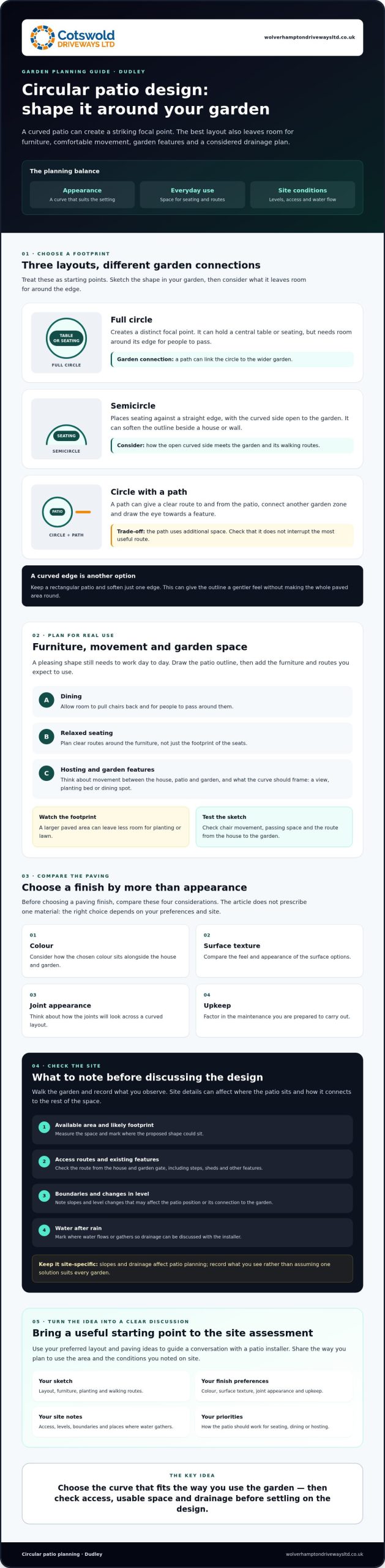
Measure the available area and mark the likely footprint. Check routes from the house and garden gate, along with access around steps, sheds and other existing features. Note boundaries, changes in level and places where water collects after rain. Slopes and drainage can affect where a patio sits and how it connects to the rest of the garden. The right approach depends on the site, so record what you observe rather than assuming one solution will suit every garden.
Full circle, half circle or curved edge?
A full circle can work as a central feature if there is room to walk around it and connect it to the house or other garden areas. A semicircle beside the house can soften the transition from a straight wall, while a curved edge can give a rectangular patio a gentler outline without making the whole space round.
Before choosing, sketch the furniture, walking routes and planting alongside the proposed shape. Allow space to move chairs and pass comfortably. This can show whether a curve improves the layout or takes useful space away from the garden. Use the sketch as a starting point, then discuss site conditions and access with a patio installer before settling on the design.
How Circular Patio Layouts Balance Appearance, Access and Everyday Use
A useful layout makes the curve work with the way you move through the garden. A full circle can stand out as a feature, while a partial curve may connect more naturally with the house or an existing rectangular paved area. Compare the options before committing to a shape.
| Layout | Seating and circulation | Garden connection and appearance |
|---|---|---|
| Full circle | Can accommodate a central table or seating, but needs room around its edge for people to pass. | Creates a distinct focal point and can link to the wider garden with a path. |
| Semicircle | Places seating against a straight edge, leaving the curved side open to the garden. | Often suits a patio beside a house or wall, where the curve softens the outline. |
| Circle with a path | A path can provide a clear route to and from the patio, though it uses additional space. | Connects the circular area to another garden zone and can draw the eye towards a feature. |
These layouts are starting points, not fixed rules. A connected path or separate paved area may suit some gardens; in others, keeping the patio on its own may preserve more lawn or planting space. A table, planter or other central feature can anchor a full circle, but leave room around it for chairs and movement.
Which circular patio layout suits your garden shape?
In a compact area beside a wall or house, consider whether a semicircle or curved edge can create the look you want without taking over the garden. A full circle is more likely to work where there is space to move around its edge and connect it to the house or garden gate. If the garden has distinct areas, a path or separate paved zone could link them, provided it does not interrupt the most useful route.
How to plan seating, access and garden features
Draw the patio outline and mark where furniture would sit. Add the route from the house to the garden, allowing for chairs to be pulled out and people to pass. Decide what the curve should frame, such as a view, planting bed or dining spot. Plan furniture and access routes together so the patio is comfortable to use as well as pleasing to look at.
As you develop the sketch, note where rainwater currently flows or gathers. GOV.UK guidance on permeable surfacing regulations concerns front gardens, so check whether it is relevant to your project rather than assuming it applies to every patio. You can also discuss the layout and site access with a local patio installer.
Circular Patio Materials Compared: Paving, Finish and Curved Edges
Paving influences the look of a circular patio, while the edge and joints help define its shape. For circular patio design Dudley homeowners should compare samples in the garden’s light and consider how each option looks beside the house, lawn and planting. Wolverhampton Driveways Ltd offers patio installation. Ask which paving materials and finishes are available for your project before choosing.
Colour can help a patio blend into the garden or make it a stronger focal point. Surface texture affects its appearance and feel underfoot, while joint colour and width can emphasise the pattern or make it less prominent. Look at samples alongside existing features rather than choosing from a small image alone. Design principles such as proportion and unity, covered in this overview of the fundamental concepts of composition, can also help the patio feel connected to the rest of the space.
How to compare paving materials for a curved patio
Ask to see the paving options available for your patio, then compare their colour, surface texture and finish in person if possible. Check what routine care each option needs and ask how its appearance may change with normal outdoor use. Unit size and shape matter too: smaller units can create a more detailed pattern around a curve, while larger ones may need more shaping to follow the edge. For further perspective on residential paving and material selection, guides from specialists like Alma Gardening Company highlight how durable outdoor surfaces are planned and laid.
If you are weighing up layouts as well as finishes, refer back to your garden sketch and intended use. You can also read more about garden patio design in Wolverhampton as part of your planning.
What to ask about curved borders and drainage
A circular edge may require paving to be cut or arranged carefully to follow the curve. Ask how the border will be formed, how cut edges will be finished and what the joints will look like. These details affect the final appearance and work involved, so discuss them before agreeing on the layout.
Talk through surface falls and water run-off in relation to your property, existing levels and the site. Ask where water is intended to flow and whether nearby boundaries or features affect the plan. Do not assume one drainage approach suits every garden. If permissions or local requirements may apply, check current guidance with Dudley Council or ask the installer what you should confirm before work begins.
Planning Circular Patio Design in Dudley: Site Checks and Quote Questions
A little preparation can help an installer understand your plans and provide a clearer quote. For circular patio design Dudley homeowners can use this checklist to organise their ideas and flag site details that may affect the layout.
What should you prepare before asking for a patio quote?
Work through these steps before contacting an installer:
- 1. Measure: Note the approximate length and width of the space you are considering. A rough sketch with measurements is a useful starting point, even if it is not to scale.
- 2. List uses: Say whether you want space for dining, seating, entertaining or a mix. Mention any furniture you already own so its likely position can be considered.
- 3. Record site features: Take photographs and note access from the house and garden gate, existing paving, changes in level, boundaries and places where water gathers after rain. Include restrictions such as narrow routes or steps.
- 4. Compare layouts: Share whether you are considering a full circle, semicircle or curved edge, along with any finishes you like. Stay open to changes if the site calls for a different approach.
- 5. Request a site assessment: Ask how the installer will check the space and confirm the design before work is agreed. If you are concerned about drainage or permissions, check current requirements with Dudley Council or the relevant authority rather than relying on assumptions.
Which questions help you compare patio installers?
Give each installer the same brief so you can compare proposals on a like-for-like basis. Ask what the quote includes, how the shape and finish will be agreed, and how it accounts for site access, preparation, curved edges and waste removal. If anything is unclear, ask for an explanation in writing before deciding.
Discuss how the proposed layout will work with existing levels, boundaries and water run-off. Ask what happens if the site assessment identifies an issue that changes the design or scope. You can also ask about insurance and licensing, and check any claims rather than making assumptions.
Wolverhampton Driveways Ltd installs patios in Dudley and offers free quotes. Share your measurements, photographs, preferred layout and access notes when you request a free patio quote, so the discussion can focus on the details that matter to your garden.
From Circular Patio Idea to Installation with a Local Dudley Contractor
A practical design starts with the footprint, then considers how you will reach and use the patio. Compare suitable paving options and discuss site details before agreeing on the final layout. This helps turn a circular patio design Dudley homeowners can picture into a plan that fits the garden, rather than forcing the garden to fit an idea.
Wolverhampton Driveways Ltd installs patios in Dudley and the wider West Midlands. The company states that its team is fully insured and licensed, and offers free quotes. An initial conversation is an opportunity to explain what you have in mind and ask how the layout could work in your garden.
What to expect when discussing your patio project
Be ready to share approximate garden dimensions, photographs and the patio’s intended use, such as outdoor dining or a seating area. Describe access from the house and gate, along with any changes in level, existing paving or drainage concerns you have noticed. These details help the installer understand the setting and the questions to consider.
Ask how the site will be assessed and how your preferred shape might be refined to suit the space. A full circle, partial curve or connected path may look different on the ground than it does in a sketch, so discuss furniture positions and routes through the garden. Confirm which materials and finishes are available for the project rather than assuming a particular option is offered.
How to move forward with a circular patio design
Bring your preferred shape and material ideas, but be open to practical advice based on access, levels and boundaries. A clear brief gives you a useful starting point: note what the patio should do, how you want it to look and any site details that could affect the design. If you are still exploring ideas, the related topic garden patio design trends in Wolverhampton may help you shape your preferences.
You do not need every detail settled before making an enquiry. Share what you know, ask questions about the proposed design and clarify what the quote covers before deciding how to proceed.
Request a free patio quote to discuss your garden, intended use and design preferences.
Take the Next Step Towards a Patio That Fits
A successful circular patio starts with a shape that suits your garden and how you plan to use it. Check that seating and access routes fit comfortably, then compare paving finishes and discuss curved edges, levels and drainage in light of your site.
These details give you a clearer brief to share with an installer. Wolverhampton Driveways Ltd installs patios in Dudley and the wider West Midlands, including Wolverhampton, Telford and Cannock. The company offers free quotes and states that its team is fully insured and licensed. Discuss your garden dimensions, intended use, access and design preferences before deciding how to proceed.
If you are ready to explore circular patio design in Dudley, request a free patio quote and share your ideas.
Frequently Asked Questions
Will a circular patio work in a small garden?
Yes, a curved or partial-circle patio can suit a compact garden if enough usable space remains around it. Consider the furniture you need, routes from the house and gate, nearby boundaries and room for planting. A simple scaled sketch can help you see whether the patio crowds other uses. There is no universal size rule, so ask an installer to assess your garden before settling on the footprint.
Which paving is best for a circular patio?
There is no single best paving choice for every circular patio. Compare the options available for your project by colour, surface texture, upkeep and how their shape will work around the curve. Smaller or differently shaped units can create a different pattern from larger slabs. Ask your installer which materials are available, how each option will be arranged, and how the joints and curved edge will be finished on your site.
Is a circular patio more difficult to install than a square patio?
A curved layout may need more planning and careful edge detailing than a straightforward rectangular patio, but the work depends on the site, paving and final shape. A partial curve could be an alternative if a full circle does not suit the space. Ask the installer to explain the proposed layout and what the quote includes, so you can understand the approach and compare proposals on a like-for-like basis.
How do you plan drainage for a circular patio?
Drainage planning depends on the garden’s levels, the patio’s position and where water can run off appropriately. Discuss the proposed surface falls, nearby boundaries and any places where water currently gathers with your installer. Do not assume a layout meets local requirements without checking. For a project in Dudley, confirm any relevant planning or drainage requirements with the appropriate authority before work begins.
Do I need permission to build a circular patio in Dudley?
It depends on the property, proposed work and requirements that apply to the site, so do not assume every patio has the same answer. Check current guidance with the relevant authority before starting, especially if property-specific restrictions or drainage questions may affect your plans. An installer can discuss the site and proposed layout, but confirm whether permission or approval is needed with the appropriate authority.
How much does a circular patio cost in Dudley?
The cost depends on factors such as the garden, preparation needed, chosen materials, access and details of the curved design. There is no reliable figure without understanding the site and agreed work. Request a quote based on your measurements and preferred layout, then check what it includes. Wolverhampton Driveways Ltd offers free quotes and serves Dudley, Wolverhampton, Telford, Cannock and the wider West Midlands.
What should I ask a patio installer before choosing a circular design?
Ask how the proposed shape will fit your garden, how access and drainage will be considered, which paving options are available and how the curved edge will be finished. Request a clear explanation of the work included in the quote. You can also check insurance and licensing details directly. Wolverhampton Driveways Ltd states that its team is fully insured and licensed, but confirm any details you need with the company.