
Most homeowners believe choosing a driveway pattern is purely about aesthetics, but it is actually a vital structural decision that determines if your frontage will shift or sink under the weight of your vehicle. It is completely natural to feel overwhelmed by the vast array of colours and layouts currently on the market. You want a finish that complements your home’s unique character, yet the fear of shifting blocks or constant weeding often makes the process feel more stressful than it should be.
This 2026 guide will help you navigate those choices to find the most durable and visually stunning block paving patterns for driveways. We promise to show you exactly how to achieve a bespoke look that boosts your property value whilst ensuring your driveway stays perfectly level for years. We will explore the strongest interlocking layouts for heavy cars, the latest SuDS-compliant materials, and the design combinations that are currently defining modern British kerb appeal.
Key Takeaways
- Learn why interlocking strength is the secret to preventing your driveway from sinking or shifting under the weight of your car.
- Discover the most durable block paving patterns for driveways, including why the 45-degree herringbone remains the top choice for structural integrity.
- Find out how to select a layout that suits your property’s scale and ensures a safe grip if you have a sloped entrance.
- Explore decorative options like circular fans and random cobbles to create a bespoke look that enhances your home’s kerb appeal.
- Understand why professional sub-base preparation and secure edge restraints are essential for a finish that lasts for decades.
Why Block Paving Patterns Matter for Your Driveway’s Longevity
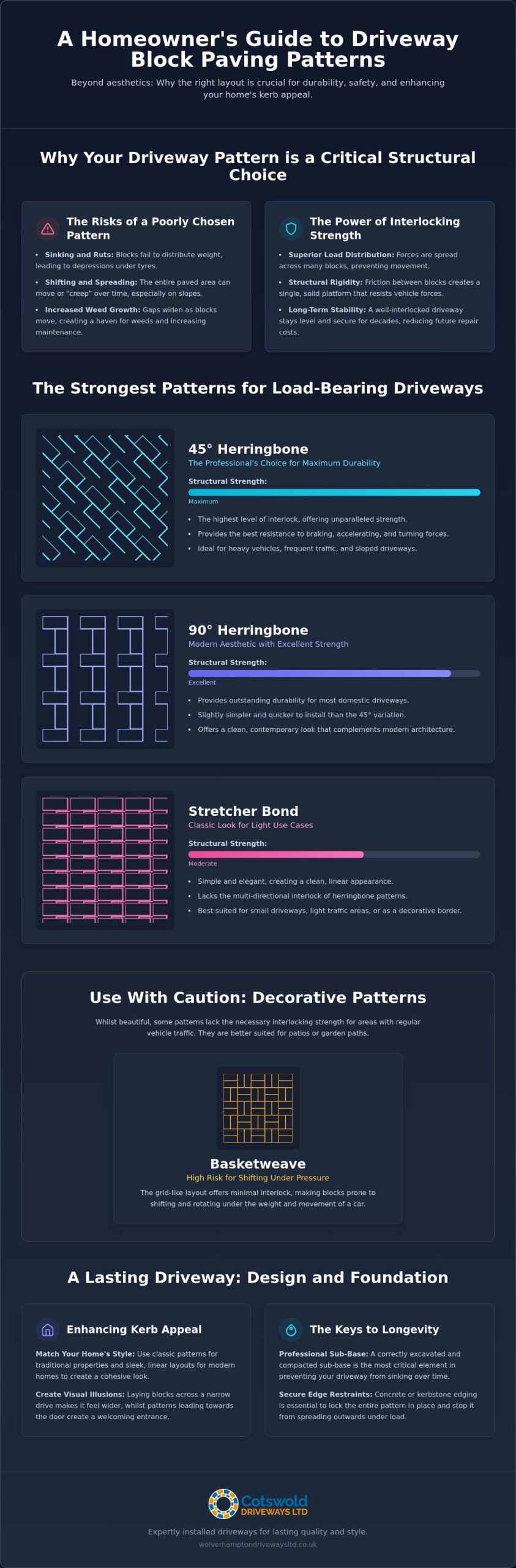
Choosing the right block paving patterns for driveways is not just a matter of personal taste; it’s the foundation of your driveway’s structural health. In simple terms, a pattern is the specific arrangement of individual bricks laid to form a continuous, cohesive surface. While the colour often catches your eye first, it is the pattern that determines how well those bricks handle the weight of your vehicle. A well-chosen layout creates “interlocking strength”, a clever mechanism where the friction between the blocks prevents them from moving independently when a heavy load is applied. Without this interlock, your driveway is far more likely to suffer from ruts, sinking, or shifting over time.
The layout you choose also dictates your long-term maintenance schedule. Some intricate designs require more precision during the initial build to ensure the joints remain tight. If the pattern is compromised, you will likely see an increase in weed growth between the gaps. By selecting a layout that maximises structural integrity, you aren’t just making a design choice; you’re investing in a surface that stays level and looks sharp for decades.
The Science of Interlocking Paving
A driveway has to withstand significant horizontal and vertical forces every single day. When you brake, turn, or accelerate, you’re pushing against the blocks. In a superior layout, these forces are spread across dozens of neighbouring bricks rather than just one. This distribution of pressure is vital for homes across the West Midlands with steep inclines, where gravity and tyre torque increase the risk of shifting. To understand the materials and methods involved, you can research Block Paving Basics. Once the pattern is set, we use kiln-dried sand to fill the joints. This sand acts as a structural wedge, locking the block paving patterns for driveways into a single, rigid platform that resists movement.
Aesthetics: Enhancing Your Home’s Architectural Style
The right pattern does wonders for your home’s kerb appeal by complementing its existing features. If you own a traditional Victorian or Edwardian property in Wolverhampton or Dudley, a classic layout can mirror the architectural heritage of your home. Modern builds often benefit from sleek, linear arrangements that suit clean, minimalist lines. You can use patterns to manipulate the perceived size of your space, too. Laying blocks across the width of a narrow drive makes it feel more expansive, while patterns that lead the eye toward the front door create a welcoming and professional entrance. Just as a well-paved driveway sets the tone for your exterior, choosing high-quality internal surfaces from specialists like GW Flooring ensures your home’s interior is just as impressive.
The Most Popular Load-Bearing Patterns: Herringbone and Beyond
When you are planning a new entrance for your home, the layout you choose dictates how many years of service you’ll get before repairs are needed. Not all block paving patterns for driveways are designed to handle the daily stress of a two-tonne vehicle. Some are built for maximum strength, whilst others are strictly for decoration. Understanding the difference ensures you don’t end up with shifting blocks after just a few months of use.
Why Herringbone is the Professional’s Choice
The herringbone pattern is the undisputed king of the driveway world. By laying blocks at a 45-degree or 90-degree angle to one another, we create a “V” shape that locks every brick into its neighbour. This prevents the blocks from shifting or “creeping” when you turn your steering wheel whilst stationary. According to technical standards found in the FHWA Pavement Design Guide, interlocking pavements are specifically engineered to distribute vertical loads horizontally. Herringbone is the superior choice for heavy SUVs and frequent traffic.
A 45-degree layout is usually the strongest because it provides the most resistance to tyre action from all directions. It requires more precise cutting at the edges, but the structural payoff is worth the extra effort. A 90-degree herringbone is slightly simpler to install and offers a cleaner, more modern aesthetic. It still provides excellent durability for most domestic homes in Wolverhampton and the surrounding areas.
Stretcher Bond and Offset Patterns
Stretcher bond, or running bond, is the classic look you see on house walls. It’s simple and elegant, but it lacks the multi-directional interlock of herringbone. We often recommend this for paving for small driveways where traffic is light and space is at a premium. It also works brilliantly as a contrasting border to frame a more complex central pattern. Basketweave is another popular choice, but we generally advise against it for main driveway areas. It’s beautiful for a patio, but the blocks can shift easily under the pressure of a car.
One detail often overlooked is how your pattern affects drainage. In 2026, staying SuDS-compliant is a legal necessity for most new installations. Herringbone patterns are particularly effective for permeable systems because they maintain joint integrity even when using larger aggregate for drainage. If you aren’t sure which layout suits your specific soil type and drainage needs, getting straight-talking advice from a local installer can prevent costly planning issues later on.
Artistic and Decorative Layouts for Enhanced Kerb Appeal
Once you have settled on a structural layout that handles the weight of your vehicles, you can begin to explore the creative potential of your frontage. Choosing artistic block paving patterns for driveways allows you to express your home’s personality whilst significantly boosting its market value. In 2026, we are seeing a shift away from uniform, single-colour expanses toward more intricate designs that act as a focal point for the entire property. These decorative choices don’t have to compromise the driveway’s strength if they are planned with professional precision.
Creating Focal Points with Circles and Diamonds
For larger properties across the West Midlands, a central circular pattern or a series of diamond shapes can break up a monotonous stretch of paving. These designs act like an outdoor rug, drawing the eye and creating a sense of grandeur. Laying a circle is technically demanding because it requires specific “tapered” blocks and a perfect centre point to ensure the geometry doesn’t drift. We often use pre-engineered kits to ensure the joints remain tight and structurally sound. Adhering to the principles found in guides on Pavement Structure and Design ensures that even these complex, non-linear shapes maintain their interlock and don’t shift under pressure.
To make these features truly stand out, we recommend using contrasting colours. A charcoal border around a silver-grey circle creates a sharp, high-definition look that feels bespoke and expensive. You can also use “soldier courses” (blocks laid side-by-side in a row) to frame these artistic elements, providing a clean transition between the decorative feature and the main load-bearing herringbone area.
Modern 2026 Colour Trends: Grey, Charcoal, and Silver
The traditional reds and buffs of the early 2000s are being replaced by a more contemporary palette of cool tones. Charcoal, silver-grey, and slate are the dominant choices for 2026, offering a sleek finish that complements both modern renders and classic West Midlands red brick. A popular technique involves “gradient” layouts, where we transition from darker blocks at the edges to lighter tones in the centre. This adds depth to the driveway and makes even a standard block paving patterns for driveways installation feel like a custom piece of masonry.
For homeowners with traditional cottage-style properties in areas like Cannock or Stafford, a random cobble layout provides a rustic, timeless charm. These layouts use blocks of varying sizes to mimic an old village street. It’s a fantastic way to achieve a traditional look whilst still benefitting from modern sub-base technology. By integrating different textures, such as a resin-bound border or a gravel margin, you can create a truly multi-dimensional entrance that stays stylish for decades.
If you are looking to complement your driveway with decorative garden paths that feature a more natural, ‘living’ aesthetic, Bayside Pavers provides a helpful guide on the best plants to use between paving joints.
How to Choose the Right Pattern for Your Property Style
Selecting block paving patterns for driveways isn’t just about what looks good in a brochure. It’s about how that design interacts with your home’s facade and the physical space available. If you have a small driveway, a large, complex pattern can feel claustrophobic. Conversely, a simple layout on a massive three-car drive can look unfinished. You want to strike a balance where the pattern enhances the architecture without competing with it for attention.
Matching Patterns to Local West Midlands Architecture
Wolverhampton’s traditional semi-detached homes typically feature classic red brickwork. A traditional herringbone in a complementary brindle or buff tone respects the heritage of the building whilst adding modern durability. For the newer estates popping up in Telford and Cannock, sleek charcoal or silver-grey blocks in linear offset patterns provide a clean, professional finish that suits contemporary renders. If you are looking for paving contractors dudley, it is vital to choose a team that understands how to work with the specific housing styles found in our region.
Practical Considerations: Drainage and Slopes
The physical shape of your land dictates your options. If your drive has a steep incline, you need a pattern with high interlocking strength to prevent “creep”, where the blocks slowly shift downhill over years of use. A 45-degree herringbone is ideal here because it provides the best multi-directional grip for your tyres. This layout ensures the blocks stay firmly in place even when you are turning your wheels on a slope.
Soil conditions also play a huge role in the West Midlands. Many areas, particularly around Dudley, have heavy clay soil that can expand and contract with the weather. This makes professional sub-base preparation even more vital to keep your chosen pattern level. Permeable block paving patterns satisfy UK planning regulations by allowing water to drain naturally through the surface. This prevents pooling and reduces the pressure on local sewer systems, which is especially important in high-density residential areas. To ensure your project meets all local requirements and looks fantastic, get a straight-talking quote from our local experts today.
Expert Installation and Maintaining Your Paving Patterns
Even the most beautiful block paving patterns for driveways will fail if the groundwork is rushed. It’s the sub-base that does the heavy lifting. If the foundation isn’t perfectly level, your pattern will eventually distort, leading to uneven blocks and puddles. We’ve seen many DIY attempts where the pattern looks great on day one but begins to sag within a year because the sub-base wasn’t compacted correctly. A precision-levelled base ensures that every brick sits at the exact height required to maintain the interlocking friction that gives the surface its strength.
The edge restraint is equally vital. Think of it as the frame for your artwork. Without a solid concrete haunching or heavy-duty kerb to hold the blocks in place, the lateral pressure from your car will cause the edges to “spread”. Once the edges move, the entire interlock of your pattern is compromised. This leads to gaps, shifting blocks, and an increased risk of weed growth. Investing in a professional installation means these structural details are handled correctly from the start.
The Wolverhampton Driveways Ltd Installation Process
We take a straight-talking approach to every project. This starts with a deep excavation to remove soft topsoil. In areas like Dudley and Wolverhampton, the clay-heavy ground requires extra care. We prioritise high-quality geotextile membranes and a thick, crushed-stone sub-base to prevent the clay from mixing with your foundation. This ensures your driveway remains stable through every season. You can read more about how our methods stand up against other options in our quality paving west midlands guide.
Maintaining Your Driveway’s Fresh Look
Keeping your block paving patterns for driveways looking sharp doesn’t require constant work, but it does need consistency. You should check your jointing sand once a year. If the sand levels drop, the blocks lose their “lock” and can start to rattle or shift. Simply brushing in fresh kiln-dried sand is a quick fix that preserves the structural integrity. It’s a simple task that prevents major movement over time.
For those who have chosen modern charcoal or dark grey tones, professional sealing is a wise investment. It protects the colour from UV fading and makes it much harder for oil stains to penetrate the surface. If a single block does get damaged, the beauty of this system is its modularity. We can lift and replace individual bricks without disturbing the rest of the layout. If you’re ready to transform your home, contact us for a free block paving quote in Wolverhampton and let’s get your project started.
Secure Your Property’s Future with Professional Paving
Choosing the right block paving patterns for driveways is the most effective way to blend long-lasting structural integrity with standout kerb appeal. We have looked at how interlocking layouts like the herringbone prevent shifting under heavy vehicles, whilst modern charcoal and silver palettes provide a Red Dot Design-inspired finish. It’s clear that the success of any layout depends on what lies beneath; that’s why we focus so heavily on expertly prepared sub-bases tailored for local West Midlands clay soil conditions.
Our team of fully insured and licensed specialists is dedicated to making your driveway transformation simple and transparent. We provide the straight-talking advice you need to ensure your new entrance is SuDS-compliant and adds genuine value to your home. Whether you’re based in Wolverhampton, Dudley, or Telford, we’re ready to help you create a surface that stays level and beautiful for decades. Get a Free, No-Obligation Quote from Our Wolverhampton Paving Experts and let’s build a driveway you can be proud of.
Frequently Asked Questions
What is the strongest block paving pattern for a driveway?
The 45-degree herringbone is widely considered the strongest of all block paving patterns for driveways. This specific layout provides the most effective interlock between the bricks, spreading the weight of your vehicle across multiple units simultaneously. It’s specifically designed to resist the heavy forces of braking and turning, making it the industry standard for high-traffic areas and households with heavy SUVs.
Can I mix different colours in my block paving pattern?
You can certainly mix different colours to create a bespoke look that suits your home. Most homeowners choose a primary colour for the main body of the drive and a contrasting shade for the borders or soldier courses. This technique defines the edges of your property and adds a professional finish, especially when using charcoal or silver-grey to frame a lighter central pattern.
Do I need planning permission for a new block paving pattern?
You generally don’t need planning permission if your driveway uses permeable blocks or directs rainwater to a soakaway within your property. Under current UK regulations, any new driveway over 5 square metres that uses impermeable materials and doesn’t manage its own runoff requires formal approval. We always suggest using SuDS-compliant systems to avoid these legal hurdles and potential enforcement notices.
Which pattern is best for a small or narrow driveway?
A linear stretcher bond or offset pattern is often the best choice for narrow driveways. By laying the blocks across the width of the drive, you create a visual trick that makes the space appear wider than it actually is. Simple patterns work better in confined areas because they don’t overwhelm the space or make the frontage feel cluttered.
How do I prevent weeds from growing in my paving patterns?
Preventing weeds starts with a high-quality sub-base and tight jointing sand. Weeds usually grow from seeds dropped into the surface gaps rather than coming up from underneath the blocks. Keeping your jointing sand topped up and applying a professional sealant every few years will significantly reduce the chances of weed growth whilst protecting the colour of your blocks.
What is the difference between 45-degree and 90-degree herringbone?
The main difference lies in the orientation relative to your house and the total structural strength. A 45-degree herringbone offers the maximum interlock but requires more intricate cutting at the edges. A 90-degree version is slightly easier to install and provides a cleaner, more modern aesthetic whilst still offering excellent durability for most domestic cars in the West Midlands.
Is block paving more durable than a tarmac driveway?
Block paving is often more durable in the long term because it is a modular system. If a section of your driveway sinks or gets stained by oil, you can replace individual blocks without needing to resurface the entire area. Whilst tarmac is a dependable choice, a well-installed block paved driveway can easily last over 25 years with only basic maintenance.
How long does it take to install a complex circular paving pattern?
Installing a complex circular pattern typically adds an extra day or two to the project timeline. This is because the geometry requires precision measurements and intricate cutting to ensure the circles remain perfectly symmetrical and the joints stay tight. Whilst it takes slightly longer, the result is a stunning focal point that adds significant kerb appeal and value to your property.