
Could the surface beneath your car determine whether you need planning permission? For homeowners asking about planning permission for driveways Wolverhampton, the answer depends on more than paving choice: drainage, property status and access all matter.
It’s easy to confuse planning permission with approval for a dropped kerb, or to assume a permeable finish settles every requirement. In many cases, a permeable driveway can be installed without planning permission. A non-permeable surface over 5 square metres may need consent unless water drains naturally within your property. A dropped kerb requires separate highways approval.
This 2026 guide explains the likely planning position for common driveway projects in Wolverhampton and how surface and drainage choices affect it. It also covers property-specific checks, including conservation area or listed status, Article 4 directions, and permissions that may apply if you’re a tenant or live in a flat. Use the checks below before work starts to plan your driveway and choose a suitable finish.
Key Takeaways
- Planning permission for driveways Wolverhampton depends on drainage, property circumstances and any local restrictions, not just the surface you choose.
- Planning permission and dropped-kerb approval are separate. Find out which City of Wolverhampton Council highway process applies if you need vehicle access across the pavement.
- Check whether your home’s status or planning restrictions could affect the usual permitted-development position before settling on a design.
- Use a practical checklist to work through ownership, tenancy conditions and required approvals before construction begins.
- Compare tarmac, block paving and resin bound surfaces as part of planning a driveway that suits your property and project.
Planning permission for driveways in Wolverhampton: when might you need it?
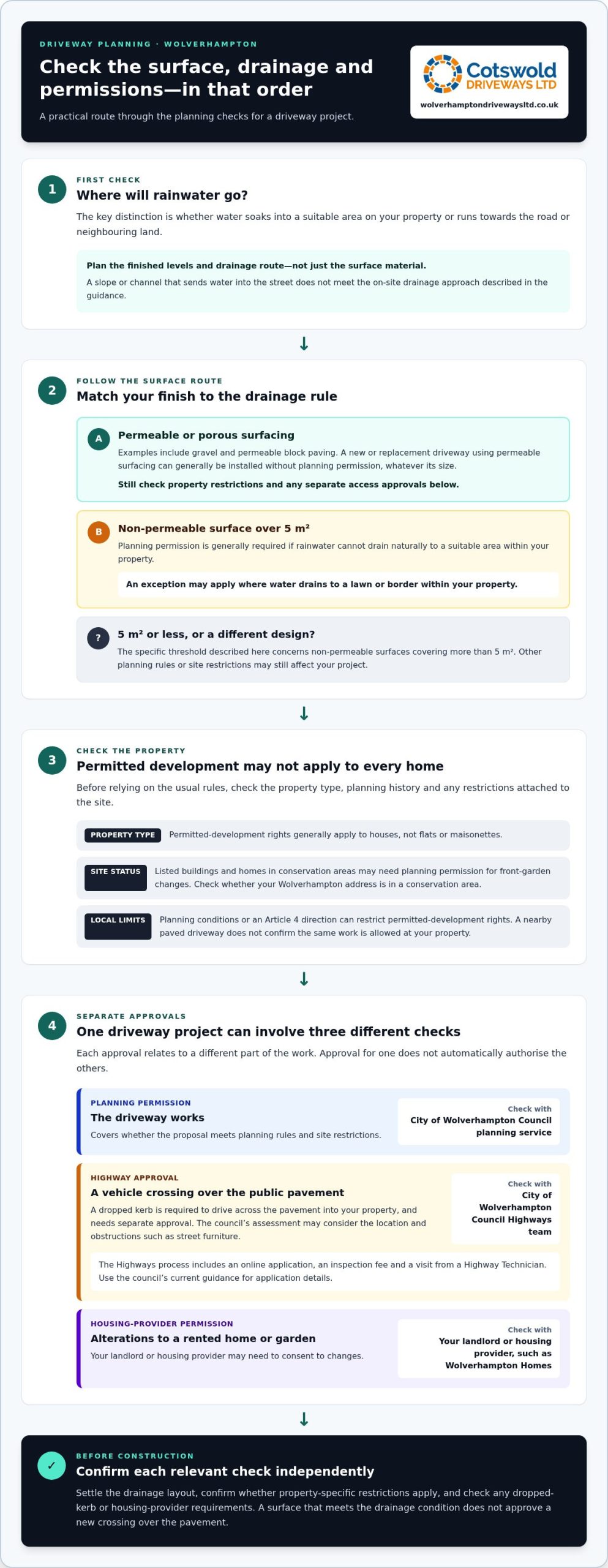
Planning permission depends on how your driveway handles rainwater, your property’s circumstances and any restrictions attached to the site. For many houses, a new or replacement driveway can fall within permitted development, which means planning permission isn’t normally needed if the relevant rules are met. This does not apply automatically to every property or design.
A new driveway may need planning permission if its surface is non-permeable, covers more than 5 square metres and rainwater cannot drain naturally to a suitable area within your property. This drainage rule helps prevent water being channelled onto roads or neighbouring land. The wider framework is explained in this overview of Planning permission in the United Kingdom, but assess your project against current England guidance and any site-specific restrictions.
Keep the access separate in your plans. Paving a front garden is a planning question; altering the pavement and kerb to let a vehicle enter is a highway matter. A driveway that needs no planning application may still need separate approval for a dropped kerb. Consider the surface, drainage layout and vehicle access before work starts.
When can a driveway fall within permitted development?
For a front garden, permeable or porous surfacing, such as gravel or permeable block paving, can allow rainwater to soak into the ground. Under the current permitted-development rules, a new or replacement driveway using permeable surfacing can generally be installed without planning permission, whatever its size. For non-permeable surfacing over 5 square metres, permission is generally required unless water drains to a lawn or border within the property.
The practical distinction is whether water soaks into a suitable area on your land or runs towards the highway. A channel or slope that sends water into the street does not meet the on-site drainage approach. Consider how the finished levels will work in heavy rain, not just which surface material appears on the quote. This drainage rule does not remove other planning or highway checks.
Which properties may need extra planning checks?
Before relying on permitted development, establish what kind of property you have and whether restrictions apply. These rights generally apply to houses, not flats or maisonettes. Listed buildings and homes in conservation areas may need planning permission for changes to the front garden. Wolverhampton has conservation areas, so check whether your address is within one rather than assuming the usual householder rules apply.
Planning conditions or an Article 4 direction can also limit permitted development rights. These restrictions are property- or area-specific, so a nearby home having a paved drive does not prove the same work is allowed at yours. Review the property’s planning history and relevant local planning information before committing to a layout or surface. If a restriction applies, obtain the required planning decision before construction begins.
Planning permission, dropped kerbs and property consent: what is the difference?
A driveway project can involve more than one approval, because each relates to a different part of the work. Planning permission concerns development of the property; highway consent covers changes to the public pavement or kerb; and a landlord or housing provider may control alterations to a rented home. One approval does not replace the others.
| Permission or approval | What it covers | Who to check with |
|---|---|---|
| Planning permission | The driveway works and whether the proposal meets planning rules and site restrictions. | City of Wolverhampton Council’s planning service. |
| Highway approval | Creating or changing a vehicle crossing over the public pavement. | City of Wolverhampton Council’s Highways team. |
| Housing-provider permission | Alterations to a rented property or garden where the provider’s consent is required. | Your landlord or housing provider, such as Wolverhampton Homes. |
Planning, highway and landlord approvals are separate checks, so permission for one part of a driveway project does not automatically authorise the others. For example, a permeable surface may meet the drainage condition for permitted development, but that does not approve a new crossing over the pavement. The government’s Permeable surfacing of front gardens guidance explains the surface-water rules; access and property permissions need separate consideration.
Does a dropped kerb need separate approval in Wolverhampton?
Yes. If you need to drive across the pavement from the road into your property, a dropped kerb is required and needs separate approval. It provides a suitable vehicle crossing; it does not determine whether the driveway itself meets planning rules. The City of Wolverhampton Council directs applications through its Highways process, which includes an online application, an inspection fee and a visit from a Highway Technician. Use the council’s current guidance for application details.
The proposed location matters. The council’s assessment can consider the site and potential obstructions, including street furniture. A crossing may not be suitable in the position you first had in mind, so factor the access decision into the driveway layout. An existing kerb or a neighbour’s crossing does not constitute approval for your entrance.
What if you rent or live in a Wolverhampton Homes property?
If you rent, check your tenancy terms before changing the garden or front of the property. Wolverhampton Homes tenants should obtain written permission from the housing provider before making alterations, including laying a driveway. That consent is separate from planning permission and highway approval, so you may need to follow more than one process before work can begin.
Start by identifying who owns or manages the property, then establish its requirements for the proposed alteration. A council planning decision does not give a tenant the right to alter the property. Once the permission route is clear, a driveway quote can help you plan the surface and scope of work. Find information about Wolverhampton Driveways Ltd’s driveway services.
Permeable and impermeable driveway surfaces: how the choice affects permission
The surface you choose affects how rainwater behaves, but the material name alone will not settle the planning question. A permeable finish is designed to let water pass through; an impermeable one sheds water across its surface. The sub-base, falls, drainage route and property restrictions also matter. For planning permission for driveways Wolverhampton, assess the complete build-up and where water will go, not just the colour or appearance of the paving.
How does permeable surfacing manage rainwater?
A suitable permeable surface lets rainwater pass into a prepared layer beneath it, where it can soak into the ground or be managed within the property. The full construction matters: a permeable-looking top layer over an unsuitable base may not provide the intended drainage. Check how the design handles heavier rainfall and make sure water is not directed onto the pavement or road.
Resin bound surfacing can be designed as a permeable option, but the installed system and drainage arrangement matter. Consider the finish, base and water route together. Find more detail in this guide to resin bound driveways. Permeability may support permitted development where the relevant conditions are met, but it does not remove checks for a dropped kerb, tenancy consent or other site restrictions.
How do tarmac and block paving compare for driveway planning?
Tarmac is generally a continuous, impermeable finish, so the design needs to account for where surface water drains. Block paving has joints between blocks, but that alone does not make it permeable: the paving system and layers beneath determine how water is dealt with. Permeable block paving is a specific construction choice, not an automatic feature of every block-paved driveway.
| Surface choice | Drainage point to consider | Practical design question |
|---|---|---|
| Tarmac | Usually sheds water across the surface. | Where will runoff be directed and managed? |
| Block paving | Joints and sub-base affect whether water can pass through. | Is the system permeable, or will water need another drainage route? |
| Resin bound | Can be installed as a permeable surface, subject to the system and construction. | Does the full build-up support the intended drainage? |
Appearance and upkeep also influence the decision. Tarmac creates a smooth, joined finish, while block paving offers a modular look; resin bound surfacing provides another finish to consider. Think about how each suits your home and how you’ll maintain it, alongside drainage. Explore tarmac driveway options and block paving choices as part of your comparison.
No surface guarantees planning approval. Current rules, drainage design and property-specific controls determine the position. For local planning information, visit the Wolverhampton Council Planning Department. A well-planned driveway starts with a surface that suits the property and a clear approach to water management.
Before building a driveway in Wolverhampton: a practical permission checklist
Checking the approval route before work starts can help you avoid delays, redesigns or problems later. Follow these steps to establish who needs to approve the project, what information to prepare and when to arrange installation.
- Confirm ownership and property status. Check whether you own the property or rent it, and identify any landlord or housing provider. If you’re a Wolverhampton Homes tenant, obtain the provider’s written permission before making alterations. Also establish whether the home is listed, within a conservation area, a flat or maisonette, or subject to planning conditions or an Article 4 direction. These details can affect the usual planning position.
- Set out the proposed design. Sketch the area to be paved, the intended vehicle entrance and the surface you’re considering. Mark the direction of the slope and where rainwater is intended to go. This gives you a clearer basis for considering planning permission for driveways Wolverhampton and distinguishes water draining within your property from runoff flowing towards the pavement.
- Check the planning route. Compare your proposal with current England permitted-development guidance, then review the City of Wolverhampton Council’s planning information for local processes and site-specific restrictions. If an application may be needed, use the council’s current forms and guidance to identify the plans or supporting information to submit. A neighbour’s driveway does not establish what is allowed at your address.
- Deal with access separately. If a vehicle needs to cross the pavement, check the council’s current dropped-kerb guidance and application route through its Highways team. Follow the relevant instructions on assessment and supporting details. A planning decision for the driveway does not grant permission to alter the highway, so keep the access application distinct from any planning enquiry.
- Get property consent and decisions in writing. If you rent, secure the housing provider’s written consent as well as any required council decisions. Keep copies of applications, decision notices, permissions and the final design. These records help you confirm what was approved and the scope of the work before construction begins.
- Wait for the necessary approvals, then build to the agreed plan. Don’t start work until the relevant planning, highway and property permissions are settled. Make sure the finished driveway follows the approved layout, access point and drainage arrangement. If you need to change the design, check whether that affects an approval before proceeding.
Once the permission route and design are clear, you can plan the surface and installation with greater confidence. This driveway quote information explains how to start discussing a project, including its proposed area, access and surface.
Planning a compliant driveway with Wolverhampton Driveways Ltd
Once you understand which permissions may apply, plan a driveway that suits your home, how you’ll use it and how rainwater will be managed. Wolverhampton Driveways Ltd installs residential driveways across Wolverhampton and the wider West Midlands, with tarmac, block paving and resin bound finishes. A considered design helps you define the work, while the relevant council or property approvals remain separate decisions.
Match the driveway surface to your home and drainage plan
Think about the look you want, how the drive will be used and where water will go. Tarmac offers a continuous finish, while block paving has a modular appearance. Resin bound surfacing gives you another option. The material alone does not determine whether planning permission is required; the full design, drainage approach and circumstances of your property matter.
Before choosing, bring together the practical details that shape the project:
- Appearance: Consider which finish sits well with the house and front garden.
- Use: Think about vehicle access, parking and the space available for manoeuvring.
- Drainage: Establish how the surface and its construction will manage rainwater, and where that water will drain.
For planning permission for driveways Wolverhampton, don’t treat a particular surface as a guarantee of permitted development. Confirm the planning position for your property and design before construction, including any relevant restrictions or separate highway requirements.
Get your driveway project moving with a clear next step
Prepare for a useful project discussion by noting the approximate driveway area, where vehicles will enter, your preferred surface and the intended route for rainwater. Gather any planning decisions or property permissions you already have, and note any restrictions you know apply. This gives the project a clear starting point without confusing a driveway quote with council approval.
Wolverhampton Driveways Ltd provides free quotes tailored to the project. Whether you’re considering tarmac, block paving or resin bound surfacing, share your preferred layout and surface so the proposed work can be understood in context. A quote helps you plan the installation; it does not replace any planning, highway or housing-provider permission that may be required.
To discuss the project, visit Wolverhampton Driveways Ltd.
Turn your driveway plans into a clear next step
Once you’ve established the permission route, use that information to shape a practical installation brief. A simple plan showing the driveway area, preferred finish, vehicle access and intended drainage gives you a strong starting point for discussing the work. Keep council or housing-provider decisions with your project notes, so the design and installation can follow the permissions that apply.
If you’re still weighing up the surface or layout, focus on what will work for your home and how the finished drive will manage rainwater. Wolverhampton Driveways Ltd is fully insured and licensed, providing a local point of contact as you move from planning to installation.
For guidance on the driveway itself and a quote tailored to your project, request your free Wolverhampton driveway quote. Wolverhampton Driveways Ltd serves homeowners in Wolverhampton, Telford, Cannock and Dudley.
Frequently Asked Questions
Do I need planning permission for a new driveway in Wolverhampton?
For planning permission for driveways Wolverhampton, the usual position for a house is that a permeable driveway may be permitted development. A non-permeable driveway over 5 square metres may also qualify if rainwater drains to a lawn or border within your property. These rules do not cover every situation. Listed status, conservation-area restrictions, an Article 4 direction, planning conditions or living in a flat or maisonette can change the answer, so check your property’s circumstances.
Does a permeable driveway mean I do not need any permission?
No. Permeable surfacing can help meet the drainage conditions for permitted development, but it does not remove every approval requirement. If you need to cross the pavement to reach the drive, you’ll need separate dropped-kerb approval from the relevant highway authority. Tenants may also need written consent from their landlord or housing provider. Property-specific planning restrictions can still apply, so confirm the permissions for your address before arranging construction.
Do I need council permission for a dropped kerb in Wolverhampton?
Yes. If you need to drive over the pavement to access your property, apply to the City of Wolverhampton Council’s Highways team for dropped-kerb approval. Its process includes an online application, payment of an inspection fee and a visit from a Highway Technician. This approval concerns the vehicle crossing, not the planning status of the driveway itself. If your home is in Telford, Cannock or Dudley, contact the relevant local highway authority instead.
Can I pave my front garden without planning permission?
Often, but the drainage design matters. Under the usual England rules, paving a front garden with permeable surfacing can fall within permitted development. For a non-permeable area larger than 5 square metres, rainwater generally needs to drain to a suitable lawn or border within your property to avoid needing planning permission. Exceptions may apply, and rules can change. Check current government guidance and your property’s restrictions before starting work.
Do Wolverhampton Homes tenants need permission to install a driveway?
Yes. Wolverhampton Homes tenants should get written permission from the housing provider before making changes to their home or garden, including installing a driveway. This is separate from council planning permission and any highway approval needed for a dropped kerb. Check your tenancy requirements and obtain the housing provider’s decision in writing. Then establish whether the proposed driveway also needs council consent before arranging construction.
What happens if I install a driveway before getting required permission?
Work started without a required approval may need to be paused or changed, and the council or housing provider may require you to address the issue. What happens depends on the type of permission involved and the details of the project. Don’t assume that an application made afterwards will automatically resolve matters. Contact the relevant authority or housing provider promptly, explain what has been done and follow their advice on next steps.
Does replacing an existing driveway need planning permission?
Not always. A replacement using permeable surfacing may usually fall within permitted development, while a non-permeable replacement over 5 square metres generally needs rainwater to drain to a suitable area within your property. Changes to the driveway’s size, levels or drainage route can affect the assessment. So can listed status, conservation-area controls, planning conditions or other restrictions. Check the current rules and your property’s planning history before replacing the surface.