
Did you know that a successful block paved driveway is actually an engineering project first and a cosmetic one second? It’s a hard truth many homeowners overlook until they’re faced with shifting blocks or standing water after a typical West Midlands downpour. You want a front garden that boosts your kerb appeal, but you’re likely worried about the long-term reality of sinking surfaces, constant weeding, or falling foul of the mandatory 2026 SuDS drainage regulations.
We understand that peace of mind is just as important as the final look. By choosing expert block paving installers in Wolverhampton who prioritise structural integrity and local soil expertise, you can ensure your investment remains level and beautiful for over 20 years. This guide is designed to help you navigate the process with confidence and clarity, avoiding the stress of hidden costs or unreliable contractors.
You’ll discover exactly how professional installation transforms your property while meeting all local compliance standards. We will walk you through the latest material trends and the essential groundwork steps that prevent those common maintenance headaches, ensuring your project is handled with reliable, no-nonsense craftsmanship from start to finish.
Key Takeaways
- Understand why Wolverhampton’s specific clay-heavy soil requires deeper excavation than standard guides suggest to prevent blocks from shifting.
- Learn the essential engineering steps, from utility checks to the professional standard 250mm excavation depth, for a level finish.
- Discover the 2026 style trends and how experienced block paving installers in Wolverhampton match paving patterns to West Midlands architecture.
- Navigate the complexities of SuDS legislation and planning permission to ensure your new driveway is fully compliant with local regulations.
- See how a “no-nonsense” approach to project management and transparent quotes ensures a stress-free transformation for your property.
Why Professional Block Paving Installers in Wolverhampton Make the Difference
Block paving is much more than just a decorative surface. It’s a complex modular system where every individual brick relies on the precision of the units surrounding it. For a driveway to remain level for decades, the groundworks must be flawless. Many homeowners view paving as a simple weekend task, but achieving a professional finish requires industrial equipment and a deep understanding of structural engineering. When you hire experienced block paving installers in Wolverhampton, you aren’t just paying for the blocks; you’re investing in the invisible layers beneath them that keep the surface from shifting under the weight of your vehicles.
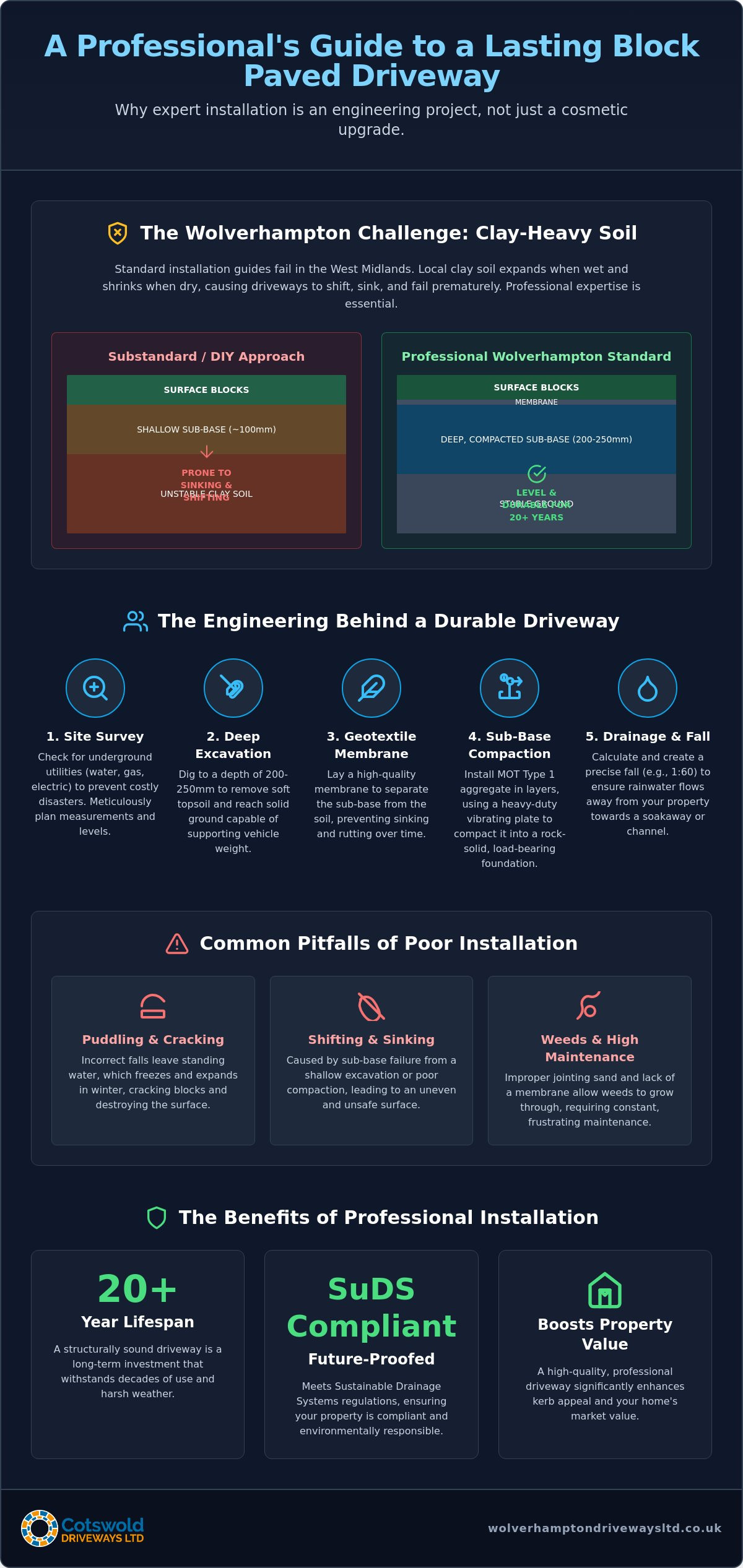
Wolverhampton sits on a unique geological foundation dominated by heavy clay soil. This type of ground is notoriously temperamental. It expands when wet and shrinks during dry spells, which puts immense pressure on any structure built above it. Standard DIY guides often suggest a shallow dig, but local conditions usually demand an excavation depth of 200mm to 250mm to reach stable ground. Skipping this step is the fastest way to ensure your new driveway fails within two seasons. A professional installation doesn’t just look better; it significantly boosts the market value of your property, providing a high-quality first impression that lasts for over twenty years.
The Risks of Substandard Installation
Poorly installed driveways often suffer from the “puddling” effect. This happens when the falls and levels aren’t calculated correctly, leaving water with nowhere to go. During a typical British winter, this standing water freezes and expands, which eventually cracks the blocks and ruins the aesthetic. The long-term costs of lifting and relaying a sunken driveway far outweigh the initial price of doing it right the first time. Sub-base failure is the primary cause of driveway shifting.
Local Knowledge: Serving Wolverhampton and Beyond
We’ve spent years working across specific neighbourhoods like Tettenhall, Penn, and Codsall, so we know exactly how the local terrain behaves. Our West Midlands weather patterns also play a huge role in how we finish a project. We select specific jointing sands and sealants that can withstand our damp climate without washing away or encouraging rapid weed growth. It’s also vital to consider Sustainable Drainage Systems (SuDS) to ensure your home stays compliant with 2026 environmental standards. For a deeper look at your options, you can read our guide on quality paving in the West Midlands to see how different materials perform in our local environment.
The Engineering Behind a Durable Driveway: Step-by-Step Installation
A driveway is only as good as the work you can’t see. Before any soil is moved, professional block paving installers in Wolverhampton conduct a rigorous site survey. This step isn’t just about measuring the area; it’s about identifying underground utilities like water pipes or electricity cables that could cause a disaster if struck. Once the site is mapped, the excavation begins. We typically dig to a depth of 200mm to 250mm. This ensures we remove the soft topsoil and reach the harder ground necessary to support the weight of multiple vehicles without the surface dipping over time.
To stop the sub-base from sinking into the soil below, we lay a high-quality geotextile membrane. This fabric acts as a filter, allowing water through whilst preventing the MOT Type 1 aggregate from mixing with the underlying earth. Without this layer, the foundation eventually weakens, leading to the dreaded “rutting” where car tyres leave permanent indents in your drive. It’s a simple addition that makes a massive difference to the longevity of the project.
Sub-Base and Drainage Requirements
The foundation of your driveway relies on MOT Type 1, a crushed aggregate that provides a rock-solid, load-bearing base. We spread this in layers and use a heavy-duty vibrating plate to compact it until it’s incredibly dense. A properly compacted surface should feel as hard as concrete before a single block is laid. Drainage is the next critical factor. We calculate a precise “fall” of either 1:60 or 1:80, ensuring that rainwater naturally flows away from your house and towards a suitable soakaway or drainage channel. This meticulous planning ensures you stay compliant with current guidelines on Navigating SUDS Regulations and Planning Permission.
The Final Laying and Jointing Process
Once the base is set, we apply a laying course of sharp sand, screeded to a perfect, level finish. We use the “click-and-drop” method to place the blocks. This technique involves placing each block against the previous one and dropping it straight down, which prevents the sand bed from being disturbed or pushed into ridges. This precision is what separates a master-craftsman from a casual installer. Finally, we sweep kiln-dried sand into the joints and compact the blocks one last time. This sand locks the blocks together through friction, creating a rigid, unified structure that won’t budge. If you’re ready to start your project, our block paving installers in Wolverhampton are here to help with a no-nonsense quote.
Selecting Your Style: Block Types and Patterns for 2026
Choosing the right aesthetic is the part most homeowners look forward to, but as professional block paving installers in Wolverhampton, we always balance style with structural logic. While the standard 200x100mm block remains a versatile and popular choice, many of our clients are moving towards “Tegula” style paving for their 2026 projects. These blocks come in multiple sizes and feature tumbled edges, creating a softer, more rustic look that perfectly complements the traditional architecture found throughout the West Midlands. They’re particularly effective at breaking up large, flat expanses, giving your driveway a more natural, hand-laid character.
Beyond the blocks themselves, the pattern you choose dictates how well the surface handles daily wear. A Herringbone layout is the gold standard for any driveway that sees heavy vehicle traffic or frequent turning. Unlike a simple grid, the interlocking nature of a Herringbone pattern ensures that weight is distributed across the entire surface. This prevents individual blocks from working loose or shifting under the pressure of heavy SUVs. For homeowners concerned about environmental impact or strict local rules, permeable blocks are the modern solution. These are designed with slightly larger joints to allow water to filter through, keeping you in line with the latest UK government guidance on permeable surfacing.
Popular Patterns and Their Uses
The 45-degree Herringbone is often considered the most visually striking for larger driveways, whilst the 90-degree version is a practical choice that requires fewer cuts along straight edges. If you’re looking for something more decorative for a garden path or a side patio, Stretcher Bond or Basket Weave patterns offer a cleaner, more geometric feel. You can find more creative block paving patterns in our dedicated guide to maximising kerb appeal for smaller spaces.
Choosing the Right Material for Your Home
Wolverhampton has a diverse range of housing, from Victorian terraces in Tettenhall to 1930s semis in Penn. Matching your paving to your home’s existing brickwork is the secret to a high-end finish. For red-brick period homes, we often suggest brindled or charcoal blocks to provide a sharp, clean contrast. Modern West Midlands builds often look best with the sleek lines of concrete pavers in silver or slate grey tones.
Durability varies between materials. Clay pavers are a premium option with exceptional colour retention that won’t fade under UV light, while concrete blocks offer a more budget-friendly range of textures. Regardless of your choice, we always install robust edging restraints. These are concrete-set borders that act as a structural frame, ensuring your driveway doesn’t “spread” or settle into the surrounding soil over time. When you work with experienced block paving installers in Wolverhampton, we help you weigh up these costs and benefits to find the perfect match for your property. To complete your property’s exterior, it’s also worth considering how well-designed fences and installation can complement your new driveway and define your boundary with the same level of structural quality.
Navigating SUDS Regulations and Planning Permission
Many homeowners assume they can pave over their entire front garden without asking anyone. That’s a mistake that can lead to costly enforcement notices. As of 2026, Sustainable Drainage Systems (SuDS) are mandatory for most new developments in England due to the implementation of Schedule 3 of the Flood and Water Management Act. If you’re planning a new or replacement driveway over five square metres using impermeable materials, you must obtain planning permission. Professional block paving installers in Wolverhampton will always advise you on how to avoid this by using permeable designs that allow water to drain naturally into your own land rather than onto the public road.
The introduction of SuDS Approving Bodies (SABs) within local authorities has added another layer of oversight. These bodies now review drainage proposals separately from standard planning permission. It means having a compliant drainage strategy is no longer optional; it’s a prerequisite for construction. Our team ensures that your project is designed to handle local rainfall patterns, keeping you on the right side of the law whilst protecting the wider community from surface water flooding.
Permeable Paving vs. Traditional Drainage
Permeable blocks are engineered with slightly wider joints to allow rainwater to filter through to the sub-grade. If you’ve set your heart on traditional, non-permeable blocks, you’ll need to incorporate a system that directs runoff to a permeable area within your property. We often install Aco drains at the threshold of a garage or the property boundary, which lead to a soakaway or a rain garden. Ensuring your project is SUDS compliant is vital for future property sales. Buyers’ solicitors now routinely check for drainage compliance during the conveyancing process, and a lack of documentation can stall a sale indefinitely.
2026 Council Guidelines and Dropped Kerbs
If your project involves a new entrance, a dropped kerb is a legal necessity. In Wolverhampton and Dudley, you must apply to the council’s Highways team for permission before any work begins. Crucially, any work on the public footpath must be carried out by a council-approved contractor who holds the correct street works licenses and insurance. We help our clients navigate these council guidelines to ensure every aspect of the project is above board. For those living in neighbouring boroughs, you can find more tailored advice in our guide for reliable paving contractors in Dudley.
If you’re unsure whether your project requires planning permission or a specific drainage strategy, contact our block paving installers in Wolverhampton for a free site survey and a straight-talking assessment of your needs.
Why Wolverhampton Driveways Ltd is Your Trusted Paving Partner
Choosing the right block paving installers in Wolverhampton is a decision that stays with your property for decades. At Wolverhampton Driveways Ltd, we don’t believe in high-pressure sales pitches or over-complicated jargon. We’re a local, fully insured team with deep roots in the West Midlands. Our reputation is built on being straight-talking professionals who take genuine pride in every driveway we lay. Whether you’re in the heart of the city or in surrounding areas like Telford and Cannock, you’ll receive the same methodical, expert service that has made us a household name in the region.
We understand that a new driveway is a significant investment. That’s why we only use materials that meet or exceed British Standards. From the heavy-duty MOT Type 1 sub-base to the final kiln-dried sand, every component is selected for its durability in our local climate. We manage the entire project from start to finish. You won’t have to worry about coordinating different trades or chasing up deliveries. We handle the design, the structural groundworks, and the final finishing touches with the efficiency you’d expect from seasoned master-craftsmen.
Our Commitment to Quality and Transparency
Transparency is the foundation of our business. We provide free, no-obligation site surveys where we assess your ground conditions and drainage needs honestly. Once we provide a quote, it’s a fixed-price contract. You won’t find any hidden “extras” or surprise costs halfway through the build. You’ll deal directly with the installers, not a middleman or a pushy salesman. This direct line of communication ensures your vision is translated perfectly into the final result. We also provide a comprehensive “peace of mind” guarantee on all our structural groundworks, ensuring your driveway remains a solid asset for years to come.
Beyond Installation: Maintenance and Repairs
Our relationship with our customers doesn’t end when the last block is laid. We offer a full suite of aftercare services to keep your property looking its best. This includes professional cleaning and re-sanding to prevent weed growth and maintain the structural integrity of the joints. If you have an older, failing driveway that was installed by another contractor, we can also help with structural repairs to stop further sinking or shifting. While block paving is a fantastic choice for many, it’s always worth weighing up your options. You can read our expert tarmac driveways guide to see how different materials compare in terms of cost and maintenance. Whatever you choose, our block paving installers in Wolverhampton are ready to deliver a stress-free transformation for your home.
Secure Your Property’s Future with Professional Paving
Your driveway is more than just a place to park; it’s the first thing people see when they visit your home. We’ve explored how proper engineering and a deep understanding of Wolverhampton’s clay soil are the real secrets to a surface that won’t sink or shift. By choosing the right block paving installers in Wolverhampton, you ensure that your project meets the latest 2026 SUDS drainage standards whilst perfectly matching the unique character of your West Midlands property.
We take the stress out of home improvements by providing a fully insured and licensed local team with expert knowledge of West Midlands drainage and soil. You’ll benefit from fixed-price contracts with no hidden fees, giving you total clarity from the initial survey to the final sweep of jointing sand. Our goal is to provide a stunning, durable finish that adds genuine value to your home for decades.
Request Your Free Block Paving Quote in Wolverhampton Today and let’s start planning your property’s transformation. We’re ready to help you create a driveway you can be proud of.
Common Questions About Block Paving in Wolverhampton
How much does block paving cost per square metre in Wolverhampton?
The total cost of your project depends on the choice of materials, the total area size, and the amount of excavation required. Whilst we don’t provide generic price lists, we offer fixed-price quotes after a site survey to ensure you have a clear, honest figure with no hidden extras. This approach allows us to account for specific local factors like ground stability and drainage needs.
Do I need planning permission for a block paved driveway in 2026?
You generally won’t need planning permission if your driveway uses permeable materials or directs water to a lawn or border within your property. However, if the area is larger than five square metres and uses impermeable blocks without a drainage system, formal approval is a legal requirement. Our team can help you design a compliant system that avoids the need for a lengthy application process.
How long does it take for professional installers to complete a driveway?
A typical residential project usually takes between five and seven working days to complete. This schedule covers everything from the initial groundworks and excavation to the final compaction and jointing. More complex designs or larger sites in the West Midlands might require additional time to ensure the structural integrity and finish meet our professional standards.
Will my block paving driveway grow weeds?
Weeds don’t grow from the soil beneath the blocks if a high-quality geotextile membrane and sub-base are correctly installed. Most weeds actually start from seeds that land in the sand joints from above. Regular sweeping and an occasional application of specialist sealant will keep the joints firm and significantly reduce the chance of any unwanted growth taking root.
What is the best way to clean and maintain block paving?
Regular sweeping with a stiff outdoor brush is the most effective way to prevent debris from building up in the joints. You can use a mild detergent for a deeper clean, but you should avoid frequent high-pressure power washing as this can blast away the vital jointing sand. If the sand levels do drop, professional re-sanding is a quick and affordable way to maintain the surface’s strength.
Can block paving be laid over an existing concrete or tarmac driveway?
We don’t recommend laying blocks over an existing surface because it often leads to drainage failures and structural shifting. For a driveway to last 20 years, it needs a fresh, compacted foundation of MOT Type 1 aggregate. Professional block paving installers in Wolverhampton will always advise a full excavation to ensure the new surface remains level and stable under the weight of your vehicles.
How long should I wait before driving my car on a new block paved surface?
You can walk on your new driveway as soon as the final jointing sand is swept in, but you should wait 48 hours before parking a car on it. This resting period allows the blocks and sand to settle into a rigid structure. If a sealant has been applied to the surface, we may suggest a slightly longer wait to ensure the coating is fully cured and durable.
What is the difference between standard and permeable block paving?
Standard blocks are non-porous and require a slight slope to direct rainwater into a drain or soakaway. Permeable blocks are designed with wider tabs that allow water to filter directly through the joints and into the ground below. Using permeable options is a popular choice for block paving installers in Wolverhampton because it simplifies compliance with local flood prevention and drainage legislation. If you’re also planning to update your garden boundaries at the same time, our guide to durable fences and installation for West Midlands homeowners covers everything you need to know about choosing materials that stand up to local weather conditions.