
A stunning garden transformation often starts with the timeless appeal of natural stone, yet the difference between a lifelong investment and a costly mistake usually lies beneath the surface. In our local climate, even the highest quality slabs will fail if the groundworks aren’t handled with precision. You likely want a space that enhances your home’s value without the constant worry of loosening stones, pooling water, or persistent weed growth. It’s frustrating to invest in beautiful materials only to see them sink or crack because of a poorly prepared sub-base.
We understand that choosing the right indian sandstone patio layers Telford homeowners can trust is about more than just finding a competitive quote; it’s about securing peace of mind. In this 2026 guide, we’ll show you exactly how to select the perfect sandstone grades and colours to suit your property’s style. You’ll discover the technical secrets behind professional installation that prevents shifting, along with essential advice on navigating local drainage regulations and planning permissions. From the popular cool tones of Kandla Grey to the warm, traditional hues of Raj Green, we’ll help you design a level, durable outdoor space that truly stands the test of time.
Key Takeaways
- Learn why Indian sandstone is the superior choice for West Midlands gardens, offering natural resistance to the British frost-thaw cycle that concrete alternatives cannot match.
- Discover the difference between natural ‘Riven’ and modern ‘Sawn’ finishes to ensure your new patio perfectly complements your home’s unique architectural style.
- Understand why professional indian sandstone patio layers Telford homeowners trust always insist on a MOT Type 1 sub-base and a full wet bed of mortar to prevent sinking.
- Compare Indian sandstone with porcelain and block paving to determine which material offers the best balance of authenticity and durability for your budget.
- Identify the essential credentials and portfolio markers to look for when hiring a local specialist to ensure a stress-free installation and a high-quality finish.
Why Indian Sandstone is the Premier Choice for Telford Gardens
Choosing the right material for your garden is a significant decision that impacts both your daily enjoyment and your property’s long-term worth. In Telford, homeowners often look for a balance between visual appeal and rugged resilience. Indian sandstone has become the gold standard for those who want a premium look without the artificial feel of concrete. When you hire expert indian sandstone patio layers Telford residents trust, you aren’t just buying stone; you’re investing in a natural product that adds genuine value to your home. It’s a material that ages gracefully, often lasting 25 to 30 years or more with the right installation.
The Unique Character of Natural Stone
Unlike mass-produced concrete slabs, every piece of natural stone tells a unique geological story. To understand the material fully, one might ask, What is Sandstone? Essentially, it’s a sedimentary rock formed over millions of years, composed of mineral particles and rock fragments. This slow formation process creates incredible variations that factory processes can’t mimic. You’ll find delicate fossil prints, shimmering mineral veins, and a spectrum of earthy tones. The stone’s appearance shifts beautifully with the weather; a light shower deepens the colours and brings out hidden textures that stay muted when dry. For the eco-conscious, natural stone is a sustainable choice, as it requires far less energy to produce than cement-based alternatives.
Suitability for the West Midlands Climate
Our local weather in Shropshire can be demanding. We experience heavy rainfall and sharp winter frosts that cause cheaper, porous materials to crack or flake. Indian sandstone is remarkably dense and naturally frost-resistant. It handles the frost-thaw cycle effectively, ensuring your patio remains level and intact. Professional indian sandstone patio layers Telford specialists often recommend specific finishes based on how you use your space:
- Riven finishes: These have a natural, textured surface that provides excellent slip-resistance, making them ideal for families and shaded garden corners.
- Sawn and honed finishes: These offer a sleek, contemporary look with a smoother feel underfoot, providing a more architectural aesthetic for modern homes.
Beyond its durability, sandstone has excellent thermal properties. It absorbs heat during the day and releases it slowly, making it comfortable to walk on during those warm British summer evenings. This combination of performance and natural beauty is why it remains the top choice for transforming outdoor living spaces across the region. It’s a hardworking material that looks just as good after a decade as it did on the day it was laid.
Understanding Indian Sandstone: Colours, Grades, and Finishes
To get the best results from your garden project, it’s helpful to understand what makes this material so special. Indian sandstone is a hard-wearing sedimentary rock primarily composed of quartz and feldspar. These minerals give the stone its incredible strength and its distinctive shimmer in the sunlight. When you consult with expert indian sandstone patio layers Telford homeowners trust, they’ll explain that the way the stone is finished defines the entire look of your outdoor space. You aren’t just choosing a colour; you’re choosing a texture and a character that will stay with your home for decades.
The two most common finishes are riven and sawn. Riven stone is split along its natural layers, resulting in a beautiful, slip-resistant surface with organic ridges. It’s the classic choice for a traditional garden. Sawn sandstone is cut with a diamond blade and often honed to a smooth finish, offering a sleek, contemporary aesthetic. You should also consider the edges. Hand-cut edges provide a rustic, hand-crafted feel, while tumbled edges are softened in a machine to look aged and weathered. For a modern finish, sawn edges offer crisp, clean lines that allow for narrow mortar joints.
Professional layers always insist on calibrated stone. This means the slabs have been processed to a consistent thickness, usually around 22mm. Non-calibrated stone varies in depth, making it much harder to achieve a perfectly level surface. Using calibrated slabs ensures your patio is structurally sound and avoids the “rocking” effect that leads to cracks over time.
Popular Colours for Telford Homes
Choosing a shade that complements your property’s architecture is essential for a seamless look. We see three main trends across the region:
- Kandla Grey: This is a modern favourite. Its cool, consistent tones work perfectly with the grey window frames and contemporary styling of new-builds in areas like Lawley and Priorslee.
- Raj Green: A versatile, traditional choice. It features a mix of green, grey, and brown hues that closely mimic reclaimed Yorkstone, making it ideal for period properties in Ironbridge or Wellington.
- Autumn Blend: These warm, earthy tones are specifically suited to Telford’s classic red brick houses. The plums and browns in the stone pick up the colours of the masonry beautifully.
Selecting the Right Grade of Stone
Quality matters just as much as appearance. Avoid thin, budget slabs that are often only 15mm thick; these are far more likely to crack under pressure. High-grade Indian sandstone should have a low water absorption rate, ideally under 1.7%, to prevent frost damage during cold Shropshire winters. We also recommend looking for the Ethical Trading Initiative (ETI) mark. This ensures the stone was sourced responsibly, with fair conditions for the workers in the quarries. If you’re struggling to decide on the best grade for your project, local paving specialists can provide samples to help you see how different stones look against your own brickwork.
Comparing Indian Sandstone with Modern Alternatives
Deciding on the right material for your garden is a significant investment. You aren’t just looking at the initial cost but also how the space will perform over the next decade. While there are many man-made options available, Indian sandstone consistently holds its ground against modern competitors like porcelain and block paving. Reliable indian sandstone patio layers Telford residents hire often find that homeowners prefer the authentic feel of natural stone, which offers a character that factory-produced units simply can’t match. It’s about choosing a material that grows with your garden rather than one that starts deteriorating the moment it’s laid.
Sandstone vs. Porcelain Paving
Porcelain has grown in popularity for those seeking a sleek, ultra-modern look with uniform precision. It’s essentially a ceramic tile for the outdoors. However, many people find porcelain can feel somewhat clinical and cold compared to the natural warmth and texture of sandstone. Installation is also more rigid; porcelain requires a specific chemical primer to bond to the mortar bed, whereas sandstone is more forgiving during the laying process. If you are considering a more uniform look, you might want to consult porcelain patio installers west midlands to see which material fits your lifestyle and property style better.
Sandstone vs. Concrete Slabs
Concrete slabs are often chosen as a budget-friendly alternative, but they come with long-term drawbacks. A major issue is the ‘fading’ problem. Because concrete is coloured with artificial pigments, the sun’s UV rays cause the colour to wash out over time, leaving the patio looking dull. In contrast, sandstone’s colour is part of its mineral makeup, meaning it often looks better as it matures. Structurally, natural stone is incredibly dense and less prone to the hairline cracks that frequently appear in manufactured concrete. From an environmental perspective, sandstone has a lower carbon footprint because it’s quarried naturally rather than manufactured in a high-energy industrial kiln.
Over a 15-year period, sandstone provides excellent value for money in a typical Telford garden. Whilst block paving is an excellent choice for driveways, the small units can lead to more weed growth in the many joints when used for a patio. Sandstone’s larger format creates a cleaner look with fewer maintenance headaches. You’ll need to seal your sandstone every few years to keep it looking its best, but this small effort preserves a surface that will outlast almost any man-made alternative. It remains a favourite amongst those who value longevity and a timeless aesthetic. Working with experienced indian sandstone patio layers Telford ensures that whichever grade you choose, the structural integrity of your comparison remains sound for years to come.
How Professional Patio Layers Install Indian Sandstone in Telford
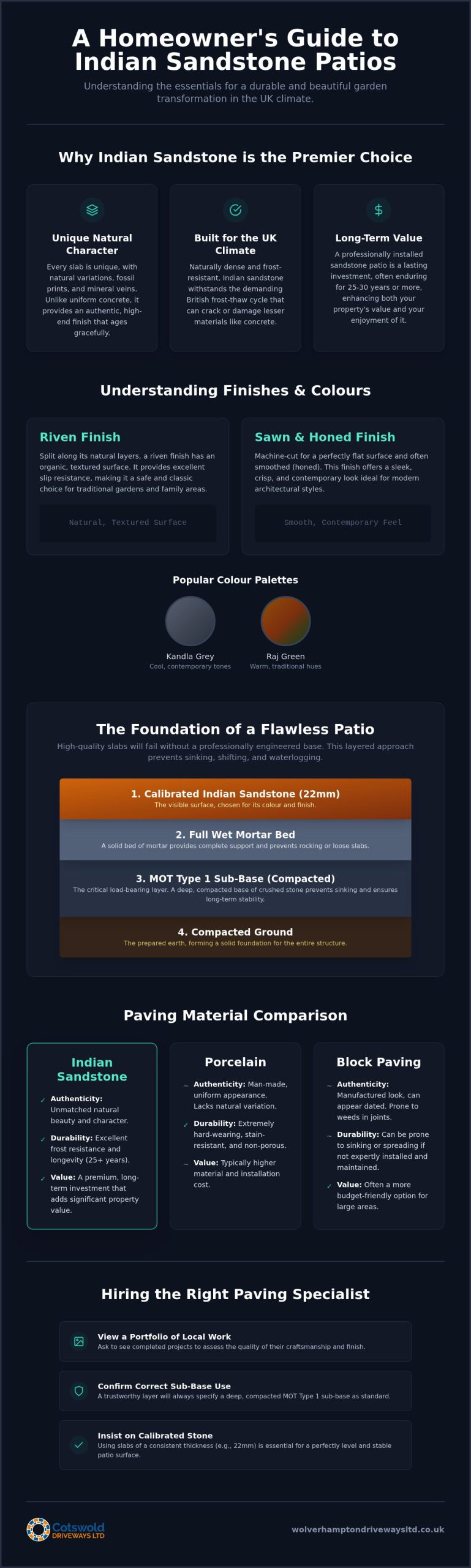
A beautiful patio is only as good as the groundwork beneath it. In our experience, many DIY attempts or cut-price installations fail because the foundation wasn’t built to handle the specific conditions of the West Midlands. When you hire professional indian sandstone patio layers Telford homeowners trust, you’re paying for a structural installation that prevents sinking and stone movement. We don’t just “lay slabs”; we engineer a multi-layered system designed to last for decades. This involves precise calculations for weight distribution and water management that ensure your garden remains a functional asset.
The process begins with a MOT Type 1 sub-base. This is a specific grade of crushed stone that provides a solid, load-bearing foundation. In Telford, where clay-heavy soil is common, this step is non-negotiable. Without a properly compacted sub-base, the ground will shift during wet winters, causing your expensive sandstone to crack or loosen. We also ensure a ‘full wet bed’ of mortar. We never use the ‘dot and dab’ method, as it leaves hollow voids where water can collect and freeze, eventually popping the slabs off their base. To guarantee a lifelong bond, we apply an SBR priming slurry to the back of every single slab before it’s laid, creating a chemical bridge between the stone and the mortar.
The 5-Step Installation Process
- Excavation and sub-base: We dig out the area to a depth of at least 150mm and compact the MOT Type 1 using heavy-duty machinery to ensure zero movement.
- SBR Priming: We recognise that sandstone is naturally porous. This priming ‘glue’ ensures a permanent bond and prevents the mortar from drawing moisture out of the stone too quickly.
- The Mortar Mix: We use a precise ratio of sharp sand and cement to create a consistency that supports the weight of the stone whilst allowing for master-craftsman adjustments.
- Laying and Levelling: Every slab is individually levelled using a rubber mallet to ensure a perfect finish that is comfortable to walk on.
- Jointing: We use high-quality, resin-based compounds. These are permeable, allowing water to drain through whilst being tough enough to stop weeds in their tracks.
Local Considerations for Telford Projects
Managing water runoff is critical for compliance with Sustainable Urban Drainage Systems (SUDS). We carefully plan ‘falls’ (slight slopes) that direct rainwater away from your house walls and towards suitable drainage points or garden borders. This prevents damp issues in your home’s foundation, which is a common worry for properties in Shropshire’s wetter areas. Because we know the local landscape, we also plan layouts that minimise waste and reduce the number of cut slabs. If you’re ready to start your project, you can get a free, no-obligation quote from our team of expert patio layers in Telford to ensure your garden is built to the highest professional standard.
Choosing the Right Telford Paving Specialists for Your Project
Selecting a contractor for your garden transformation is a decision that carries long-term consequences. You aren’t just looking for someone who can lay stone; you’re looking for a partner who understands the structural requirements of your specific site. When you begin your search for indian sandstone patio layers Telford homeowners can rely on, focus on transparency and local reputation. A high-quality installer will always be happy to provide a detailed, written quote and a realistic project timeline. They should treat your property with respect and maintain a tidy site throughout the installation process.
A specialist’s portfolio is their best calling card. Look for completed projects that show variety in stone colours and complex layouts. It’s often helpful to ask if you can speak with a previous customer or even view a local installation in person. This allows you to see how the stone has aged and whether the drainage is performing as promised. A true master-craftsman takes pride in the details that aren’t immediately visible, such as the depth of the excavation and the quality of the sub-base compaction.
Questions to Ask Your Installer
Before you sign a contract, it’s essential to vet your installer with technical questions. This ensures they follow industry best practices rather than taking shortcuts that lead to future failures. You should ask whether they use a full mortar bed or the ‘dot and dab’ method; as we’ve discussed, only a full bed ensures a lasting bond. Inquire about how they handle drainage, especially if your garden has a significant slope or heavy clay soil. You should also ask to see specific examples of their landscaping and driveways telford projects to confirm they have experience with the local architecture and ground conditions.
Working with Wolverhampton Driveways Ltd
Wolverhampton Driveways Ltd has built a reputation for being a dependable, “straight-talking” partner for homeowners across Shropshire. We take a no-nonsense approach to every project, focusing on technical excellence and customer satisfaction. We don’t believe in high-pressure sales tactics or hidden costs. Instead, we provide clear advice and a structural installation that stands the test of time. Our team is fully insured and licensed, providing you with complete peace of mind whilst we work on your property.
We handle everything from the initial design and structural groundworks to the final jointing and cleaning. Our goal is to make the process as stress-free as possible, delivering a beautiful, level patio that adds genuine value to your home. If you’re looking for experienced indian sandstone patio layers Telford residents trust for quality work, we’re ready to help. Contact us today to organise a free, no-obligation quote and take the first step toward your new outdoor living space.
Start Your Garden Transformation Today
Investing in a natural stone patio is one of the most effective ways to enhance your home’s character and value. We’ve explored how the right choice of colour and finish can complement Telford’s unique architecture, and why a professional sub-base is essential for handling our local clay-heavy soil. A well-installed sandstone surface doesn’t just look beautiful; it provides a durable, slip-resistant space that ages with grace and requires minimal long-term maintenance.
Finding reliable indian sandstone patio layers Telford homeowners can trust is the final piece of the puzzle. At Wolverhampton Driveways Ltd, we combine expert local knowledge of drainage with a commitment to high-end natural stone finishes. As fully insured and licensed master-craftsmen, we take pride in delivering results that stand the test of time. Request your free Indian sandstone patio quote in Telford today and let’s discuss how we can bring your vision to life. We look forward to helping you create a stunning outdoor space you’ll enjoy for years to come.
Frequently Asked Questions
How much does an Indian sandstone patio cost in Telford?
Costing depends on the stone grade, finish, and the complexity of the groundworks required for your specific site. Factors such as the area size and the choice between riven or sawn slabs will influence the final quote from indian sandstone patio layers Telford specialists. We provide free, no-obligation assessments to give you an accurate figure tailored to your garden. This ensures there are no surprises regarding the structural foundation.
Does Indian sandstone need to be sealed?
Yes, sealing is highly recommended to protect the natural beauty of the stone and prevent staining from leaves or spillages. It also helps inhibit the growth of algae and lichen in damp Shropshire conditions. We usually advise waiting a few months after installation to allow any natural efflorescence to escape. Once sealed, the stone’s colours often appear more vibrant and the surface becomes much easier to maintain over time.
How do I stop weeds growing between my sandstone slabs?
Preventing weeds starts with a professional installation. By using a full wet bed of mortar and high-quality resin jointing compounds, we eliminate the gaps and hollows where weeds typically take root. Unlike traditional sand and cement pointing, modern resin compounds are incredibly durable and resistant to cracking. This ensures your patio remains tidy and low-maintenance without the need for constant weeding or harsh chemical treatments between the slabs.
Is Indian sandstone slippery when it rains?
Natural riven Indian sandstone provides excellent slip resistance because of its textured, uneven surface. This makes it a safe choice for families even during heavy British rainfall. If you choose a sawn or honed finish, the surface is smoother and can be more slippery when wet. In these cases, we can apply specific anti-slip treatments or suggest stones with a lightly sandblasted texture to ensure safety whilst maintaining a contemporary look.
Can Indian sandstone be used for a driveway?
Standard patio slabs are usually 22mm thick and are not designed to support the weight of vehicles. Using them for a driveway would likely result in cracking and sinking. For areas with vehicle traffic, we recommend dedicated block paving or resin bound driveways. These are engineered to handle heavy loads. If you insist on the sandstone look for a driveway, you would need much thicker, specially sourced flagstones and a reinforced concrete base.
How long will an Indian sandstone patio last?
A professionally installed Indian sandstone patio can easily last 25 to 30 years or more. Its longevity depends heavily on the quality of the sub-base and the skill of the indian sandstone patio layers Telford homeowners choose. Because it is a natural material, it doesn’t fade like concrete. Instead, it develops character as it ages. With routine cleaning and occasional re-sealing, your investment will remain a beautiful feature of your home for decades.
What is the best way to clean my natural stone patio?
The best approach is regular sweeping to prevent organic matter from sitting on the stone. For a deeper clean, use warm, soapy water and a stiff natural-bristle brush. Avoid using acidic cleaners or high-pressure washers at close range, as these can damage the stone’s surface and blast away the jointing material. If your patio requires a professional refresh, we also offer specialised driveway and patio cleaning services to restore the stone safely.
Do I need planning permission for a new patio in Telford?
Most rear garden patios don’t require planning permission as they fall under permitted development. However, if you’re installing a patio in a front garden larger than five square metres using non-porous stone, you must ensure proper drainage or seek permission from Telford & Wrekin Council. Significant structural work like high embanking or terracing might also need approval. It’s always best to check local regulations or consult a professional before starting any major project.