
Could the paving you choose make your garden steps less comfortable or safe to use? When planning garden steps and paving Telford homeowners should consider the whole route through the garden, rather than treating each surface as a separate job. A joined-up layout can make different levels easier to reach and help the space work better day to day.
It’s understandable to focus first on colour and style, but the materials also need to suit how you’ll use the area and how water will drain. Steps need careful thought too, from their position and proportions to the surface underfoot. A clear plan helps you compare options before work begins.
This guide explains how to weigh up paving materials, layout and practical safety, and what to ask when comparing local contractors. You’ll also find out what to look for in a written quote, including how it covers preparation, access and the connection between paving and steps. That gives you a better basis for discussing your project and requesting a local quote.
Key Takeaways
- Plan steps, landings and paved paths as one connected route between garden levels.
- Compare paving options by appearance, intended use and upkeep, then consider how each finish meets the steps.
- Assess step proportions, landing space, edges and drainage with everyday users in mind.
- For garden steps and paving Telford projects, prepare a clear brief and compare written quotes for the work they include.
- Ask whether excavation, base preparation, waste removal and drainage are covered before agreeing next steps.
Garden steps and paving in Telford: plan the route before choosing finishes
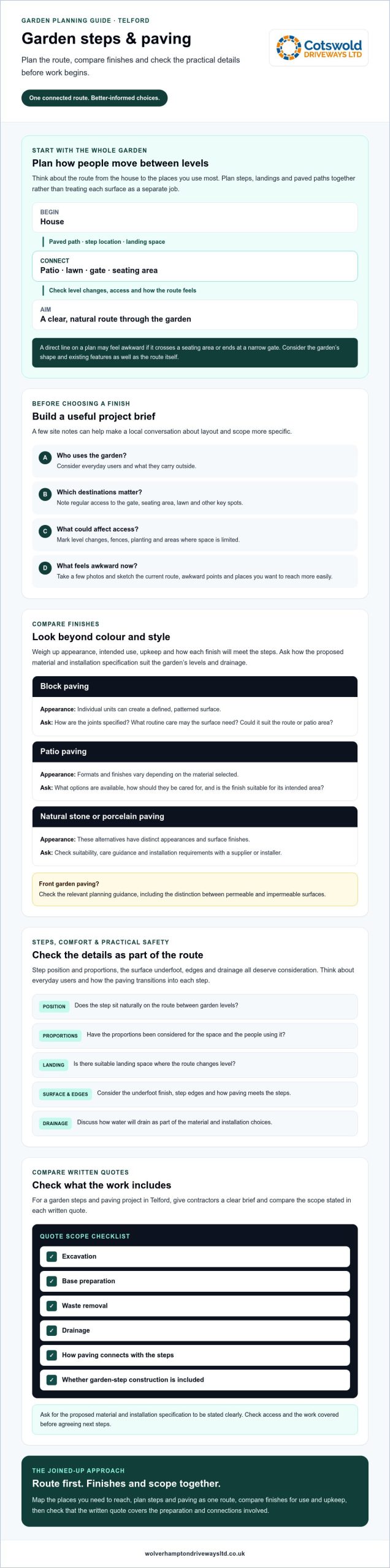
A practical route through the garden should feel natural to use and fit comfortably within the space. Before choosing paving colours or patterns, think about how people move between the house, patio, lawn and other everyday areas. You may need to plan steps, landings and paved paths together so the route makes sense wherever the ground changes level.
A well-planned garden route connects the house and key outdoor areas with clear paths, suitable landings and steps that fit the garden’s levels.
Start your brief with the household’s needs. Consider who uses the garden, what they carry outside and whether regular access to a gate, seating area or lawn matters most. Then look at the garden’s shape and existing features. A route that seems direct on a plan may feel awkward if it cuts across a seating area or ends at a narrow gate.
Good layout involves more than choosing individual surfaces. The principles of garden design can help you consider how paths and patios fit together as part of the wider space.
Where should garden steps sit in a Telford garden?
Map the route from the house to the garden’s main destinations before deciding where steps should go. Mark gates, seating, lawn edges and any areas you use regularly. Note where the ground changes level, and whether fences, planting or limited space might affect access. This information gives a contractor useful context when discussing the layout and scope.
For a garden steps and paving Telford project, take a few photos and make a simple sketch. Mark the route you use now, any awkward points and the areas you want to reach more easily. You don’t need a finished design. A clear record of your priorities and site constraints is a useful starting point for discussing a quote.
When should steps and paving be planned together?
Plan them together from the outset. The paving beside a step affects where the step can sit, how much landing space is available and whether the route flows naturally between levels. Treating each element as a separate decision can leave awkward transitions or lead to layout changes once work is being planned.
A shared brief keeps the route, levels and finishes under consideration at the same time. If a patio is part of the project, explore wider layout choices in this garden patio design guide. Take your priorities and site notes to a local discussion, and ask the contractor to state whether garden-step construction is included in the work being quoted for.
Choosing paving and step finishes for your Telford garden
The right finish should suit how you use the garden, not just look appealing in a sample. Consider how it will connect paths, patio areas and steps, as well as how much cleaning or upkeep you’re willing to do. Suitability also depends on the site and installation specification, so ask how the proposed option will work with your garden’s levels and drainage.
Compare paving materials by intended use, upkeep expectations and how their colour, texture and edges will finish beside the steps.
How do paving materials differ in everyday garden use?
Compare practical features rather than assuming one finish suits every garden. Block paving and patios are options offered by Wolverhampton Driveways Ltd. Other materials in the table are alternatives you may wish to discuss with a supplier or installer.
| Option | Appearance to consider | Upkeep and use questions |
|---|---|---|
| Block paving | Individual units can create a defined, patterned surface. | Ask how joints are specified and what routine care the surface may need. Could it suit the route or patio area you have in mind? |
| Patio paving | Available in varied formats and finishes, depending on the material selected. | Ask what options are available for the project, how they should be cared for and whether the finish is suitable for the intended area. |
| Natural stone or porcelain paving | These alternatives have distinct appearances and surface finishes. | Check suitability, care guidance and installation requirements with a supplier or installer before choosing. |
Ask for the proposed material and installation specification to be set out clearly in any quote. If the project includes paving in a front garden, check the relevant guidance on planning permission for paving, including the distinction between permeable and impermeable surfaces.
How can paving and steps look like one design?
Choose a small number of finishes that work together. You could coordinate colour across the path and landing, then use a considered change in texture or edging to make the transition clear. Joints and borders matter too: discuss how they will meet where a path reaches a step, and how the patio finish will relate to the route. A consistent brief can link these areas without making every surface identical.
For more detail on block paving, read the block paving homeowner guide. To discuss patio paving or block paving for a garden in Telford, you can also contact the local team with details of the site, intended use and finishes you’re considering.
Compare garden-step designs, drainage and safety before choosing
A finish can look right but still be awkward to use. For garden steps and paving Telford projects, consider how people will move through the space in everyday conditions, as well as how it looks from the house. Assess the whole route, including step proportions, landing space, edges and the transition between paved areas and changes in level.
Think about who uses the garden and what access they need. Children, older relatives or anyone with limited mobility may have different needs from an adult carrying garden tools. Explain these needs during the first project discussion, and ask how they will be reflected in the proposed layout. Don’t assume a standard design will suit every household.
What makes garden steps practical to use?
Consistency helps make steps easier to anticipate. Ask how the proposed design will keep the steps uniform and provide clear space to pause at the top and bottom. Check that the route doesn’t lead directly into an obstacle or create an abrupt change from paving to a step. Step edges should be easy to see against the garden’s surroundings. Avoid relying on generic dimensions: ask what guidance applies to your project and check it before agreeing the work.
Building-control or accessibility requirements can depend on the project, including how the steps relate to access to the home. Where needed, check with the relevant council or building-control service rather than assuming that rules for one type of work apply to every garden.
What should Telford homeowners ask about drainage?
Ask where rainwater will flow once the paving is in place. Will it drain towards a suitable garden area, or could it collect beside the steps, near the house or on a landing? The answer depends on the site’s levels and existing drainage, so ask the contractor to explain how these affect the proposed approach. A site assessment should consider the whole paved route, not just the surface material.
For paving in a front garden, the UK government guidance on permeable paving explains considerations around permeable surfacing. Check how it applies to your plans, since guidance for front gardens may not cover every paving project.
- Ask where surface water is intended to go.
- Find out how changes in level affect drainage and step placement.
- Confirm which safety, building-control or planning requirements apply before settling the design.
Ask the contractor to explain the proposed steps, adjoining paving and drainage together. Confirm whether step construction is included in the scope rather than assuming it forms part of a paving project.
How to compare Telford paving quotes and prepare for installation
A useful quote lets you compare the work being proposed, not just the final figure. For garden steps and paving Telford projects, access, changes in level, materials and preparation can all affect the scope. Give each contractor the same brief, then check that their written proposals describe comparable work.
Use this process to get organised:
- Prepare a brief. Note the route you want, the areas to be paved, your preferred materials and any access needs.
- Arrange a site survey. Show the contractor the garden, level changes and access restrictions so they can assess the work rather than rely on assumptions.
- Compare written scopes. Check what’s included, what’s excluded and whether each proposal covers the same areas and preparation.
- Confirm next steps. Before agreeing, clarify how changes will be discussed, how updates will be communicated and what needs to happen before work begins.
What should a garden paving quote include?
Look for a written description of the paved areas and any steps, including whether step construction is specifically within the scope. Ask whether excavation, base preparation, waste removal and drainage are included, and how the quote accounts for materials and getting them to the work area. If anything is excluded, find out what that means for the overall project.
Check how the contractor will handle changes if the site differs from initial assumptions. A clear point of contact and an agreed way to share updates can make decisions easier as the work progresses. It’s also sensible to ask about relevant experience with similar projects, references and insurance, and to verify any claims directly with the contractor.
How can you prepare for a Telford site visit?
Share a few useful details before or during the visit: photos, approximate dimensions and the route you’d like to create. Point out gates, level changes, existing surfaces and any narrow access that could affect moving materials or removing waste. Mention drainage concerns and how the garden is used day to day.
Ask the contractor to explain assumptions about preparation, access and how the steps will meet the adjoining paving. If one quote includes waste removal and another doesn’t, or their proposed areas differ, resolve that before comparing them. Like-for-like proposals give you a clearer basis for choosing.
Wolverhampton Driveways Ltd serves Telford and offers free quotes for its services. Request a quote to discuss your paving project, and ask directly whether garden-step construction can be included in the scope.
Plan your garden steps and paving project with a Telford contractor
A well-scoped project starts with four decisions: the route through the garden, suitable paving, practical transitions between levels and a written description of the work. If you’re planning garden steps and paving in Telford, bring these points together before settling on finishes or comparing proposals. A site discussion can help clarify what the space needs and which parts of the project a contractor can quote for.
What to expect when discussing your garden project
Be ready to explain how you use the garden and what you’d like to change. Share the route you have in mind, the areas for paving, preferred finishes and any access constraints, such as narrow gates or changes in level. Photos and a simple sketch can make your priorities easier to understand.
Use the conversation to ask practical questions. What preparation might the site need? How will drainage and the sequence of work be considered? Which elements will appear in the written scope, and what would be excluded or need a separate arrangement? If your plans include steps, confirm explicitly whether the contractor undertakes that work before treating it as part of the proposed project.
Wolverhampton Driveways Ltd serves Telford and offers patios and paving-related services. The company states that its team is fully insured and licensed, and free quotes are available. Ask for relevant details directly and check that the written proposal clearly sets out the work being quoted for.
Arrange a garden paving quote in Telford
A clear brief makes it easier to discuss the project and understand the proposed scope. Before requesting a quote, gather your photos, approximate measurements, access notes and questions about preparation or drainage. Then review the written quote carefully so you know which paving work it covers and whether any requested step construction has been confirmed.
For a quote on a patio or paving project in Telford, discuss your garden paving project with the local team. Describe the garden and your priorities, then ask what can be included in the proposed scope.
Take the next step towards a garden that works for you
A successful garden project starts with a clear route between the areas you use, paving suited to the site and transitions that feel practical underfoot. For garden steps and paving Telford homeowners should also compare written scopes carefully, checking what preparation, drainage and materials are included before agreeing to the work.
A site discussion can help you explain your priorities, access constraints and preferred finishes. Wolverhampton Driveways Ltd serves Telford, offers free quotes and has a fully insured and licensed team. If your plans include steps, ask directly whether this work can be included in the proposed scope.
Request a free quote for your garden paving project and start a practical conversation about your plans. With your questions and site details ready, you’ll be better placed to assess the proposal and decide what suits your home.
Frequently Asked Questions
How do I choose paving for garden steps and paths?
Choose paving to suit the route’s everyday use, the garden’s appearance and the upkeep you’re prepared to do. Consider how the surface will meet steps and landings, and ask the installer about its suitability for the site and how it may behave in wet weather. Block paving and patio paving are options to discuss, but check which materials are available for your project before settling on a finish.
What should I look for in a garden paving contractor in Telford?
Look for clear communication, relevant experience and a written scope that explains the proposed work and exclusions. Ask about insurance and licensing, and request references or examples of comparable projects if available. Wolverhampton Driveways Ltd states that its team is fully insured and licensed and serves Telford, as well as Wolverhampton, Cannock and Dudley. Confirm directly whether the contractor can undertake every part of your project, including any garden-step construction.
Do garden steps and paving need to be installed at the same time?
No, they don’t always need to be installed at the same time, but planning them together helps coordinate levels, landing space and the join between surfaces. If you’re staging the work, ask how the first phase will affect the next and whether the layout allows for both. Agree the intended route and scope in writing, and check that later work won’t require changes to the finished paving.
How can I make garden steps safer to use?
Make the steps easy to follow, with consistent proportions, clear space at the top and bottom, and no abrupt transition into the adjoining path. Consider the surface finish, visibility of edges and the needs of everyone who uses the garden. Explain any mobility or access needs during the initial discussion. Requirements can depend on the project, so check applicable building-control or accessibility guidance rather than relying on generic dimensions.
Will garden paving need drainage in Telford?
Discuss drainage as part of the site assessment. The right approach depends on existing levels, the paved area and where water can flow, so ask whether the design could leave water pooling near the house, steps or landings. If the work involves a front garden, check current planning guidance for the proposed surface. Don’t assume the same rules or drainage solution apply to every garden project.
What should be included in a quote for garden steps and paving?
A quote should describe the areas to be paved, any steps included and the materials proposed. Check whether excavation, base preparation, waste removal and drainage are covered, then ask for exclusions and assumptions to be made clear. Confirm how changes to the scope and project updates will be handled. Compare proposals by the work included, not just the headline figure, so you can see whether they cover the same project.
Can a contractor quote for garden steps and paving after a site visit?
Yes, a site visit can help a contractor assess access, garden levels, existing surfaces and the intended route before preparing a quote. Share photos or approximate measurements in advance, then ask the contractor to explain any assumptions in the proposal. Wolverhampton Driveways Ltd offers free quotes for its services in Telford. If your plans include steps, confirm directly whether the company undertakes that work before expecting it in the quoted scope.