
The paving you see is only part of the driveway schedule. If you’re asking how long to lay a block paved driveway, a typical installation takes around 4 to 5 days. Treat that as a guide, not a fixed promise for every site.
It’s natural to want to know how long you’ll be without access to your drive, and whether rain or unexpected groundwork could add time. Excavation, building a sound sub-base and finishing the surface all matter, so the visible blocks are only one stage of the job. Careful preparation shouldn’t be rushed.
This guide explains the main installation stages and what can affect their timing. You’ll see how driveway size, design, access, ground conditions and weather can shape the schedule, plus what to arrange before work begins. That makes it easier to plan parking and household access in Wolverhampton, Telford, Cannock, Dudley and the wider West Midlands.
Key Takeaways
- Find out how long to lay a block paved driveway when the full job includes groundwork and finishing, not just placing the blocks.
- Follow the usual installation sequence to understand what happens on site and why stages can overlap.
- See how ground conditions, access, weather and design can affect the schedule, sometimes more than driveway size alone.
- Use a practical checklist to plan parking, access and deliveries before work begins.
- Learn why a clear programme and careful workmanship matter when planning a driveway in Wolverhampton or the wider West Midlands.
How long to lay a block-paved driveway?
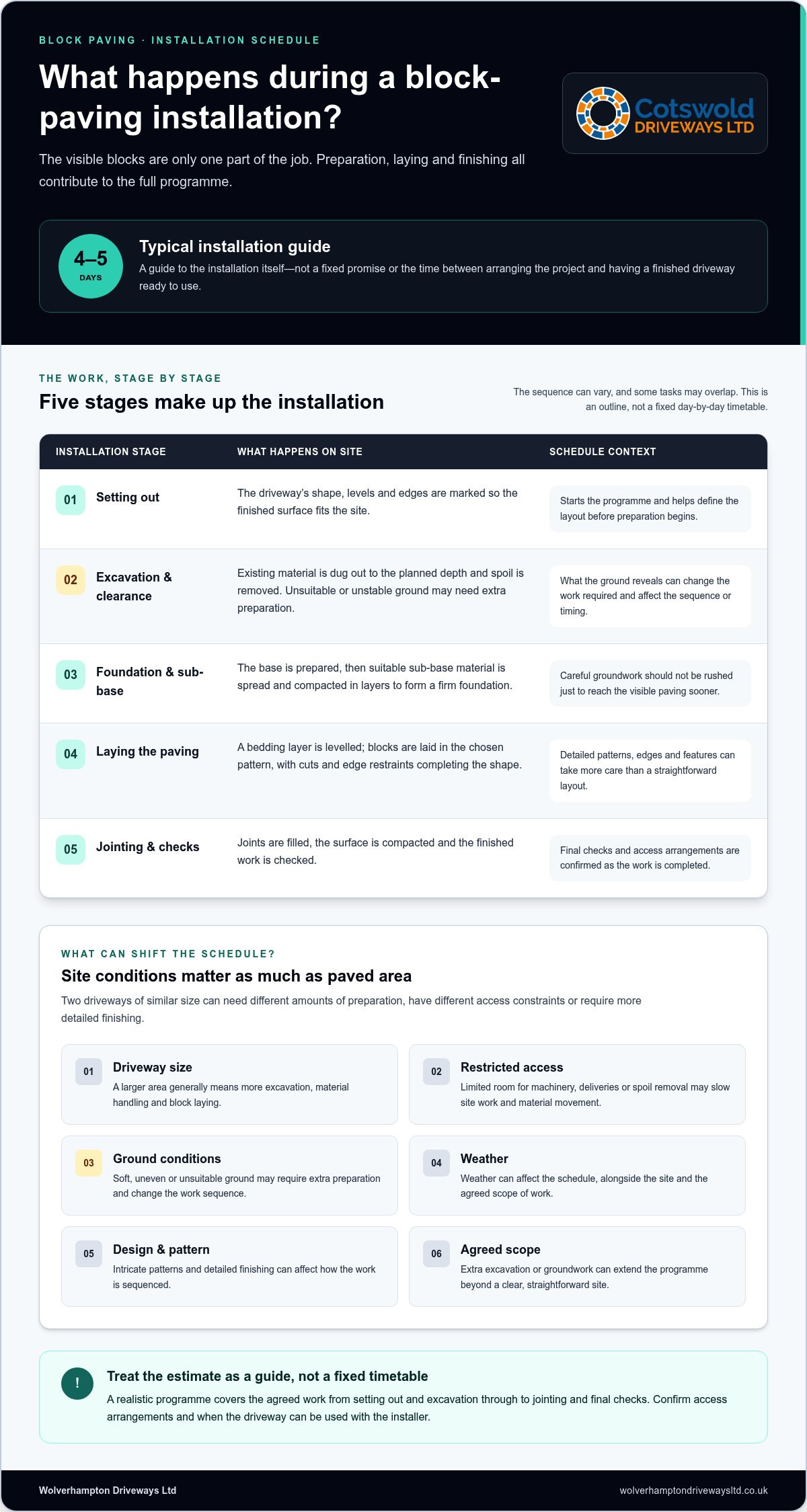
A typical block-paved driveway takes around four to five days to install, but the exact programme depends on the property and the agreed scope of work. This is a guide to the installation itself, not necessarily the time between arranging the project and having a finished driveway ready to use.
When estimating how long to lay a block paved driveway, include the preparation and finishing work as well as the time spent placing blocks. A clear, straightforward site may take less time than a larger driveway with difficult access, extra excavation or a detailed pattern. The condition of the site can matter as much as the paved area.
Which parts of the job count towards the total time?
The programme starts with setting out the driveway and preparing the site. This can include excavation, removing spoil and preparing the foundation. The team then builds the sub-base and bedding layer before laying the blocks, fitting the edges and completing the joints. Each step contributes to a stable, neat finish, so block laying is only one part of the work.
Some tasks may overlap, and the sequence can vary with the layout and site access. Discuss final checks and when the driveway can be used as part of planning, then confirm the arrangements as the work is completed. Any time before installation, such as arranging the start date, is separate from the days spent on site.
What does a realistic duration estimate include?
Four to five days is a useful guide for a typical installation, not a promise for every property. A small, straightforward driveway may have a shorter programme, while a larger or more complex project can take longer. Extra groundwork, restricted access, weather and intricate block patterns can all affect how the work is sequenced.
A realistic estimate should cover the agreed job from setting out and excavation through to jointing and final checks. It should also explain what could change the schedule if the site differs from what was expected. Wolverhampton Driveways Ltd plans block-paving work around the site and project scope, helping you understand the work involved and organise access.
Block-paved driveway installation stages: what happens each day?
A block-paving job follows a sequence, but the work won’t always fit neatly into one task per day. The outline below is an example, not a fixed timetable. Site size, access, weather and what the ground reveals during excavation can change the order or length of each stage.
- Setting out: The driveway’s shape, levels and edges are marked so the finished surface fits the site.
- Excavation and clearance: Existing material is dug out to the planned depth, and spoil is removed. Unsuitable or unstable ground may need extra preparation.
- Foundation and sub-base: The base is prepared, then suitable sub-base material is spread and compacted in layers.
- Laying the paving: A bedding layer is levelled, blocks are laid to the chosen pattern, and cuts and edge restraints complete the shape.
- Jointing and checks: The joints are filled, the surface is compacted and the finished work is checked before access arrangements are confirmed.
On a straightforward project, setting out and excavation may happen early in the programme, followed by base preparation, block laying and finishing. Some jobs combine stages; others need more time for one part than another. This paving preparation reference provides background on why groundwork is part of the installation, not an optional extra.
How do excavation and base preparation affect the schedule?
Excavation is more than clearing the visible surface. The team needs to reach the planned formation and remove material that won’t provide a dependable foundation. If the ground is soft, uneven or otherwise unsuitable, the preparation may need to change, affecting the sequence and timing. Sub-base is then placed and compacted in suitable layers to form a firm base for the paving.
Rushing this stage to reach the visible blocks sooner can compromise the work beneath them. A sensible programme allows time to prepare the base properly instead of squeezing the task into an unrealistic schedule.
How long do laying, jointing and final checks take?
Once the bedding layer is ready, blocks are laid in the agreed pattern. Cutting around edges and features takes care, while secure edge restraints help hold the layout in place. Jointing and final compaction are essential working steps, not cosmetic extras: they help lock the surface together and complete the finish.
Before using the driveway, follow the installer’s guidance. For a programme based on your property and the agreed work, request a free block paving quote.
What can make a block-paved driveway take longer than expected?
Driveway area matters, but it doesn’t tell the whole story. Two drives of similar size may need different amounts of preparation, have different access constraints or require more detailed finishing. Those differences affect how long to lay a block paved driveway, and their impact depends on each property.
Extra groundwork isn’t automatically a sign that progress has stalled. If excavation reveals unsuitable material, taking time to address it can help create a more dependable foundation for the finished paving. A realistic programme allows for the work the site actually needs.
| Site factor | Possible effect on the schedule |
|---|---|
| Driveway size | A larger area generally means more excavation, material handling and block laying. |
| Restricted access | Limited room for machinery, deliveries or spoil removal may slow site work and material movement. |
| Ground conditions | Soft, uneven or unsuitable ground may need additional preparation before paving can continue. |
| Drainage and levels | Adjusting the layout to achieve suitable levels and manage water can add planning or groundwork. |
| Design and detailing | Intricate patterns, edges and cuts around features can take longer than a simple layout. |
| Wet or cold weather | Conditions may make excavation, laying or finishing unsuitable, so some tasks could be delayed. |
How do driveway size, access and ground conditions affect timings?
More paving usually means more work, but access can change the pace. A narrow entrance or limited space to store materials may affect how machinery and deliveries reach the site. Removing excavated material can also take longer if vehicles can’t get close to the work area.
Drainage and levels need consideration alongside the surface area. Changes in level or ground that needs extra preparation can require a different sequence from a clear, even plot. Assess these details in relation to the property rather than estimating the schedule from dimensions alone.
Can rain or cold weather delay block paving?
It can. In Wolverhampton and the wider West Midlands, conditions vary, and persistent rain or cold spells may make parts of the work impractical. Wet ground can affect excavation and preparation, while unsuitable conditions can disrupt laying or finishing. The timing impact depends on the task and the site, so weather shouldn’t be treated as a fixed number of extra days.
A careful programme allows for sensible adjustments rather than rushing work to meet an arbitrary finish date. The aim is to keep the job moving where conditions permit while giving each stage the attention it needs.
How to plan for block paving work and minimise disruption
Planning before the start date can make driveway work easier to manage. Decide where to park, how materials will reach the site and what to expect as the work progresses. Agreeing these details helps the installation team organise the programme around your property and the agreed scope.
What should you arrange before the installers arrive?
Use this checklist to get the practical details in hand:
- Move vehicles: Clear the driveway and any areas needed for access or materials, in line with the agreed start plan.
- Plan alternative parking: Arrange somewhere else to leave your car whilst the drive is unavailable, and consider the needs of other household members.
- Discuss access: Identify gates, narrow entrances or other restrictions that could affect people, machinery or deliveries.
- Clear the work area: Move items that could obstruct the driveway or the route to it.
- Talk through boundaries: Make sure the work area and any shared or neighbouring boundaries are understood before work begins.
- Agree delivery space: Decide where materials can be unloaded and stored without blocking access more than necessary.
These details are especially useful if the drive is the main route into your home or there’s limited space nearby. Raising access needs in advance gives everyone a clearer picture of how the work can proceed.
What should you agree about the project programme?
Before the start date, discuss the expected order of work, the main stages and how you’ll receive progress updates. Agree who to speak to if plans need to change. It’s also sensible to talk through how rain, cold conditions or unexpected ground issues may affect the sequence, so a schedule change doesn’t come as a surprise.
For projects in Wolverhampton, Telford, Cannock or Dudley, site access can vary from one property to another. A restricted entrance, limited delivery space or a shared approach may shape how materials and equipment are brought in. The programme should reflect those site-specific details instead of relying on a one-size-fits-all estimate. This helps answer how long to lay a block paved driveway at your property with more confidence.
Wolverhampton Driveways installs block paving with the site and project scope in mind. To discuss access, the work sequence and timing for your driveway, request a free block paving quote.
Planning a block-paved driveway in Wolverhampton and the West Midlands
A dependable driveway programme includes the whole job: setting out, groundwork, laying the blocks and completing the finish. The quickest-sounding estimate isn’t necessarily the most useful. A schedule that reflects the actual site and allows time for careful preparation gives you a clearer basis for planning access and parking.
For homeowners asking how long to lay a block paved driveway, the practical answer depends on the property, not just a general day count. A straightforward layout with clear access may follow a different programme from a drive with awkward levels, limited working space or additional groundwork. Good workmanship and clear expectations matter more than an unsupported promise to finish as quickly as possible.
How does a site-specific quote help set expectations?
A quote based on your project can account for the driveway’s size and chosen layout, access for materials and equipment, and the work needed to prepare the site. These details help shape the proposed stages and give you a more useful understanding of what the installation involves. They also make it easier to plan for the period when your driveway may be unavailable.
No single duration fits every property. The expected programme should reflect the agreed scope and the conditions on site, rather than being treated as a fixed timeline before those details are understood.
What should you expect from a local block paving team?
Wolverhampton Driveways Ltd installs block-paved driveways across Wolverhampton and the wider West Midlands, including Telford, Cannock and Dudley. Local coverage doesn’t mean every project follows the same schedule. Access, ground conditions and the chosen design still shape the work at each property.
The company is fully insured and licensed. Professional workmanship includes planning the groundwork as well as laying and finishing the paving. A clear explanation of the proposed work helps you understand what will happen and prepare for disruption.
If you’re considering a new block-paved driveway, share the details of your property and project to get a clearer picture of the work involved. Request a free block paving quote for a programme based on your site and scope.
Plan your block-paved driveway with confidence
There’s no single timetable that suits every property. How long to lay a block paved driveway depends on the agreed scope, site access and ground conditions, as well as the time needed for preparation, laying and finishing.
Allow for the complete installation, not just the visible block-laying stage. A clear programme should explain the main steps and account for factors such as weather or unexpected groundwork. That helps you plan parking and household access without relying on an unrealistic fastest-time promise.
Wolverhampton Driveways Ltd installs block-paved driveways across Wolverhampton and the wider West Midlands. The company is fully insured and licensed, and offers free quotes for driveway projects.
Ready to discuss your driveway and get a clearer idea of the work involved? Request a free quote for your block-paved driveway.
Frequently Asked Questions
How many days does it take to lay a block-paved driveway?
A typical block-paved driveway takes around four to five days to install, but the actual time depends on the property and agreed work. If you’re asking how long to lay a block paved driveway, remember the estimate covers more than placing blocks: setting out, excavation, base preparation and finishing all form part of the job. A larger area, restricted access or unexpected ground conditions can change the programme.
Can a block-paved driveway be laid in one day?
One day is unlikely to cover a typical driveway installation from preparation through to finishing. Block laying is only one stage, and the site may first need setting out, excavation and a properly prepared base. A small project with straightforward conditions may have a shorter programme, but the full schedule depends on its size and scope. Treat any timing as specific to the property, not a standard promise.
What takes the longest when installing block paving?
Ground preparation can take a substantial part of the programme, particularly if excavation reveals unsuitable material or the site needs extra levelling. The sub-base must be prepared before the bedding layer and blocks can go in. Laying and cutting blocks, fitting edges, jointing and compacting the surface also take time. Which stage takes longest varies with the driveway’s layout, access and ground conditions.
Does rain delay block paving installation?
Rain can delay some stages if wet conditions make excavation, base preparation, laying or finishing unsuitable. The effect depends on the work underway and the condition of the site, so there isn’t a fixed number of days to add. In Wolverhampton and the wider West Midlands, weather can vary during a project. A careful programme allows for adjustments rather than rushing work when conditions aren’t right.
How long before I can park on a new block-paved driveway?
As a general guide, wait around five to seven days before driving on new block paving, but follow the installer’s instructions for your project. The right timing can depend on how the work has been completed and the conditions on site. Don’t assume the driveway is ready for a vehicle as soon as the installation looks finished. Confirm when it can be used before moving your car back.
Does the size of a driveway affect how long block paving takes?
Yes. A larger driveway generally needs more excavation, material handling and block laying, so it can take longer than a small area. However, size alone doesn’t determine the schedule. A compact drive with restricted access, difficult ground or a detailed pattern may need more time than its area suggests. The site and agreed scope together give a more useful basis for estimating the work.
Is block paving quicker to install than resin or tarmac?
There isn’t a reliable, one-size-fits-all answer. Installation time for block paving, resin or tarmac depends on the area, site preparation, access, design and finishing requirements. Each surface has a different installation process, and the condition of the existing ground can affect the programme for any option. For a home in Wolverhampton, Telford, Cannock or Dudley, compare project-specific schedules rather than assuming one surface is always quicker.