
A non-slip surface can still become slippery when wet. Composite decking can offer better grip than traditional timber, but standing water, dirt and debris can affect traction; a PTV greater than 36 is stated as the level for a lower risk of slipping. For non-slip decking boards in Telford, the board texture matters, but so do the base, drainage and layout.
It’s sensible to consider grip before choosing decking, especially in a garden exposed to wet weather. A board labelled non-slip is not the whole answer: water needs somewhere to drain, and the surface must stay clear of build-up that can make it slippery.
This guide explains how wet conditions affect composite decking and what board texture, walking direction, gaps and drainage can contribute. It also covers the practical considerations for decking supply and installation in Telford, so you can understand what shapes a suitable design for your garden.
Key Takeaways
- Good drainage depends on the deck’s base as well as clear gaps between boards, so layout needs to account for where water will go.
- Board texture can help with grip, but wet conditions and dirt still affect how safe a surface feels underfoot.
- Grooved and embossed finishes offer different surface details; the right choice depends on the deck’s setting and intended use.
- A well-planned installation considers walking direction, drainage and board selection together for a practical garden deck.
Deck layout, drainage and walking direction
Start by tracing the main route from your back door to the garden seating area. Lay boards perpendicular to heavy foot traffic to improve traction across the walking line. For example, mark the route between the kitchen door and a dining table before deciding board direction. This helps the layout work with everyday movement, rather than treating the deck as an empty rectangle.
Drainage depends on the deck’s base as well as its surface. A slight slope helps rainwater run off composite decking rather than pool. Keep the gaps between boards clear so water can pass through, but remember that gaps alone will not fix a base that traps water underneath. Plan where runoff can go and consider how nearby walls, borders or planting affect its route.
Use a simple sequence: assess the ground, plan the fall, then set the board direction. Check the finished layout for low spots where water could collect. A deck beside a house needs particular care around the wall and doorway, where moisture can linger. Good airflow below the boards also helps the structure dry after wet weather. Keep leaves and garden debris out of drainage gaps.
Colour and design affect how the deck sits in your outdoor space. A natural timber-style colour can complement planting, while a darker composite finish may contrast with pale paving. Consider the view from the house as well as the board surface. You might run boards towards a garden focal point, unless foot traffic makes another direction more practical. Choose a finish that suits the patio, fencing and garden furniture, balancing appearance with drainage and a clear walking route.
Can composite decking become slippery when wet?
Yes. Composite decking can offer better grip than traditional timber, but wet conditions can still make the surface slippery. Grip depends on the finish, surface contamination and how the deck is used.
Understanding slip-resistance claims
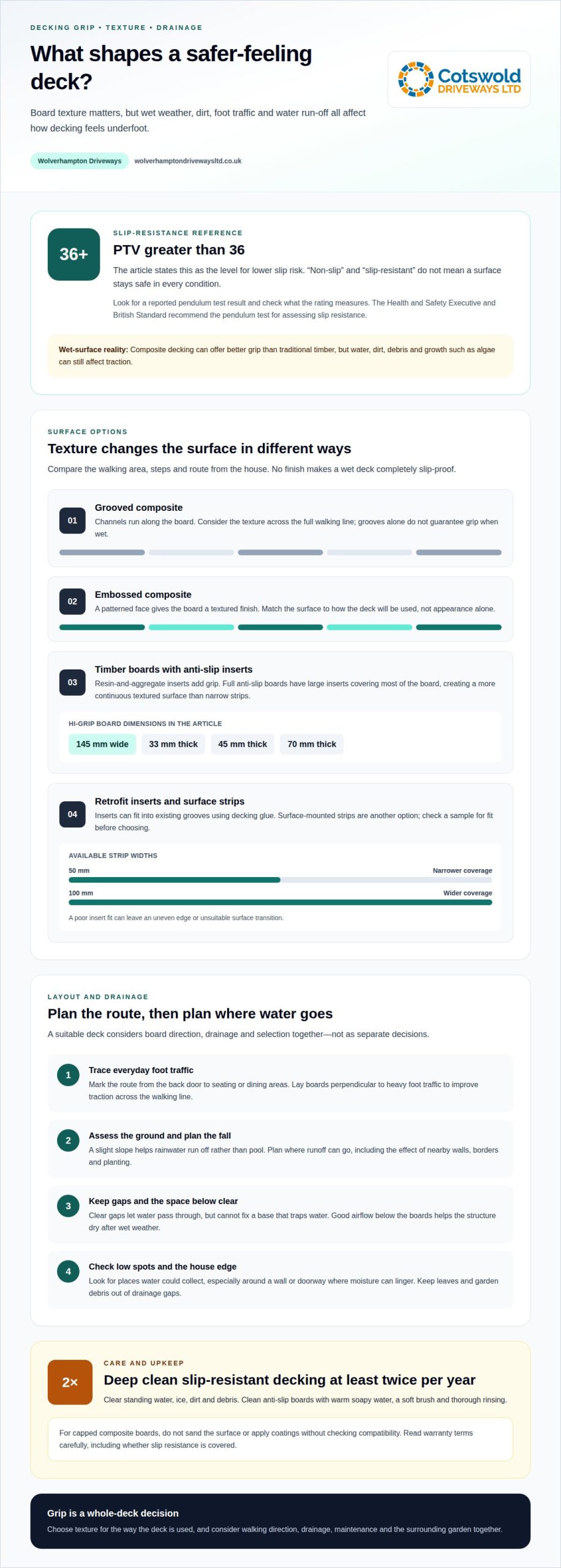
“Non-slip” and “slip-resistant” describe reduced slip risk, not a surface that stays safe in every condition. A PTV greater than 36 is stated as the level for lower slip risk. The Health and Safety Executive and British Standard recommend the pendulum test for assessing slip resistance. Look for a reported test result, rather than relying on a product label alone.
For family use, consider where children walk, play or step out of the house. Full anti-slip boards have large inserts covering most of the board, made from waterproof, slip-resistant rubbery material. They may suit areas that need more consistent grip, such as around a hot tub.
Comparing timber and composite boards
Timber anti-slip boards can use resin-and-aggregate inserts to add grip, including during winter. Composite boards have a different surface finish and can become slippery when wet. The practical choice depends on the space, expected foot traffic and the level of grip needed.
Neither material removes the need for care. Clear standing water, ice, dirt and debris from the surface. Damp conditions and contamination can also encourage algae or other growth on composite decking, changing how it feels underfoot.
Applicable safety standards
Slip risk is not determined by the board alone. The Health and Safety Executive’s guidance considers flooring alongside contamination, cleaning, footwear, people and the environment. A family deck should therefore be considered as a whole, including how it is used and maintained.
For performance, look for a pendulum test result and check what the stated rating measures. Read warranty terms carefully, including whether they cover slip resistance, rather than assuming every product warranty does.
Clean anti-slip boards with warm soapy water, a soft brush and thorough rinsing. Deep clean slip-resistant decking at least twice per year. For capped composite boards, don’t sand the surface or apply coatings without checking compatibility. A carefully planned decking installation can account for board choice, use and upkeep together.
Choosing grooved or embossed board textures
UK options include grooved or embossed composite boards, timber boards with anti-slip inserts, and retrofit strips. Each changes the surface differently, so choose based on how the deck will be used and the grip required, not appearance alone.
Grooves create channels along a board, while embossing gives its face a patterned texture. Neither finish makes a wet surface completely slip-proof. Compare the texture across the walking area, including steps and routes from the house. A dark colour may show dirt differently from a pale one, so consider how the deck will look between cleans.
Some timber boards use resin and aggregate inserts to add grip. Hi-Grip non-slip timber decking boards are 145 mm wide, with thicknesses of 33 mm, 45 mm and 70 mm. Full anti-slip boards have large inserts covering most of the board. This can provide a more continuous textured surface than narrow strips, which may suit a busy path across the deck.
For existing boards, anti-slip inserts can fit into grooves using decking glue. Surface-mounted strips offer another retrofit option. Strips are available in 50 mm and 100 mm widths, giving different coverage across a board. Before choosing an insert, buy a sample to check its fit against the groove. A poor fit can leave an uneven edge or an unsuitable surface transition.
Look closely at the board profile and intended walking line. Grooved boards may suit a simple, straight deck, while inserts can add grip to selected boards along a route. Match the texture to regular foot traffic and the overall design. Consider surface, coverage and appearance together instead of assuming deeper grooves always mean better grip.
Decking supply and installation in Telford
A Telford decking project starts with the garden, not a board catalogue. Assess the footprint, ground conditions, access and route from the house. These details help determine the deck’s shape, board direction and drainage plan. If there is an existing deck, consider its condition and supporting base before removing boards. Replacing the surface alone will not solve a base that traps water.
Board lengths can help guide the design. Gripsure Classic non-slip decking boards are available in 3.6 m and 4.8 m lengths. Hi-Grip Standard timber decking boards are available in lengths up to 4.8 m. The installer can plan board runs around the garden’s dimensions, reducing awkward joins and offcuts where practical. The final choice also needs to suit the intended texture, appearance and use.
Installation planning brings the details together: assess the site, prepare the base, set out the boards, then fit and finish the deck. A slight slope helps rainwater drain across composite surfaces, while clear board gaps let water through. The base must also allow water to escape. With timber or composite decking, correct support and layout help the finished surface work as intended.
Choose materials to suit the site plan, rather than letting the supply dictate it. A narrow garden, for example, may suit board runs that create a clear route from the back door, while a wider seating area may call for another pattern. Gardens in Telford vary in access and levels, which can affect preparation and installation. A sound plan brings board length, walking direction, ground preparation and drainage together in one practical design.
To discuss how your garden’s layout and ground conditions shape the project, talk through your Telford deck plans.
Wolverhampton Driveways: Decking
Wolverhampton Driveways Ltd provides decking installation for homeowners planning an outdoor space in Telford. If you’re weighing up board texture, garden layout or drainage, the team can bring those choices together in a practical plan. Consider how you’ll use the space, where people will walk and how rainwater can drain away. This gives you a clearer basis for choosing a surface and design suited to your garden.
Decking can also form part of a wider garden improvement. You might plan it alongside block paving, a resin bound driveway or a tarmac driveway. Each area has a different purpose, so consider how the materials and routes connect around your home.
If you’re planning decking in Telford, contact Wolverhampton Driveways Ltd to discuss your project.
Plan a deck that fits your garden
Turn your priorities into a clear project brief. Think about how you use the garden, which areas need regular access and the look you want beside your home. This gives the installation plan a practical starting point, whether you want a family seating area or a simple route outdoors.
If you’re considering non-slip decking boards in Telford, Wolverhampton Driveways can discuss how decking could fit your space. You can also plan the wider layout alongside its Tarmac Driveways, Block Paving and Resin Bound Driveways, where those surfaces suit your needs.
A well-considered outdoor project starts with a straightforward conversation about the space and what you want from it. Contact Wolverhampton Driveways to discuss your decking plans and take the next step towards a garden that works for you.
Frequently Asked Questions
Is any decking completely non-slip?
No decking is completely slip-proof in every situation. Leaves, muddy shoes or a spill can change how a surface feels, even when the boards are textured. A garden route used after children have played on wet grass, for example, needs attention to both the boards and what gets walked across them. Choose to reduce slip risk, not to guarantee that slips cannot happen.
Can I improve an existing slippery deck?
An existing deck may be improved, depending on the cause and its condition. First identify whether the problem is surface growth, worn boards or water collecting underneath. Cleaning may address surface contamination, while grooved-board inserts or surface-mounted strips can add grip to suitable boards. If boards move or the base holds water, surface treatments alone will not solve the underlying issue.
Looking for affordable decking near you?
For a Telford garden, Wolverhampton Driveways offers decking installation and free, no-commitment quotations. The work depends on the garden’s shape, access, ground preparation and chosen design, so a clear brief helps define the project. Consider whether the deck will be a standalone space or part of a wider garden improvement. This helps you set priorities before deciding on a suitable design.
Non-slip, anti-slip and slip-resistant: what should you expect?
These terms generally describe surfaces designed to reduce slipping, not to promise that slipping is impossible. A textured board or added insert may provide grip, but the result still depends on how the deck is used and cared for. A route used to carry food from the kitchen, for example, may need more attention than a quiet corner used occasionally.
Where is high-grip decking needed?
Prioritise places where people regularly turn, step down or move between surfaces. These might include steps from a patio door, a route beside a garden dining area or decking around a hot tub. High-grip boards or inserts can be considered for these sections. Planning coverage around actual movement focuses texture where it matters, rather than applying it without regard to use.
Where can I buy non-slip decking boards in Telford?
For homeowners considering non-slip decking boards in Telford, Wolverhampton Driveways provides decking installation. Discuss the garden layout, intended use and preferred board appearance when planning the project. The company also serves Telford with other outdoor work, including patios and fencing. Contact Wolverhampton Driveways to discuss how decking can suit your home and garden.