
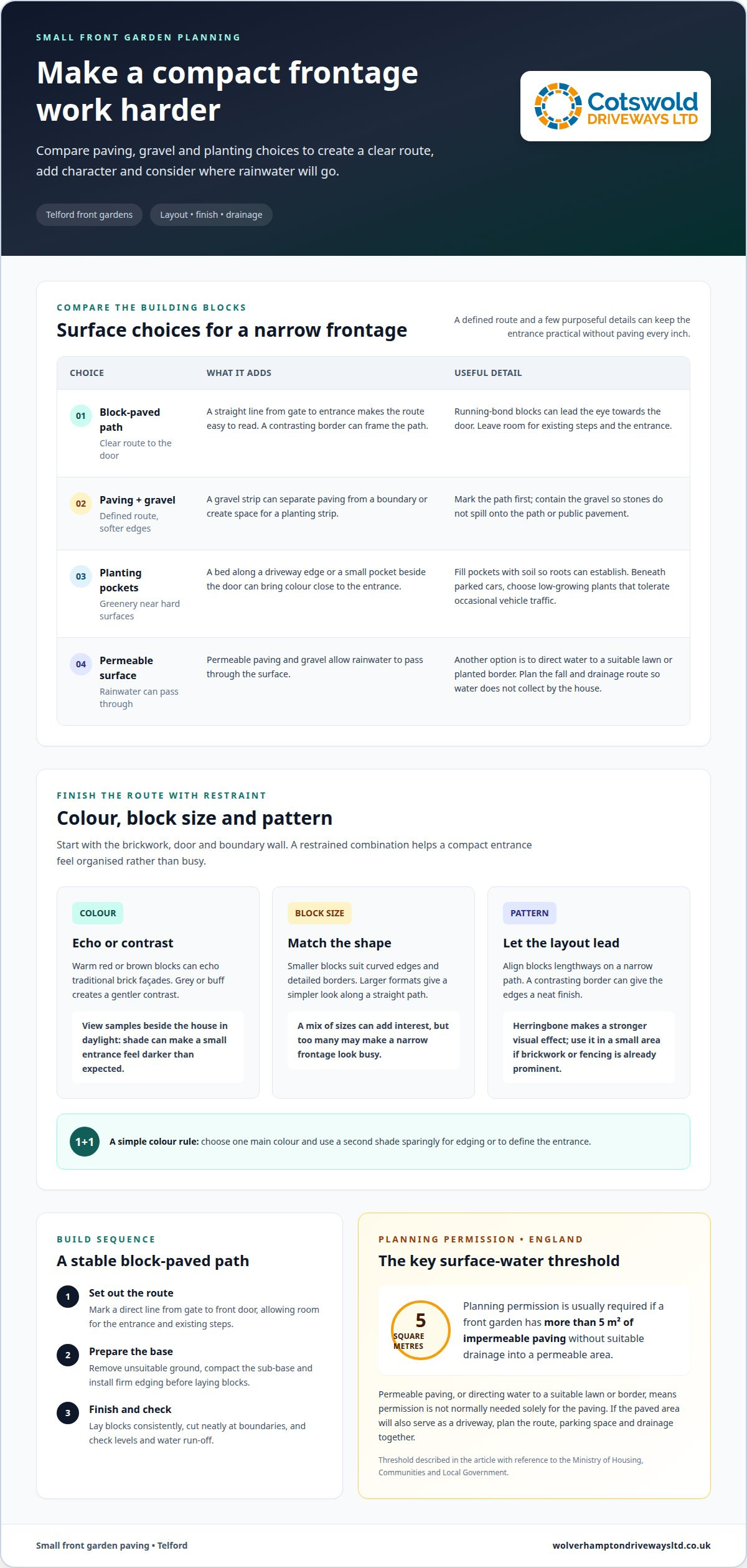
Planning permission is usually required in England if a front garden has more than five square metres of impermeable paving without suitable drainage into a permeable area, according to the Ministry of Housing, Communities and Local Government. For small front garden paving ideas in Telford, choosing permeable materials or directing water to a suitable lawn or border can mean permission isn’t normally needed solely for the paving.
A compact terraced frontage still needs to work hard. The right layout can make room for a clear path or vehicle access while keeping the entrance welcoming, rather than paving every inch.
This guide explores practical layouts for narrow front gardens, including paved tracks, block-paved paths and sloped entrances. You’ll also find ideas for colours and patterns, gravel with planting pockets, and drainage and access points to consider before work begins. Use these ideas to plan a front garden that suits your home and understand when paving alone may need planning permission.
Key Takeaways
- Plan the path and parking together so a compact frontage feels clear and practical.
- Use paving colour, format and pattern to give the entrance character without making it feel crowded.
- Combine gravel with purposeful planting pockets to soften hard surfaces and add greenery.
- Consider drainage and any changes to vehicle access before settling on your final layout.
Block-paved patios and paths
For small front garden paving ideas in Telford, block paving can define a front path, a compact sitting area or both. Blocks in different colours and textures create an attractive feature without making the whole frontage look uniform. A straight path from gate to door gives a clear route, while a contrasting border marks its edges. A small paved area beside the entrance can provide a practical spot for a pot or bench.
Installation starts by setting out the path or patio, then excavating and preparing a suitable compacted sub-base. Secure edging helps hold the blocks in place, while accurate levels help keep the finished surface stable. Lay the blocks in the chosen pattern, cut them neatly at the boundaries and fill the joints. Plan the surface’s fall and drainage route too, so water doesn’t collect by the house.
- Set out the route. Mark a direct line from the gate to the front door, allowing room for the entrance and any existing steps.
- Prepare the base. Remove unsuitable ground, compact the sub-base, and install firm edging before laying blocks.
- Finish the surface. Lay blocks consistently, make clean cuts around boundaries, and check levels and water run-off.
These small front garden paving ideas for Telford homes work well with a simple pattern. Running-bond blocks can lead the eye towards the door, while a second-colour border frames the path. For example, set a narrow brick path beside a gravel strip to create a defined route without paving the whole garden. Choose a pattern that fits the space instead of adding competing details.
If the paved area will also serve as a driveway, drainage affects planning permission. In England, planning permission is usually required for a front-garden driveway if more than five square metres is covered by an impermeable surface without suitable drainage into a permeable area, according to the Ministry of Housing, Communities and Local Government. Permeable paving or drainage to a suitable lawn or border can help manage surface water. Keep the route, parking space and drainage plan together from the outset.
Paving colours, formats and patterns
For a compact Telford frontage, a simple format and restrained colour scheme keep the entrance looking organised. Paving contractors and materials suppliers serving Telford can help with choosing blocks and planning their arrangement.
Colour and Format Choices
Start with the brickwork, door and boundary wall. Warm red or brown blocks can echo traditional brick façades, while grey or buff creates a gentler contrast. View colour samples beside the house in daylight: shade can make a small entrance feel darker than expected.
Block size matters too. Smaller blocks suit curved edges and detailed borders, while larger formats give a simpler look along a straight path. A mix of sizes can add interest, but too many may make a narrow frontage look busy. Choose one main colour and use a second shade sparingly for edging or to define the entrance.
Different block textures and colours can create decorative features in paths, driveways or walls. For example, a contrasting row along each side of a path frames the route to the front door without covering the whole area in pattern. For those seeking design inspiration on textured, hard-wearing outdoor finishes, projects by Inspire Concrete illustrate how exposed stone aggregates can deliver visual depth and practical durability underfoot.
Styles for Compact Front Gardens
Choose a layout that suits the garden’s shape and use. A straight-running pattern can draw the eye from gate to doorway, while a border at the entrance makes the threshold feel distinct. Herringbone creates a stronger visual effect; use it in a small area if the frontage already has prominent brickwork or fencing.
On a narrow path, align the blocks lengthways to emphasise its direction. A simple border in a contrasting tone gives the edges a neat finish. If the path meets a paved parking area, use the same main block and change only the border to connect the two spaces.
In Telford, a paving contractor can plan a block layout around the entrance and boundaries. For an example of the surface option, explore block paving options and consider how colour, format and pattern will work together at your home.
Gravel and planting pockets
Gravel can soften a paved front garden without compromising its practical use. Shingle and stones work as decorative ground cover or as a driveway surface, while flowers can add colour beside a path. In a narrow Telford frontage, use gravel to define a planting strip or separate the paving from the boundary.
To combine gravel with paving, mark out the path first and leave a defined strip for stones. A permeable weed-suppressing membrane beneath the gravel helps limit weeds while allowing water through. Contain the edges so stones don’t spill onto the path or public pavement. Pale gravel beside darker paving can also make the entrance easier to read.
Planting pockets need enough growing space, not just a gap in the hard surface. Fill each pocket with soil so roots can establish; hardcore or concrete won’t provide a suitable growing medium. A flower bed along a driveway edge can brighten a plain surface, while a small pocket beside the front door brings colour close to the entrance.
Where plants sit beneath parked cars, choose low-growing varieties that can tolerate occasional vehicle traffic. Choose low-growing plants that can tolerate occasional vehicle traffic for pockets beneath parked cars. Keep plants away from wheel paths where possible, and clearly edge each pocket to reduce the chance of a vehicle brushing them.
Permeable paving and gravel let rainwater pass through the surface. Another option is to direct water towards a suitable lawn or planted border. In a mixed layout, leave gravel or planted areas between paved sections rather than sealing the whole frontage. This can help manage surface water while preserving greenery. In England, paving with permeable materials or draining water to a suitable lawn or border will not normally require planning permission solely for the paving.
Paving layouts for small terraced front gardens
A clear layout can make a small front garden feel more open by keeping the route from gate to door direct. Long paving lines draw the eye towards the entrance, while limiting material changes helps avoid a cluttered look. A straight path with one defined border, for example, creates a feature without dividing the frontage into several small sections.
If the garden needs occasional vehicle access, two paved tracks can mark the wheel routes, leaving the rest of the area for gravel over a permeable weed-suppressing membrane. This uses less continuous paving and keeps the frontage looking open. Align the tracks with the entrance and parking position, while keeping a clear route to the front door.
Slabs offer another way to distinguish a path from a traditional block-paved route. A line of larger slabs can create stepping points across a compact frontage, with gravel or planting between them. Keep the spacing consistent and the walking route obvious. A narrow strip of contrasting material can define the edge without adding another dominant pattern.
On a sloped front garden, steps can make it easier to move between levels and add a design feature. Plan the path and steps as one route to avoid an awkward turn at the entrance. A landing at the doorway can make the transition from path to threshold feel more natural. Include the direction of water drainage in the layout.
Vehicle access needs more than a neat surface. Creating a driveway on private land doesn’t itself authorise driving across the public footpath; an approved vehicle entrance may be needed. Telford & Wrekin Council considers visibility, parking space and road safety when assessing vehicle-access crossing applications. If you’re planning a block-paved frontage, discuss a practical paving layout that suits the space and its intended use.
Wolverhampton Driveways: Block Paving
Wolverhampton Driveways Ltd can install your chosen block-paved layout as a practical frontage. If you’ve settled on a path, parking area or a combination of both, the next step is to plan the surface as part of a considered design.
For a terraced home, the design needs to suit the available space, entrance and intended use. Block paving can create a clear route to the front door, frame a compact parking area or bring both together in one coherent layout. Drainage, secure edging and accurate levels also matter for a stable finish, particularly where the surface meets existing boundaries.
If you’re ready to discuss block paving for your front garden, contact Wolverhampton Driveways.
Turn your front garden plan into a clear next step
Turn your inspiration into a simple project brief. Decide what matters most: a clear route to the door, space for a vehicle or a greener entrance. A quick sketch showing the gate, doorway and boundaries can clarify your priorities before you settle on a layout.
The best small front garden paving ideas in Telford are shaped around how you use the space. Wolverhampton Driveways Ltd installs Block Paving, Tarmac Driveways and Resin Bound Driveways, giving you different surface options for your frontage. The right choice depends on your preferred layout and finish, as well as practical needs such as drainage and access.
If you’re ready to discuss a suitable surface for your home, contact Wolverhampton Driveways. A clear plan is a good starting point for creating a front garden that feels welcoming and works for everyday life.
Frequently Asked Questions
Do You Need Planning Permission?
Planning permission depends on the surface and drainage. In England, permission is usually required for a front-garden driveway if more than five square metres is covered by an impermeable surface without suitable drainage into a permeable area, according to the Ministry of Housing, Communities and Local Government. Permeable paving, or drainage to a suitable lawn or border, will not normally require permission solely for the paving.
Which paving materials are best for a small front garden in the UK?
Choose a material that suits how you use the frontage. Block paving offers a choice of colours and patterns, while slabs can create a distinct path. Gravel or shingle can provide a contrasting area beside a paved route. A front entrance used mainly for walking, for example, may suit a slab path with gravel alongside; vehicle use calls for a layout designed around that purpose.
What drainage rules apply to front garden paving in England?
Plan where rainwater will go before deciding how much of the frontage to pave. Permeable materials let water drain through the surface, while directing run-off to a suitable lawn or border provides another option. Avoid a layout that sends water towards the house or a neighbouring property. For a driveway, the planning-permission threshold depends on permeability, the area covered and whether suitable drainage is provided.
Do I need planning permission to pave my front garden in Telford?
Paving alone will not normally need planning permission if you use permeable materials or drain water to a suitable lawn or border. In England, a driveway with more than five square metres of impermeable surface and no suitable drainage usually requires permission. In Telford, creating a driveway on private land doesn’t authorise crossing the public footpath; an approved vehicle entrance may be needed separately.
Which paving colours and patterns suit a small north-facing front garden?
For a north-facing entrance, consider lighter colours such as buff or pale grey to keep the paving visually bright. A simple running pattern can guide the eye towards the front door, while a darker border defines the path without adding competing details. View samples beside the house in daylight to see how the paving works with the façade.
How can I add planting and privacy to a paved front garden?
Use pots, narrow borders or planned planting pockets to add greenery without obstructing the route to your door. For privacy, a boundary fence or carefully placed container plants can screen a direct view while keeping the entrance usable. Choose plants to suit the available light and space, and leave soil in planting pockets so roots have room to grow.