
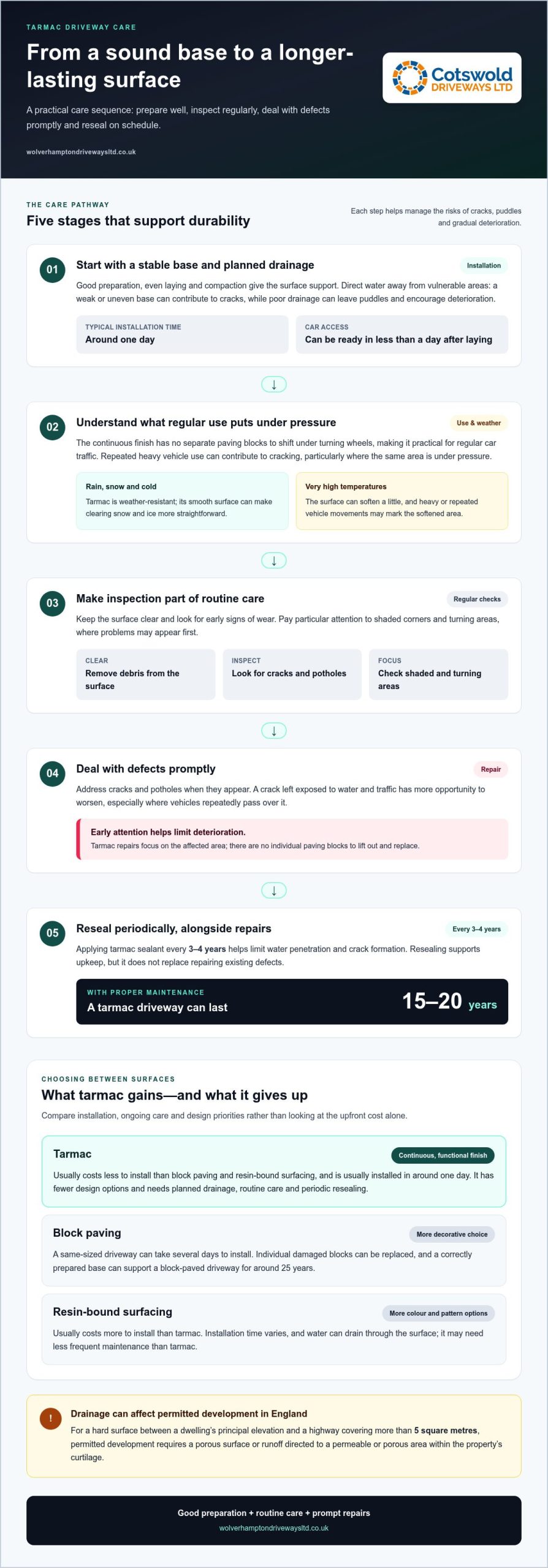
A hard-wearing surface still has trade-offs. Weighing the pros and cons of tarmac driveways means balancing durability with upkeep and fewer design choices. With proper maintenance, a tarmac driveway can last 15-20 years, but it needs attention over time.
If you’re considering a practical surface for regular vehicle use, tarmac can be a sensible option. The key is understanding its advantages and drawbacks, including its maintenance needs and whether its simple, continuous finish suits your home.
This guide covers how tarmac performs under regular use and heavy loads, what helps keep it in good condition, and how its design options compare with block paving and resin surfacing. You’ll have a clearer basis for deciding which surface suits your priorities.
Key Takeaways
- A well-prepared base and effective drainage help reduce the risk of cracks, puddles and uneven areas.
- With proper maintenance, a tarmac driveway can last 15-20 years, though repeated heavy vehicle use and extreme heat can affect its condition.
- Plan for routine care: inspect for cracks and potholes, deal with them promptly and consider resealing every 3-4 years.
- Tarmac offers a clean, continuous finish, while block paving and resin-bound surfacing provide more scope for colour, pattern and decorative detail.
- Compare the surface’s durability and upkeep with your design priorities before choosing the best fit for your driveway.
Why Select a Tarmac Driveway?
Tarmac is a practical driveway material if you want a continuous surface that stands up to everyday vehicle use. Its performance depends on more than the finished asphalt: careful base preparation and effective drainage also matter.
Installation quality and drainage
Poor installation or base preparation can lead to cracks and puddles. An uneven or weak base provides less support, while inadequate drainage lets water collect and may contribute to deterioration over time. A sound installation depends on a stable base, even laying and compaction, and directing water away from vulnerable areas.
Drainage matters for both tarmac and block paving. On a steep driveway, water can run down the tarmac surface, so suitable edging or drainage can help manage its flow. A continuous finish may suit a straightforward drive, but the slope and route water takes should inform the design.
Installation and maintenance costs
Tarmac usually costs less to install than block paving, partly because the material is less expensive and installation is often simpler. Its initial cost is also generally lower than that of resin-bound surfacing. Tarmac is worth considering if the upfront cost matters more to you than decorative choice.
Maintenance also affects longer-term costs. Tarmac may need resealing and small repairs, while resin-bound surfacing may need less frequent maintenance. Compare the installation work and ongoing care each surface requires, rather than judging materials on the initial cost alone.
Installation time and planning requirements
A tarmac driveway usually takes around one day to install, and the surface can be ready for a car in less than a day after it is laid. The hot asphalt is spread and compacted, so preparation, access and the work area affect the labour involved. Block paving on a driveway of the same size can take several days.
In England, according to the UK Government, a hard surface between a dwelling’s principal elevation and a highway that covers more than 5 square metres must be porous or have runoff directed to a permeable or porous area within the property’s curtilage to qualify as permitted development. This is the relevant planning rule for the described location and surface; drainage design determines how runoff is managed.
| Driveway option | Installation | Upfront cost | Design and drainage |
|---|---|---|---|
| Tarmac | Usually around one day | Usually less than block paving and resin | Fewer design options; drainage needs planning |
| Block paving | Several days for a same-sized drive | Usually more than tarmac | More decorative choice; base and drainage matter |
| Resin-bound surfacing | Installation time varies | Usually more than tarmac | More colour and pattern options; water can drain through |
Choose tarmac when a relatively quick, functional surface suits your budget and design priorities.
Durability under frequent vehicle use and heavy loads
Tarmac forms a continuous surface, so it has no separate paving blocks that can shift under turning wheels. That makes it suitable for driveways with regular car traffic and properties where a practical finish matters. It can withstand heavy vehicles over time, but repeated use by heavy vehicles can also contribute to cracking. Load, turning movements and the condition beneath the surface all affect how it holds up.
Longevity is tied to care as well as construction. With proper maintenance, a tarmac driveway can last 15-20 years. Prompt attention to small defects and periodic resealing help maintain the surface and limit deterioration. By contrast, leaving a crack exposed to water and traffic gives it more opportunity to worsen, particularly where vehicles repeatedly pass over the same spot.
British weather puts the surface through changing conditions. Tarmac is weather-resistant and can withstand rain, snow and cold temperatures. Its flexibility helps it cope with temperature fluctuations, and a smooth finish can make clearing snow and ice more straightforward. Extreme heat is a different challenge: tarmac can soften a little in very high temperatures, so heavy or repeated vehicle movements may mark a softened area.
Can tarmac driveways withstand cold or wet weather in the UK? Tarmac is weather-resistant, including in heavy rain and freezing temperatures. However, laying it on a wet or unstable base can undermine the installation. Proper preparation and drainage help support a durable surface.
Block paving offers a different kind of durability. A correctly prepared base can support a block-paved driveway for around 25 years, and a damaged block can be replaced individually. Tarmac has no individual units to lift or swap, so repairs tend to focus on the affected area rather than one component. That continuous finish suits straightforward access, whilst block paving gives more localised repair options.
Concrete is another comparison point: tarmac is less prone to cracking than concrete, although no surface is immune to damage. Think about the vehicles using the drive, where they turn or park, and whether heavy traffic is frequent. For example, a shared access used repeatedly by heavier vehicles places different demands on a surface than a household drive used by cars. A carefully planned driveway installation can account for those traffic patterns.
Maintenance, resealing and repairs
Regular care helps keep tarmac in serviceable condition and makes it easier to spot defects early. Build a simple routine around three tasks: clear debris, inspect the surface and address cracks or potholes promptly. Check shaded corners and turning areas, where problems may appear first.
Resealing and routine inspection
Tarmac sealant should be applied every 3-4 years to help protect the surface. Sealant helps limit water penetration and crack formation, but it doesn’t replace repairs or correct poor drainage. Before resealing, clean the driveway and inspect it closely. Mark cracks and holes that need attention, and make sure the surface is suitable for treatment.
Small cracks and potholes can often be repaired without replacing the entire driveway. Address them promptly rather than allowing water and vehicle use to worsen the damage. If puddles repeatedly form in the same place, look beyond the surface: drainage or the base may need attention, since a repair alone will not resolve those underlying issues.
Cleaning, stains and weed control
Remove leaves, soil and other debris before they build up. Petrol and some other chemicals can stain tarmac, so clean spills promptly using a suitable method. Moss can grow in shaded areas, including beside buildings, and may become slippery in winter. Clear it carefully, especially where people walk between the house and parked vehicles.
Include driveway edges in your routine checks. Remove visible weeds and clear accumulated soil where tarmac meets borders or paving. If a weed grows in a crack, address the crack too; removing the growth alone leaves the surface defect behind. A clean edge also makes new cracks, potholes or loose material easier to spot.
How block paving maintenance differs
Block paving needs a different inspection routine because its surface is made from separate units and joints. Look for loose or damaged blocks, weed growth between joints and areas where water collects. Replacing a damaged block can be fairly simple, whilst tarmac repairs usually involve sealing the affected area rather than swapping one component.
Block paving sealant should last around 2 years when applied properly, compared with tarmac sealant applied every 3-4 years. These intervals describe sealant maintenance, not a guarantee that either surface needs no other care. For either material, remove weeds, address damage early and keep drainage paths clear. A consistent routine helps homeowners manage upkeep without overlooking repairs.
Limited customisation compared with block paving or resin-bound surfacing
Tarmac gives a driveway a smooth, continuous finish, but offers fewer design choices than block paving or resin-bound surfacing. Its dark appearance can suit a practical, uncluttered frontage. If you want contrasting colours, patterns or decorative borders, tarmac offers less scope. Decide whether appearance or a simple, functional surface matters more before comparing options.
Block paving creates pattern through the arrangement of individual blocks. Homeowners can use contrasting colours or laying patterns to define parking areas, paths or the entrance to a property. Resin-bound surfacing offers a different choice: its aggregate can be selected to create colours and patterns. Tarmac can have a coloured finish, but this may increase its cost, and it still has fewer design options overall.
Upfront affordability is one reason to consider tarmac. It is usually cheaper to install than block paving, partly because the material costs less and installation is often simpler. It is also generally less expensive initially than resin-bound surfacing and concrete. Those comparisons concern initial installation, not the full lifespan cost; include maintenance, repairs and any future resurfacing when weighing the investment.
Concrete offers a durable, relatively low-maintenance surface, but can cost more initially than tarmac. Concrete can also crack, and repairs may involve replacing a section rather than patching it. Tarmac can be repaired locally, though a repair may be visible against the older surface. The better fit depends on whether you prioritise a simple finish, lower initial cost or concrete’s different maintenance profile.
Gravel creates a loose, textured surface rather than tarmac’s continuous finish. It can suit a rural-style frontage, but stones may move under tyres and need raking back into place. For example, repeated turning near a garage can displace gravel. Tarmac avoids this loose-material upkeep, but offers less variation in colour and texture.
Use a simple decision test: choose tarmac if a straightforward finish and lower initial cost outweigh decorative choice. Favour block paving or resin-bound surfacing if colour and pattern are central to your design. Compare concrete if durability and lower maintenance matter more, and gravel if you prefer a loose, textured appearance.
Periodic resealing and crack repairs
Tarmac can develop cracks and potholes over time, even with routine care. Inspect the driveway periodically, especially along traffic routes, at the edges and wherever water gathers. Note changes in the surface so you can tell whether a small defect is spreading. Prompt attention helps maintain the driveway’s appearance and may prevent a minor repair from becoming more extensive.
Resealing is part of looking after the surface. Tarmac driveway sealant should be applied every 3-4 years to help keep the material in good condition. Sealant helps reduce water penetration and crack formation, but it cannot correct a poor base or ineffective drainage. If the same area stays wet after rain, investigate the cause rather than relying on another coat to solve it.
Cracks and potholes can often be repaired without replacing the entire driveway. Start by assessing the affected area: note the defect’s size and location, whether it is growing, and whether water collects nearby. Localised damage may suit a targeted repair. Widespread cracking or recurring puddles can point to a deeper problem, such as poor installation or base preparation.
Weather exposure also matters. Tarmac is designed to withstand heavy rain and freezing temperatures, but repeated vehicle use can still affect its surface over time. A crack lets water into the damaged area, while standing water may contribute to further deterioration. Clear leaves and debris from drainage paths, then recheck spots that regularly collect water after rainfall.
Repairs have a practical and visual side. A well-maintained surface looks more even, while neglected potholes and cracks can make a property entrance appear worn. Tarmac repairs may leave a visible difference between the repaired patch and the older surface. If appearance matters, address defects early and keep up with maintenance rather than waiting until several areas need attention.
Use this simple inspection routine: look over the full surface, mark cracks or potholes, check for standing water, then arrange suitable repairs. If damage returns in the same place, consider the base and drainage alongside the visible defect. A sealant schedule supports upkeep, but it is only one part of preserving the driveway’s lifespan.
For help addressing surface damage, arrange driveway cleaning and repairs as part of your maintenance plan.
Wolverhampton Driveways Ltd: Tarmac Driveways
Wolverhampton Driveways Ltd can help if you’re weighing tarmac’s practical finish against its upkeep and design limits. Its Tarmac Driveways service gives you a route to discuss a surface suited to your property and how you use the drive.
If decorative choice matters more, compare Block Paving and Resin Driveways. For an existing surface that needs attention, Driveway Cleaning & Repairs may be the more relevant next step. The right option depends on your priorities, including appearance, maintenance and regular vehicle use.
Contact Wolverhampton Driveways Ltd for a free, no-commitment quote and advice on your driveway requirements.
Choose the surface that fits your plans
Weighing the pros and cons of tarmac driveways is a useful starting point, but your decision should also reflect how you want your property to look and function day to day. Consider your preferred finish, the traffic your driveway handles and the ongoing care that suits your routine. These priorities give you a clearer basis for comparing tarmac with block paving or resin surfacing.
Before moving ahead, note what matters most and where you’re willing to compromise. A practical shortlist can make a conversation about your driveway more focused, whether you’re planning a new surface or considering a change to an existing one.
Wolverhampton Driveways Ltd can help you explore the options and decide on a suitable next step. Discuss your driveway plans with Wolverhampton Driveways Ltd, and move forward with a choice that feels right for your home.
Frequently Asked Questions
Is Tarmac Right for Your Home?
Tarmac can suit your home if you value a practical, continuous driveway surface over detailed patterns or colour choices. Think about how you use the space: a straight parking area has different needs from a narrow entrance with tight turns or a steep slope. Consider where rainwater will go and whether the surface’s upkeep fits your routine. These points help you judge suitability beyond appearance alone.
Why is a good sub-base important?
A sound sub-base spreads vehicle weight and supports the tarmac above it. Without stable, even support, the surface can dip, crack or collect water, especially where cars repeatedly park or turn. The base also affects drainage. For example, a low spot beside a garage can become a recurring puddle if levels beneath the finished surface are not properly considered.
What are the pros and cons of a tarmac driveway in the UK?
Tarmac offers a practical finish, suits regular vehicle use and usually costs less initially than block paving or resin-bound surfacing. Its main trade-offs are fewer decorative choices and the need for periodic care, including resealing and repairs. In England, according to the UK Government, a hard surface over 5 square metres between a home’s principal elevation and a highway must meet permeability or runoff conditions to qualify as permitted development.
How much does a tarmac driveway cost per square metre in the UK?
There isn’t one fixed per-square-metre figure that applies to every UK driveway. For an individual project, the price depends on the area, access, excavation, base condition, drainage needs and chosen finish, and is given after a quote request. A straightforward replacement over a suitable base involves different work from a site needing substantial preparation. Compare the scope of work as well as the surface area when reviewing a project estimate.
How long does a tarmac driveway last, and what affects its lifespan?
A tarmac driveway can last 15-20 years with proper maintenance. Its lifespan depends on the quality of the base, drainage, installation and ongoing care, as well as the traffic it handles. Repeated heavy vehicle use can put greater strain on the surface than household cars. If one section deteriorates noticeably sooner than the rest, check for local drainage or support problems instead of treating the whole driveway as equally worn.
How does tarmac compare with block paving, concrete and gravel driveways?
Tarmac creates a smooth, continuous surface, while block paving offers individual units that can be replaced and a wider choice of patterns. Concrete is a hard, uniform alternative, but cracks may be more difficult to repair. Gravel gives a loose finish that may need raking back after vehicles move it. Consider how much you value decorative choice, localised repairs and day-to-day tidiness before selecting a material.
How much maintenance does a tarmac driveway need, and how is it repaired?
Plan to inspect the surface periodically, clear debris and check for moss, cracks, holes or water collecting in the same place. Sealant should be applied every 3-4 years; small cracks and potholes can often be sealed without relaying the whole drive. If damage returns, look for an underlying cause such as poor drainage or base movement. Prompt repairs help prevent a small defect becoming a larger patch.
How long does it take to install a tarmac driveway, and how long before it can be used?
A tarmac driveway usually takes around one day to install, and it can be ready for a car in less than a day after laying. The work can take longer where the site needs more preparation, has restricted access or involves a larger area. Allow the installer’s instructions to guide when you use the finished surface, as careful timing helps avoid marking newly laid tarmac with tyres or turning wheels.