
Did you know that the secret to a patio that lasts for decades isn’t the blocks you see on the surface, but the invisible engineering beneath your feet? Most homeowners in the West Midlands dream of a beautiful outdoor space, yet they often worry about blocks sinking over time or the constant battle against stubborn weeds. It’s a valid concern because a poorly installed block paving patio in Wolverhampton can quickly become a maintenance nightmare rather than a relaxing retreat. You deserve a garden surface that stays level and looks as sharp in five years as it does on the day it’s finished.
This 2026 guide is designed to give you total peace of mind by showing you how to transform your garden with a professional finish that combines durability with bespoke British style. You’ll discover the latest design trends that suit our local climate and learn how to navigate the updated BS 7533-103:2026 drainage standards without any confusion. We’ll walk you through the essential installation steps, from selecting the right colour palettes to understanding the project timeline, ensuring you have the confidence to create a stunning, low-maintenance outdoor living area that truly lasts.
Key Takeaways
- Learn why a professional block paving patio in Wolverhampton is the most versatile way to extend your living space and create a modern outdoor room for 2026.
- Compare concrete and clay pavers to find the perfect colour palette that complements the traditional brickwork of West Midlands homes.
- Master the technical differences between patterns like Herringbone and Stretcher Bond to ensure your patio is as strong as it is stylish.
- Understand why a deep excavation and MOT Type 1 sub-base are essential for preventing sinking on local clay soils.
- Get practical advice on routine cleaning and the pros and cons of sealing to protect your investment for years to come.
Why Choose a Block Paving Patio for Your Wolverhampton Home?
Block paving is a versatile surfacing method that uses individual bricks to create a flexible, durable patio. It’s become the gold standard for homeowners who want to upgrade their garden with something more substantial than basic slabs. Choosing a block paving patio in Wolverhampton isn’t just about aesthetics; it’s a structural decision that suits our local environment. These patios are built to last, providing a solid foundation for your outdoor activities whilst offering a level of customisation that other materials simply can’t match.
In 2026, the “Outdoor Room” concept has taken centre stage in British garden design. We no longer see the patio as a separate entity tucked away at the back of the house. It’s now a direct extension of your interior living space, designed for socialising and relaxation throughout the year. Whether you’re hosting a summer evening dinner or enjoying a crisp autumn afternoon, a well-planned patio creates a seamless hub for modern life. This social trend has made high-quality paving a priority for those looking to get the most out of their property.
Whilst basic tarmac or concrete might seem like a quick fix, block paving offers a significantly higher return on investment. It provides a premium finish that instantly elevates the look of your home. It’s a fact that quality stonework stands out to potential buyers and maintains its appeal much longer than monolithic surfaces. It handles the unpredictable West Midlands weather with ease, keeping its refined look even after heavy rain or frost.
Durability Amongst the Elements
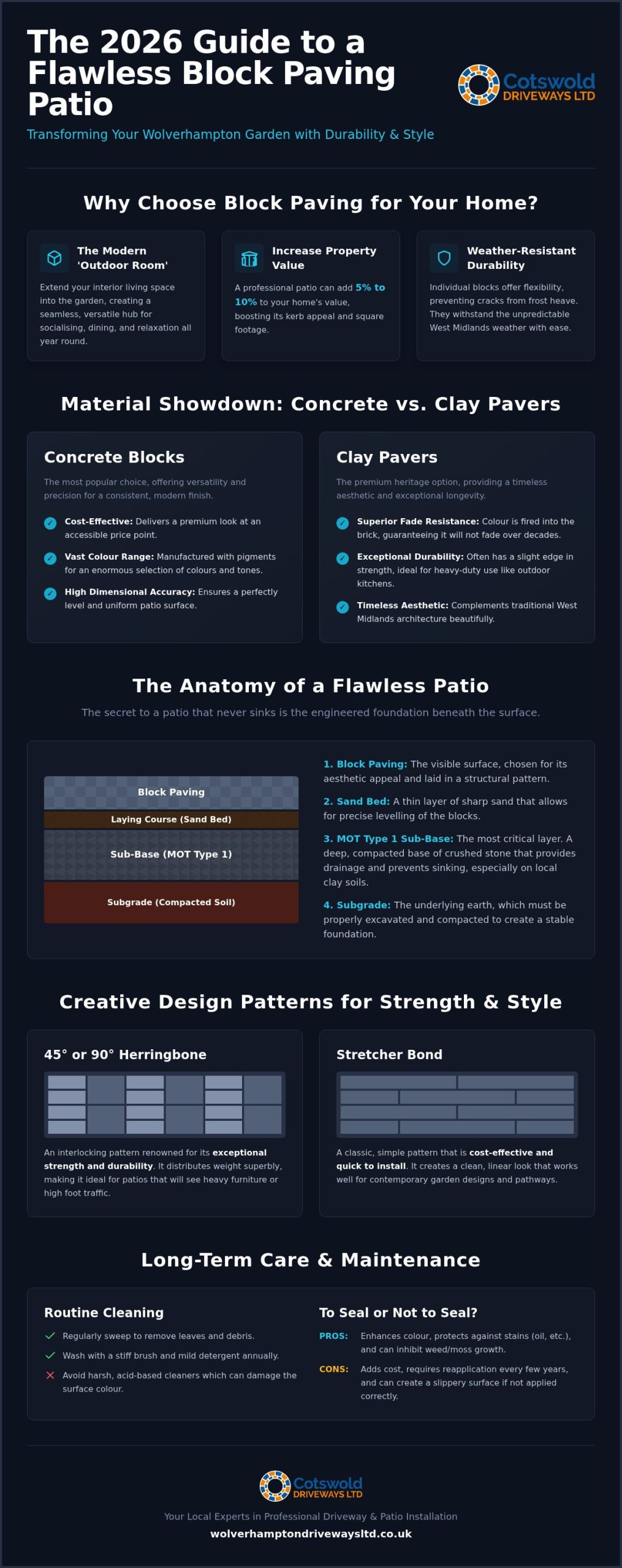
The secret to the longevity of block paving lies in its flexibility. Individual blocks are designed to move slightly without breaking. This is vital during harsh winters when the ground can shift. Unlike solid concrete, which often cracks when the ground expands in a frost, interlocking concrete pavers distribute weight evenly across the entire surface. This prevents structural failure and keeps your patio level. If a block becomes stained or chipped, you can simply replace that single piece. You don’t have to rip up the whole garden, making it a favourite amongst local residents who value practical, long-term solutions.
Property Value and Curb Appeal
A professionally designed patio has a massive impact on house valuations. It can add between 5% and 10% to your home’s total value, depending on the scale of the project. By creating a seamless transition between your home interior and the garden, you effectively increase your usable square footage. To ensure your project meets these high standards, it’s wise to work with Expert Block Paving Installers in Wolverhampton. A master-craftsman will ensure the levels are perfect and the drainage is compliant, giving you total peace of mind and a stunning finish that lasts.
Selecting the Right Blocks: Materials, Colours, and Textures
Choosing the right materials is the most creative stage of planning your block paving patio in Wolverhampton. It’s the moment your garden starts to take on its own personality. You aren’t just picking a colour; you’re selecting a material that needs to withstand years of foot traffic, heavy garden furniture, and the local climate. With so many options available in 2026, understanding the functional differences between blocks will help you make a choice that looks great and lasts.
Concrete vs Clay: The Great Debate
Concrete blocks are the most popular choice for residential patios. They’re cost-effective and manufactured with high dimensional accuracy, which ensures a very consistent and level finish. Because they’re made from a mix of aggregates and pigments, you can find them in a massive range of colours. Clay pavers, on the other hand, are the premium heritage option. Their colour is fired into the brick, meaning they have natural fade-resistance that lasts for decades. Whilst clay is often more expensive, it provides a timeless aesthetic that many homeowners find irresistible. Both materials are incredibly strong, but clay often has a slight edge in durability if you’re planning a heavy-duty BBQ station or outdoor kitchen area.
Matching Your Wolverhampton Architecture
Your patio should feel like a natural extension of your home’s architecture. In Wolverhampton, we have a diverse mix of housing styles, from traditional Victorian terraces to sleek 21st-century developments. If you’re unsure which direction to take, you can always request a free quote to see samples against your own brickwork. Consider these common local pairings:
- Modern Builds: Charcoal, silver, and deep grey tones create a sharp, minimalist look that suits contemporary properties.
- Traditional Homes: Brindle, burnt ochre, and classic red hues complement the warm brickwork of Victorian and Edwardian houses.
- Zoning: Use a contrasting “soldier course” border in a darker shade to organise different garden zones, such as a dining area versus a path.
Texture also plays a huge role in the final feel. Smooth blocks offer a clean, sophisticated finish, whilst “rumbled” or tumbled blocks have distressed edges for a rustic, cottage-style charm. For those who want a more organic look, Tegular paving is a fantastic choice. It uses blocks of three different sizes to create a random pattern that mimics natural stone whilst retaining the structural benefits of a block paving patio in Wolverhampton. This multi-sized approach breaks up the monotony of standard grids and creates a more bespoke, high-end appearance for your outdoor space.
Creative Design Patterns for a Bespoke Patio
Selecting the right pattern for your block paving patio in Wolverhampton is the blueprint of its character. It’s the stage where technical engineering meets personal style. Whilst many homeowners focus on the colour of the bricks, the way those bricks are laid determines both the structural integrity and the visual flow of your garden. In 2026, we’re seeing a move towards patterns that don’t just look pretty but actively solve spatial challenges in smaller urban gardens.
The Strength of the Herringbone
The Herringbone pattern is the undisputed heavyweight of the paving world. It involves laying blocks at either a 45-degree or 90-degree angle to create a continuous, interlocking surface. This layout is incredibly popular because it prevents “block creep”. This is the term we use when individual pavers start to shift or spread over time due to weight. Because the blocks are locked together, the weight is distributed across the entire patio surface.
It’s an ideal choice for multi-use patios that need to support heavy planters, large BBQ stations, or even a hot tub. Beyond the strength, a 45-degree Herringbone pattern is a clever visual trick for narrow Wolverhampton gardens. The diagonal lines draw the eye outwards to the boundaries, making a compact space feel significantly wider and more open. It’s a professional’s favourite for a reason.
Modern and Minimalist Layouts
If you prefer a cleaner, more contemporary aesthetic, the Stretcher Bond or “Offset” pattern is a fantastic alternative. This mimics traditional indoor flooring or classic brickwork, with blocks laid end-to-end in straight rows. It creates long, clean lines that lead the eye towards a specific focal point, such as a summer house or a specimen tree. For more ideas on how to use these layouts effectively, you can explore our guide on Garden Patio Design Wolverhampton.
For smaller patios, using large-format blocks in a Stretcher Bond layout can make the area feel less cluttered. Fewer joint lines mean a smoother, more architectural finish. We also frequently integrate circular features or focal points into these designs. A circular kit in a contrasting colour can break up the geometry of a square garden, creating a dedicated “zone” for a fire pit or a bistro set. This adds a level of bespoke craftsmanship that truly sets your home apart from the neighbours. Whether you choose the intricate Basket Weave for a decorative path or a bold modern grid, the pattern is what turns a simple surface into a designed space.
The Installation Process: Why the Sub-Base Matters Most
The beauty of a block paving patio in Wolverhampton is only as good as the ground it sits on. Whilst most homeowners are understandably excited about picking their favourite colours and patterns, the real success of the project is decided before the first brick is even laid. A professional installation is a methodical process that prioritises structural integrity over speed. It starts with excavation, where we typically remove between 200mm and 250mm of topsoil. This ensures we reach stable, undisturbed ground that can support the weight of the new surface without shifting.
Once excavated, we install a sub-base of MOT Type 1 crushed stone. This is the gold standard for West Midlands soils. We then install heavy-duty edge restraints to prevent the patio from spreading or “creeping” over time. The final precision work involves screeding a layer of sharp sand to create a perfectly level bed for the blocks. After laying, we use kiln-dried sand for jointing. This fine sand locks the blocks together whilst allowing for the tiny natural movements caused by seasonal temperature changes.
Wolverhampton Soil and Drainage (SUDS)
Wolverhampton is known for its heavy clay soil, which can make drainage a challenge during the West Midlands’ wetter months. In 2026, managing rainfall is about more than just avoiding puddles; it’s a legal requirement. Under the updated British Standard BS 7533-103:2026, new hard surfaces must be permeable or drain into a permeable area within your property. We carefully calculate the “fall” of the patio, ensuring it slopes away from your home at a precise gradient. This is non-negotiable for damp prevention and protects your property’s foundation from water ingress.
The Secret to a Sinking-Free Patio
The number one reason for patio failure is poor compaction. We take a straight-talking approach to quality: if you don’t use a mechanical vibrating plate at every single layer, the patio will sink. We compact the sub-base and the sand bed multiple times to remove any air pockets. Cutting corners here leads to uneven blocks and standing water within a few seasons. If you want a garden surface that stays level for decades, it pays to invest in a team that understands the local geology. If you’re ready to start your project, you can contact us for a free site assessment and quote to discuss your requirements.
Maintaining Your Block Paving and Ensuring Long-Term Value
Investing in a block paving patio in Wolverhampton is a significant upgrade for your property. To keep that premium look, you need a simple but consistent maintenance routine. Most homeowners are surprised by how easy it is to preserve the surface if they follow a few basic rules. A clean patio doesn’t just look better; it prevents the build-up of organic matter that can lead to slippery surfaces and premature wear. Your patio is a structural asset, and a little care goes a long way in protecting your return on investment.
One of the biggest concerns we hear is about weed growth. It’s a common myth that weeds grow through the blocks from the soil below. If your patio has been installed with a proper MOT Type 1 sub-base as we discussed earlier, this is physically impossible. In reality, weed seeds land in the joints from the air and take root in the surface sand. Regular sweeping with a stiff brush is your first line of defence. It disturbs the seeds before they can establish themselves, keeping your joints clean and the blocks firmly locked together.
The Benefits of Professional Sealing
Whilst block paving is naturally durable, applying a high-quality sealant can offer an extra layer of protection. This is particularly useful in the West Midlands, where our damp climate often encourages algae and lichen growth. Sealing acts as a barrier against oil stains from BBQs and prevents UV rays from fading the vibrant colours of your blocks. In 2026, homeowners usually choose between a “natural look” finish, which preserves the original texture, or a “wet look” that deepens the colour and adds a slight sheen. For more detailed advice on restoring older surfaces, our guide on Driveway Cleaning and Repairs Stafford provides expert insights into professional-grade restoration techniques.
Simple Homeowner Care Tips
We always advise caution when it comes to power washing. It’s tempting to blast away dirt with a high-pressure jet, but this can easily wash out the essential kiln-dried jointing sand. If the sand is removed, the blocks lose their interlocking strength and may start to move. If you do use a pressure washer, keep the nozzle at a shallow angle and always be prepared to re-sand the joints once the surface is dry. It’s also wise to perform seasonal checks. After a harsh West Midlands winter, look for any signs of movement or areas where the jointing sand has settled. Addressing these small issues early prevents them from becoming costly repairs later on.
Professional restoration is always an option if your patio has been neglected for several years. A deep clean and professional re-sanding can often make a decade-old patio look brand new again. This approach is much more cost-effective than a full replacement and ensures your garden remains a stunning feature of your home. Ready for a transformation? Contact us for a free block paving quote today and let our experienced team help you design a space that stands the test of time.
Start Your Garden Transformation Today
Investing in a high-quality garden surface is more than just a home improvement; it’s a long-term commitment to your property’s value and your daily lifestyle. You’ve seen how the right choice of materials and patterns can create a bespoke look that perfectly matches your home’s character. More importantly, you now understand that the secret to a sinking-free surface lies in the professional engineering of the sub-base and drainage. By following the 2026 standards, you ensure your block paving patio wolverhampton remains level, beautiful, and fully compliant for years to come.
Don’t settle for a generic garden surface when you can have a master-crafted patio designed for our local climate. As fully insured and licensed local specialists, we take pride in delivering a straight-talking service that prioritises structural integrity and customer satisfaction. We’re here to help you navigate the process from initial design to final jointing with total peace of mind. To take the first step towards your stunning new outdoor room, Get Your Free Block Paving Patio Quote in Wolverhampton today. We provide free, no-obligation professional quotes for homeowners across the region. Let’s build something that lasts.
Frequently Asked Questions
Do I need planning permission for a block paving patio in Wolverhampton?
In most cases, you don’t need planning permission for a back garden patio in Wolverhampton as it falls under permitted development. This assumes the surface isn’t raised more than 300mm above ground level. However, if you’re paving a front garden over five square metres, national regulations require the surface to be permeable or have drainage to a permeable area. Our team ensures every installation meets these 2026 SUDS requirements to keep your project fully compliant.
How long does a block paving patio installation typically take?
A standard block paving patio wolverhampton installation typically takes between three to five working days to complete. This timeline includes the essential excavation, sub-base preparation, and final jointing. Larger or more complex designs with circular features may take slightly longer. We always provide a clear schedule during your free consultation so you know exactly what to expect. Factors like West Midlands weather can occasionally influence the pace, but we prioritise a thorough, high-quality finish.
Can block paving be laid over an existing concrete patio?
We strongly advise against laying block paving directly over an existing concrete patio. Doing so often creates issues with threshold heights and poor drainage, which can lead to damp problems in your home. It also prevents us from installing a proper MOT Type 1 sub-base, which is vital for long-term stability on local clay soils. For a result that won’t sink or crack, we always recommend a full excavation and a professional, multi-layered foundation.
How do you prevent weeds from growing between the paving blocks?
The best way to prevent weeds is through a solid installation and regular maintenance. A professional sub-base prevents plants from growing up through the ground, whilst kiln-dried sand in the joints blocks seeds from taking root. We recommend regular sweeping with a stiff brush to disturb any new seeds that land on the surface. For added protection, you can opt for a professional sealant that hardens the jointing sand and creates a hostile environment for weeds.
What is the best way to clean my block paving patio without damaging it?
For routine care, a simple mix of soapy water and a stiff broom is the safest and most effective method. Whilst pressure washers are popular, they can easily dislodge the jointing sand if used at high pressure or the wrong angle. If you do use one, always keep the nozzle at a forty-five-degree angle and be prepared to re-sand the joints once dry. For deep stains, our team offers professional cleaning and repair services across Dudley and Telford.
Is block paving more expensive than using porcelain or Indian stone?
Block paving is generally more cost-effective than porcelain or high-end Indian stone. Whilst porcelain offers a sleek look, the installation process is often more labour-intensive and requires specialist adhesives. Block paving provides a durable, premium aesthetic at a more accessible price point for many Wolverhampton homeowners. It also offers the unique benefit of being easy to repair; you can replace individual blocks if they become damaged, which isn’t possible with large porcelain slabs.
How much weight can a block paving patio support?
When installed with a professional MOT Type 1 sub-base, a block paving patio wolverhampton can easily support heavy garden furniture, large planters, and even hot tubs. The interlocking nature of the blocks distributes weight across the entire surface, preventing individual pavers from sinking. This structural strength is why we emphasise the importance of mechanical compaction during the installation phase. If you’re planning on placing exceptionally heavy structures, we can adjust the sub-base depth to suit.
What happens if a single block gets stained or damaged?
One of the greatest advantages of block paving is that individual units are easy to replace. If a block becomes permanently stained by oil or physically chipped, it can be lifted out without disturbing the rest of the patio. We simply remove the damaged piece, level the sand bed, and install a matching replacement before re-jointing with kiln-dried sand. This flexibility makes it a far more practical long-term choice than monolithic surfaces like concrete or tarmac.