
Fresh pointing can make a loose paving slab look fixed, but it won’t solve movement caused by a failed bed or shifting ground. A lasting repair starts below the surface. This guide to fixing loose paving slabs Wolverhampton homeowners can use explains how to identify the likely cause before choosing a repair.
A wobbly or uneven slab is more than an eyesore. It can catch a foot and make a patio or path less safe to use. The movement alone doesn’t show whether the bedding, joints or ground has failed, so a cosmetic patch may soon come loose again.
You’ll learn when a slab may need lifting and resetting, when repointing could be suitable, and when a cracked or badly damaged slab may need replacing. We’ll also cover signs that the issue affects a wider area and may call for professional paving repair. Wolverhampton Driveways Ltd carries out paving and driveway repairs across Wolverhampton and the wider West Midlands. A free quote gives you a way to discuss the affected area and the work involved.
Key Takeaways
- Rocking slabs, uneven edges and widening joints can point to different causes. Inspect the surrounding paving before settling on a repair.
- Compare the slab’s level with nearby paving and look for movement across adjoining joints to judge whether the problem appears isolated.
- Repointing, resetting and replacing each address different problems. The condition of the support beneath the slab matters too.
- For fixing loose paving slabs Wolverhampton homeowners should prioritise safe handling and avoid lifting heavy slabs without suitable equipment and help.
- A professional assessment can consider the slab, joints, drainage and support beneath the paving, helping shape a repair that addresses the cause rather than masking it.
Why do paving slabs come loose in Wolverhampton?
A slab that rocks underfoot, sits lower than its neighbours or has a widening gap around its edge is a reason to look closer. Movement may come from weakened bedding, a change in the supporting ground, water entering through joints or jointing wearing away. Wolverhampton’s rain and winter frosts can add seasonal stress, but the cause varies from one property to another.
A loose paving slab has shifted or no longer sits firmly on its support, creating an uneven surface that can make walking across it less safe. The visible gap is a clue, not a diagnosis. A joint may have deteriorated because the slab is moving, rather than being the original cause. Adding fresh pointing without checking what lies beneath can disguise the symptom while leaving the movement unresolved.
Paving slabs can be made from concrete or natural stone. As this overview of paving stone explains, paving is laid over a prepared supporting base. If that support weakens or shifts, the slab above may rock, sink or tilt.
What are the common causes of loose paving slabs?
Disturbed or weakened bedding can leave a slab without even support, causing it to rock or settle. Water entering through open or worn joints may affect the bedding or ground, but it isn’t the explanation in every case. Look for worn joints, movement at the edges and signs of repeated loading over the same spot. These clues help you describe the problem, but inspection is needed to identify the cause.
Which warning signs should Wolverhampton homeowners look for?
Walk the paved area carefully and compare each slab with those around it. Note any rocking, uneven levels, open joints or water pooling after rain. Check whether movement affects one slab or continues across a wider area. If a slab becomes loose again after its joint has been repaired, the problem may lie beneath it rather than in the joint alone.
Make a note of where movement appears and whether it changes after wet or frosty weather. This record can help distinguish an isolated issue from a wider pattern, and gives you a clearer starting point before choosing a repair. For fixing loose paving slabs Wolverhampton homeowners should first work out what has moved and why, rather than treating every gap as a pointing problem.
How to assess loose paving slabs before choosing a Wolverhampton repair
Before deciding whether a slab needs repointing, resetting or replacing, inspect the whole paved area. You can gather useful clues without lifting anything. Look across the surface from a low angle, then compare the suspect slab with the paving around it. Note changes in level, gaps and any pattern of movement.
A single slab moving on its own is more likely to be a localised issue; movement across several adjoining slabs may point to a wider problem with their shared support or the ground beneath. This is not a diagnosis, but it can help you describe the problem clearly and avoid planning a repair based only on the most obvious gap.
How can you tell whether one slab or several need attention?
Check whether nearby slabs rock or sit at different heights. Look for open joints that continue along a line rather than stopping at one slab. Make a note of the affected area or take photographs from the same position, so you can compare the pattern over time. If several slabs move together, the repair may need to address a broader section of bedding or ground, not just one unit.
What should you check around joints, drainage, and edges?
Look for missing or crumbling jointing and check whether rainwater collects beside or on the paving. Pooling can show where water is not draining away as expected, though it doesn’t prove what caused the movement. Inspect the paved edge too: a shifted or apparently unsupported boundary can affect the slabs beside it. Avoid lifting slabs at this stage; record what you can see first.
If the surface is block paving rather than individual slabs, remember that its units work together as an interlocking surface, so movement may need a different assessment. Read the Wolverhampton block paving installation guide for more on how that paving type differs.
Keep your notes practical: mark which slabs move, where joints are open and where water gathers after rain. This gives you a clearer basis for choosing the next step in fixing loose paving slabs Wolverhampton homeowners may face, especially if the issue extends beyond one spot. If the pattern is unclear or covers a wider area, a professional paving assessment can help establish the repair scope. You can request a free quote for paving repairs to discuss the work involved.
Reset, repoint, or replace: comparing loose paving slab repairs
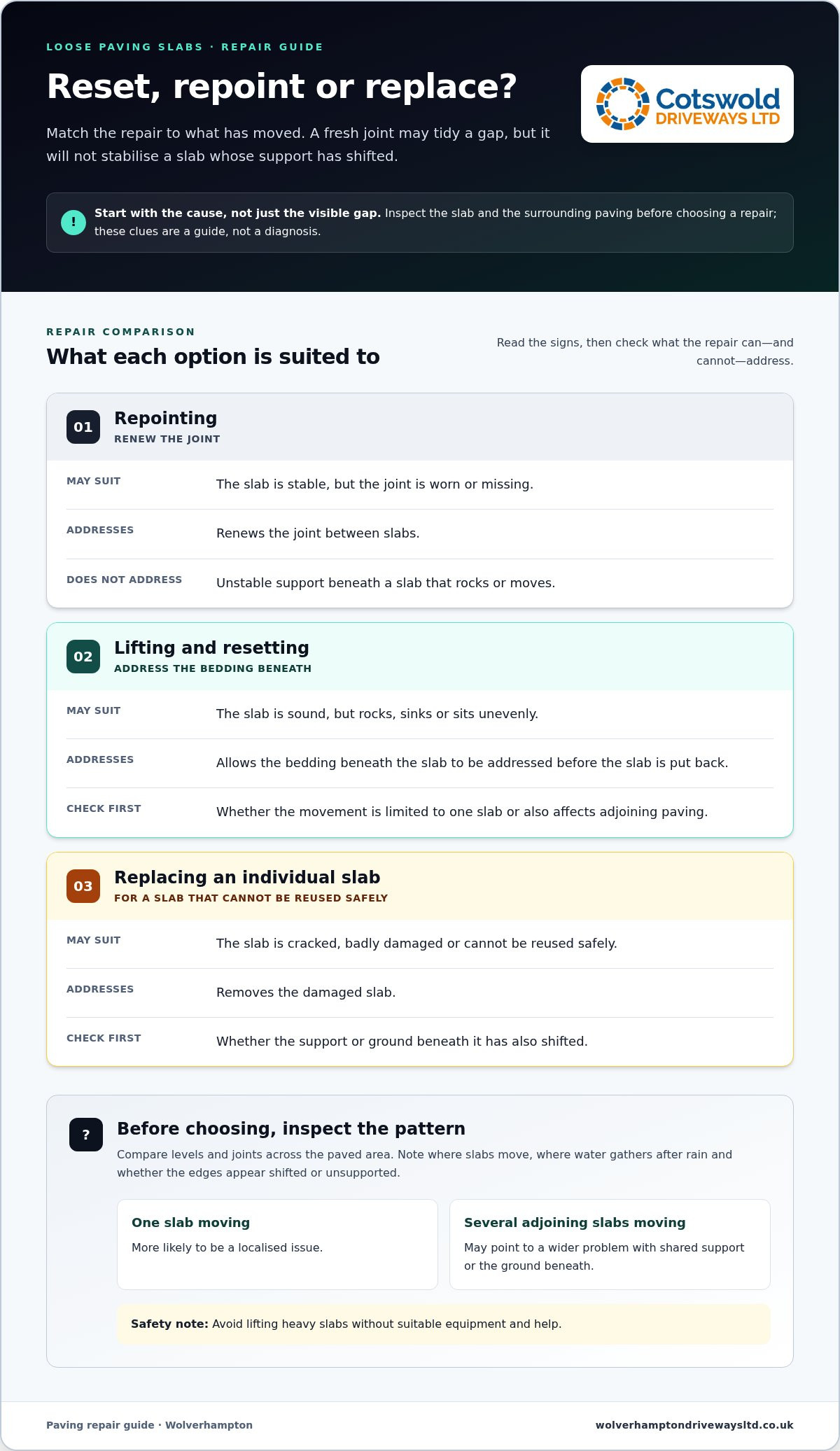
The right repair depends on what is moving and why. Fresh jointing may tidy a gap, but it won’t stabilise a slab that rocks because its support has shifted. Use the comparison below as a guide, not a diagnosis. The slab and surrounding area need to be inspected before settling on a method.
| Repair | May suit these signs | What it addresses |
|---|---|---|
| Repointing | The slab is stable and the joint is worn or missing. | Renews the joint between slabs, but doesn’t correct unstable support. |
| Lifting and resetting | The slab is sound but rocks, sinks or sits unevenly. | Allows the bedding beneath it to be addressed before the slab is put back. |
| Replacing an individual slab | The slab is cracked, badly damaged or can’t be reused safely. | Removes the damaged unit; the supporting area still needs attention. |
When might repointing be enough?
Repointing may be suitable when a slab feels firm and level, but its jointing has worn away or crumbled. It can restore the joint’s appearance and close the gap. If the slab rocks, fresh jointing alone won’t correct movement beneath it. The new joint may be disturbed as the slab continues to shift, so inspect the slab and its support before choosing this repair.
When is resetting or replacing a slab more appropriate?
Resetting may be the better option when a slab is intact but no longer sits securely. Lifting it gives access to the bedding, which can be assessed and corrected before the slab is returned to position. If it’s cracked or unsafe to reuse, replacement may be more suitable. The choice can also depend on the patio’s slab materials and layout; see this garden patio design guide for more on those considerations.
A small visible problem doesn’t always mean a simple repair. One loose slab may still have an underlying support issue, so DIY repointing can be a false economy if it only covers the symptom. If you’re assessing the surface yourself, check whether the slab is stable and whether nearby paving has moved too. Don’t commit to a repair until you understand what it needs to address.
For fixing loose paving slabs Wolverhampton homeowners should match the method to the slab’s condition and its support, rather than choosing the quickest-looking fix. A careful assessment helps distinguish a joint that needs attention from a slab that needs resetting or replacing.
How to fix loose paving slabs safely: a practical repair sequence
A careful repair follows a clear order: assess the problem, prepare the area, address the support, reset or replace the slab, then check the finish. The exact work depends on the slab and what’s beneath it, so treat these as broad stages rather than a specification for every patio.
What are the main stages of resetting a paving slab?
- Assess. Check whether the slab is cracked, whether it can be reused and whether neighbouring slabs have moved. If the issue appears to affect a wider area, pause before treating it as an isolated repair.
- Prepare. Keep people away from the work area and gather suitable tools before starting. Don’t try to lift a heavy slab without appropriate equipment, help and safe handling knowledge. Slabs can be difficult to control, even when they look manageable.
- Remove and inspect. If it’s safe to proceed, lift the slab carefully and look over the support beneath it. Address the cause of the movement rather than simply filling the visible gap. Avoid guessing at materials or methods if the support is unclear.
- Reset or replace. Reuse the slab only if it remains sound. Set it back so it aligns with nearby paving and sits evenly; replace it if it’s damaged or can’t be reused safely. The right approach depends on the condition of the slab and its support.
- Check the finish. Once the work is complete, check that the slab is stable, level with its neighbours and properly aligned. Look over the joints and surrounding paving too. A slab that still rocks needs further attention, not another cosmetic patch.
When should you stop and choose professional repair?
Stop if several slabs are moving, the same slab has shifted repeatedly, the paving is damaged or you can’t tell whether the support is stable. Safe lifting and accurate levelling can be difficult without the right tools and experience. Don’t use a path or paved area if an unstable slab presents an immediate trip risk; keep others away until it can be made safe.
For fixing loose paving slabs Wolverhampton homeowners should avoid rushing into a repair before understanding what has moved. Wolverhampton Driveways Ltd carries out professional paving repairs that assess the slab and its supporting area, then address the cause rather than disguise the symptom. If you’d like to discuss the next step, request a free paving repair quote.
Professional loose paving slab repairs in Wolverhampton: what to expect
A professional assessment helps establish whether the problem is confined to one slab or involves a wider section of paving. Wolverhampton Driveways Ltd’s local paving and driveway repair experience helps homeowners understand the issue before choosing a repair. The aim is to address what’s causing movement, not simply cover up a visible gap.
What can a paving repair assessment cover?
The affected slab and nearby paving can be checked for rocking, uneven levels, damaged edges and worn joints. The assessment also considers visible drainage issues, such as water collecting around the paved area, and whether movement continues across adjoining slabs. These details help show whether the repair may be localised or whether a wider section needs attention.
The repair scope depends on what’s found. A sound slab with worn jointing may need a different approach from a cracked slab or one that has shifted because its support is unstable. The condition of the slab and supporting area guides the recommendation, so avoid assuming what work is required before the site has been assessed.
How can local homeowners take the next step?
When requesting a quote, describe which slabs are loose, whether the movement has returned and how much of the paved area appears affected. Mention water pooling or open joints too. Clear details make it easier to discuss the concern and the appropriate next step.
Wolverhampton Driveways Ltd serves Wolverhampton and the wider West Midlands, including Telford, Cannock and Dudley. The business is fully insured and licensed. A free quote offers a practical way to discuss the paving repair and its likely scope, without assuming every loose slab needs the same treatment.
If you’re concerned about a rocking slab, recurring movement or several uneven areas, arrange an assessment before the problem is patched over. For fixing loose paving slabs Wolverhampton homeowners can start by describing the symptoms and affected area, then discuss the repair options.
Get a free quote for paving repairs.
Restore a safer, more even paved surface
A lasting repair starts by finding out why the slab has moved. Check whether the problem is limited to one slab or affects nearby paving, then choose between repointing, resetting or replacing based on the slab’s condition and support. Fresh jointing alone won’t solve movement beneath a rocking slab.
For fixing loose paving slabs Wolverhampton homeowners can take a practical first step by noting which slabs move, where joints have opened and whether water collects nearby. If the cause is unclear, a professional assessment can shape the repair around the problem, rather than a quick fix that may need repeating.
Wolverhampton Driveways Ltd is a fully insured and licensed local specialist. Free quotes are available for paving and driveway work, giving you a straightforward way to discuss the repair and understand the next steps.
Request a free quote for paving repairs and take the next step towards a safer, more even outdoor space.
Frequently Asked Questions
Why do paving slabs become loose?
Paving slabs often become loose when their bedding or supporting ground shifts, weakens or no longer holds them evenly. Water entering through worn joints can contribute to movement, but it isn’t always the cause. Repeated loading, damaged joints or movement at the edge of a paved area may also be relevant. A slab that rocks, sinks or sits unevenly needs its support assessed before you choose a repair.
Can I fix a loose paving slab myself?
You may be able to tackle a small repair if the slab is manageable, safe to handle and the cause is clear. First check whether nearby slabs have moved and whether the slab is cracked. Don’t lift a heavy slab without suitable equipment, help and safe handling knowledge. If the support is uncertain, the paving is damaged or movement returns, professional repair can help address the cause rather than just the visible gap.
Do all the paving slabs need replacing if one is loose?
No, one loose slab doesn’t automatically mean the whole paved area needs replacing. If the problem is isolated and the slab is sound, it may be possible to reset it after addressing its support. A cracked slab may need replacement, whilst several moving slabs could indicate a wider issue. Inspecting the affected slab, adjoining paving and joints helps determine whether the repair can stay localised.
How much does it cost to fix loose paving slabs in Wolverhampton?
The cost depends on the work needed, so it isn’t possible to give a reliable figure without understanding the repair scope. Repointing a stable slab differs from lifting and resetting it, replacing a damaged slab or addressing movement across a wider area. Wolverhampton Driveways Ltd provides free quotes for paving and driveway work. Describe the affected area and visible symptoms to discuss the repair required.
Can rain make paving slabs loose?
Rain can contribute to movement if water gets through open joints and affects the bedding or ground beneath the slabs. Pooling may also be a clue that water isn’t draining away as expected. However, rain alone doesn’t explain every loose slab. Check whether movement appears alongside worn joints, uneven levels or several affected slabs. Recurring movement may indicate that the support needs attention, not just the jointing.
Who fixes loose paving slabs in Wolverhampton?
A local paving specialist can assess loose slabs and carry out repairs suited to the condition of the paving and its support. Wolverhampton Driveways Ltd provides paving and driveway repair work across Wolverhampton and the wider West Midlands, including Telford, Cannock and Dudley. The business is fully insured and licensed, and offers free quotes. When requesting one, describe which slabs have moved and whether the issue affects nearby paving.