
Most homeowners believe the surface layer determines a driveway’s life, but the real secret to a thirty-year lifespan is hidden six inches underground. You’re likely asking how long does a resin driveway last because you don’t want to see your hard-earned money crack after the first West Midlands frost. It’s a fair concern. Nobody wants to invest thousands only to find weeds poking through or the colour fading within a few seasons.
We understand the anxiety of choosing between resin bound and resin bonded systems, especially when UK weather is so unpredictable. You want a surface that stays beautiful for over 20 years without constant scrubbing or repairs. In this 2026 durability guide, we’ll share the honest truth about resin longevity and the critical installation factors that ensure your investment stands the test of time. We’ll look at the importance of UV-stable materials, why the sub-base is your best defence against sinking, and how simple maintenance can extend your driveway’s life well beyond two decades.
Key Takeaways
- Learn that a high-quality resin bound surface typically serves a household for 20 to 25 years, provided you choose a chemical bond over cheaper bonded alternatives.
- Discover why the “invisible” sub-base accounts for 70% of your driveway’s durability and how to spot the red flags of a poor installation.
- Understand the critical role of UV stability in preventing your surface from becoming brittle, ensuring you know exactly how long does a resin driveway last when exposed to the elements.
- Compare resin against tarmac and block paving whilst mastering the simple maintenance habits that prevent moss and algae growth.
- Gain peace of mind by understanding how West Midlands soil types, such as local clay, influence the specific drainage requirements of your new driveway.
Understanding Resin Driveway Life Expectancy
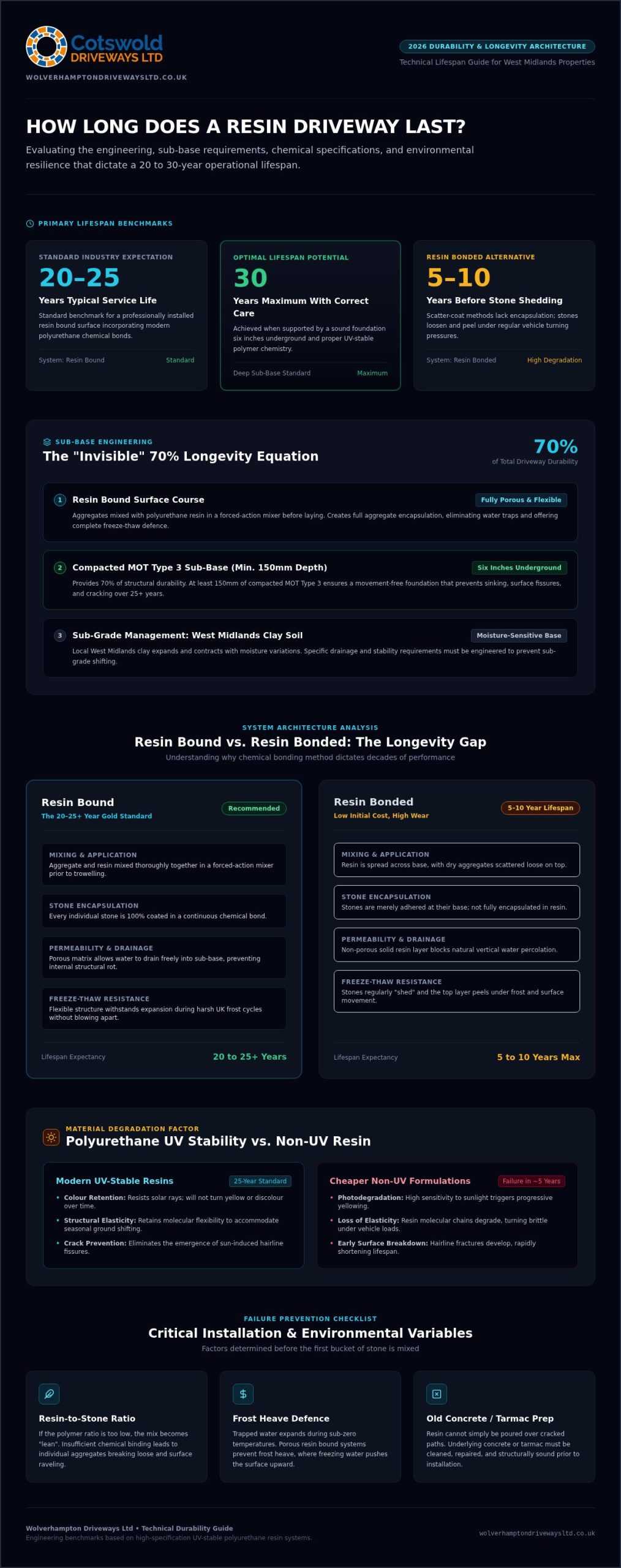
When you invest in your home, you want to know it’s money well spent. The industry standard for a professionally installed resin bound surface is usually between 20 and 25 years. Some systems can even reach 30 years with the right care. This longevity makes it a superior choice compared to many traditional materials, but achieving these numbers depends entirely on the specific system you choose. One of the biggest reasons homeowners ask how long does a resin driveway last is because they’ve heard conflicting reports about cracking or peeling in the local area.
A major factor in this lifespan is permeability. Unlike solid concrete or tarmac, a resin bound system allows water to drain naturally through the surface into the ground below. This prevents “internal structural rot,” which occurs when trapped water freezes and expands, eventually blowing the surface apart from the inside. According to Resin-bound paving standards, this porous nature is what keeps the driveway flexible and resistant to the typical UK freeze-thaw cycle that often destroys rigid pavements.
Resin Bound vs. Resin Bonded: The Longevity Gap
There’s a massive difference in how these two systems behave over time. Resin bound surfacing involves mixing the aggregate and the resin together in a forced-action mixer before laying it. This creates a thick, flexible, and porous layer that typically lasts 20 years or more. It’s the gold standard for durability because every stone is fully coated in a protective chemical bond.
In contrast, resin bonded systems involve spreading resin over a base and scattering loose stones on top. The stones aren’t fully encapsulated; they’re just stuck to the surface. These systems often start to “shed” stones and peel away within 5 to 10 years. We always advise homeowners to double-check their quotes. If a price seems too good to be true, it might be a bonded system that won’t last half as long as you expect.
Why 25 Years is the Modern Benchmark
Polyurethane resin technology has come a long way since the early 2000s. The resins we use today are far more advanced than the early iterations that were prone to becoming brittle under pressure. Modern UV-stable resins are specifically designed to resist the sun’s rays. Without this UV protection, the resin can turn yellow and lose its flexibility, leading to hairline cracks that shorten the driveway’s life.
By using these high-spec materials, a 25-year lifespan is now a realistic expectation rather than a best-case scenario. You can find more details on these material specifications in our Resin Bound Driveways West Midlands guide. Understanding these technical shifts helps you see why how long does a resin driveway last depends so heavily on choosing current chemical standards rather than outdated methods.
Key Factors That Determine How Long Your Resin Driveway Will Last
Achieving a two-decade lifespan isn’t just down to the resin itself. It’s a combination of chemical quality, precise ratios, and environmental management. Many people ask how long does a resin driveway last without realising that the answer is often determined before the first bucket of stone is even mixed. If the resin-to-stone ratio is too low, the surface becomes “lean” and stones will eventually break loose. Conversely, poor drainage can lead to frost heave, where trapped water freezes and pushes the surface upwards, causing irreparable damage during a harsh UK winter.
The Critical Role of the Sub-Base
We often tell our clients that the sub-base is 70% of the longevity equation. You can have the highest quality resin in the world, but if you lay it on a shifting foundation, it will fail. In the West Midlands, we often deal with heavy clay soil which expands and contracts with moisture. A movement-free base is essential to prevent surface fissures from appearing over time.
Laying resin over old tarmac or concrete requires specific preparation. You can’t just pour resin on top of a cracked old path and expect it to stay perfect. We ensure the base is cleaned, repaired, and structurally sound before application. For a standard residential driveway, a sub-base depth of at least 150mm of compacted MOT Type 3 is typically required to ensure the surface remains stable for 25 years or more.
UV-Stable vs. Non-UV Resins
The choice of resin is the difference between a driveway that looks new for decades and one that fails in five years. Cheaper, non-UV resins are highly sensitive to sunlight. Over time, the sun’s energy breaks down the chemical bonds, causing the surface to become yellow and incredibly brittle. This leads to a “shattering” effect where the driveway develops spider-web cracks under the weight of a vehicle.
UV-stable resins stay flexible. This flexibility allows the driveway to expand and contract slightly with temperature changes without snapping. According to FeRFA, The Resin Flooring Association, using the correct grade of polyurethane is vital for outdoor durability. UV-stability is the primary defence against colour fading and structural failure. If you want to ensure your home’s kerb appeal remains intact, our experts at Wolverhampton Driveways Ltd always recommend using high-grade, UV-protected materials for every installation.
Maintenance Habits to Extend Your Driveway’s Lifespan
A common misconception when asking how long does a resin driveway last is the idea that it requires zero effort once installed. Whilst it’s true that resin is a low-maintenance solution, it isn’t “no-maintenance.” Neglect can allow organic matter to build up, which eventually compromises the very permeability that makes the surface so durable. If you want your driveway to remain pristine for its full 25-year potential, a few simple habits make all the difference.
The biggest threat to longevity is moss and algae. If left to grow, moss roots can penetrate the resin matrix, slowly prising the aggregate apart. We recommend regular sweeping to remove soil and seeds before they take root. When cleaning, a jet wash is highly effective, but you must use the correct pressure. A fan-tip nozzle held at least 20cm from the surface prevents the high-pressure water from dislodging the stones. This keeps the pores open and ensures rainwater continues to flow through rather than pooling on top.
Stains are another concern for homeowners. Oil spills should be soaked up immediately with a paper towel and cleaned with a mild detergent. Tyre marks, often caused by “dry steering” (turning wheels whilst the car is stationary), can be scrubbed away with soapy water. Addressing these minor issues early prevents permanent discolouration and keeps the resin bond strong.
Seasonal Care Checklist
Adapting your routine to the UK weather ensures your surface stays resilient throughout the year. Follow this simple schedule to protect your investment:
- Autumn: Clear fallen leaves promptly. If left to rot, they release tannins that can stain the resin and provide a damp breeding ground for moss.
- Winter: Use standard rock salt for de-icing, but avoid harsh chemical alternatives that might react with the polyurethane. Simply wash away the salt residue once the frost clears.
- Spring: Give the area a light power wash. This clears away winter silt and grit that may have settled into the permeable pores, restoring full drainage functionality.
Professional Maintenance: When to Call the Experts
Sometimes, a standard garden hose isn’t enough. If your driveway has suffered from heavy staining or significant moss growth, professional driveway cleaning Stafford services can restore the surface to its original glory using industrial-grade equipment. Experts can also identify minor “patch repairs” before they escalate into larger fissures.
Proper care is the deciding factor in whether you get 15 or 25 years of service, directly answering the question of how long does a resin driveway last in a practical, everyday sense. Catching a small chip or a thinning area early allows for a seamless repair that protects the structural integrity of the entire installation.
Resin vs. Tarmac and Block Paving: A Longevity Comparison
When you’re choosing a new surface, the upfront price is only half the story. To truly understand how long does a resin driveway last, you have to compare it against the alternatives you’re likely considering. While tarmac and block paving are popular choices across the West Midlands, they often fall short of the 25-year benchmark set by a high-quality resin bound system. The difference lies in how these materials handle the pressure of daily use and the shifting UK climate over two decades.
Tarmac typically offers a 12 to 15-year lifespan before it requires significant attention. It’s a functional material, but it has structural weaknesses that resin simply doesn’t share. Over a 20-year period, the total cost of ownership for resin is often lower because you aren’t paying for resurfacing or major crack repairs every decade. Resin is a “fit and forget” solution that stays looking new for much longer than its competitors.
Resin vs. Block Paving
Block paving is a beautiful, traditional choice, but it requires a lot of “elbow grease” to stay that way. The gaps between blocks are magnets for weeds and moss. Most homeowners find they need to re-sand and apply weed killer every two years to prevent the driveway from looking neglected. Over time, individual blocks can shift or “sink” under the weight of a heavy vehicle, creating trip hazards and puddles.
Resin bound surfaces are monolithic, meaning they are one single, unified layer. There are no cracks for weeds to take hold, and the surface stays perfectly level. Unlike blocks, resin distributes weight across its entire area, preventing the sinking issues common in older drives. If you’re weighing up your options, our guide to Block Paving Installers Wolverhampton provides a fair look at how these materials perform in local conditions.
Resin vs. Tarmac
Tarmac is often the cheapest initial investment, but it loses its kerb appeal quickly. It softens during hot summers and becomes brittle in the winter, leading to the inevitable cracks and potholes we see on many local roads. Resin bound stone keeps its vibrant colour for decades because it’s flexible enough to move with the temperature changes without snapping.
The maintenance-to-lifespan ratio for tarmac is much higher than resin. You’ll spend more time and money patching a tarmac drive than you will simply sweeping a resin one. For homeowners looking for long-term value, resin is the clear winner for durability. If you want to see how these comparisons apply to your specific property, you can request a free quote and durability assessment from our local team.
Choosing a Professional Installation in Wolverhampton for Maximum Durability
The final answer to how long does a resin driveway last often comes down to who you trust to install it. In Wolverhampton and Dudley, we aren’t just dealing with generic ground conditions. We frequently encounter heavy West Midlands clay. This specific soil type holds moisture longer than sandy alternatives, which can lead to significant ground movement if the drainage isn’t handled correctly. A professional who understands local geology will adjust the sub-base to compensate, ensuring your surface doesn’t shift when the ground settles or freezes.
You should also be aware of common red flags during the installation process. If a contractor offers to lay resin whilst it’s raining, you should stop them immediately. Moisture reacts with the polyurethane, causing it to foam and fail within a few months. Similarly, some installers try to save money by laying the resin too thin. A durable bound surface needs a minimum thickness of 18mm for residential driveways. Anything less is a shortcut that compromises the 25-year lifespan you’re paying for.
At Wolverhampton Driveways Ltd, we strictly follow SUDS (Sustainable Urban Drainage Systems) protocols. This isn’t just about following the law; it’s about ensuring your driveway handles the local rainfall patterns without flooding your garage or damaging your home’s foundations. By prioritising these technical standards, we ensure your investment remains a permanent fixture of your home.
Local Climate Resilience
We prepare every project for the specific damp and frost cycles seen across Wolverhampton and Telford. Our team uses high-quality, crushed aggregates that won’t pulverise under the weight of modern SUVs or heavy traffic loads. We’ve built our reputation on quality workmanship that stands up to the unpredictable West Midlands weather, year after year. Our commitment to the local community means we provide honest advice and long-term aftercare that national firms often overlook.
Your Next Steps to a Permanent Driveway
A lasting driveway starts with an honest assessment of what’s underneath your current surface. We provide a free, no-obligation site survey to check your sub-base integrity and drainage levels. Our quotes are transparent, detailed, and focused on long-term durability rather than the cheapest quick fix. We’ll explain exactly how long does a resin driveway last based on your specific property conditions.
Ready for a driveway that stays beautiful for decades? Get your free resin quote today and speak with a local expert who takes pride in a job well done.
Secure Your Home’s Kerb Appeal for Decades
Choosing a new surface is a significant investment for any homeowner. The final answer to how long does a resin driveway last depends on three core pillars: a rock-solid sub-base, the use of UV-stable resins, and a commitment to simple seasonal maintenance. When these elements align, you can expect a beautiful, permeable surface that serves your home for 25 years or more. By avoiding the pitfalls of non-UV materials and poor drainage preparation, you ensure your driveway remains a durable asset rather than a recurring expense.
Our team of expert local installers serves Cannock, Dudley, and Stafford with pride. We provide fully insured and licensed services, specialising in SUDS-compliant surfacing that’s specifically engineered to withstand the unique West Midlands climate. We’re here to help you transform your property with a solution that’s as practical as it is stunning. Each project we undertake is built to last, giving you peace of mind that your investment is protected against the elements.
Take the first step towards a stress-free home improvement. Request Your Free Resin Driveway Quote in Wolverhampton today and let’s build something that lasts.
Frequently Asked Questions
Does a resin driveway crack easily?
A professionally installed resin bound surface is highly resistant to cracking because the material remains flexible enough to move with ground temperatures. Most fissures occur when the sub-base is insufficient, particularly in West Midlands areas with heavy clay soil. If the foundation is solid and movement-free, the resin layer itself acts as a unified, resilient mat. This flexibility is why many homeowners ask how long does a resin driveway last before seeing any structural wear.
Will the colour of my resin driveway fade in the sun?
Fading only occurs if an installer uses a cheaper, non-UV stable resin. We exclusively use UV-stable polyurethane, which is chemically engineered to resist the sun’s rays and maintain its original colour for decades. This prevents the yellowing or “ambering” effect that can ruin the look of lighter stone blends. Choosing the right chemical grade is the most effective way to protect your home’s kerb appeal against long-term sun exposure in the UK.
Is a resin driveway stronger than concrete?
While concrete is exceptionally hard, resin bound surfacing is often considered “stronger” in terms of durability because it isn’t brittle. Concrete driveways frequently crack during the UK freeze-thaw cycle because they cannot expand. Resin is flexible and porous, allowing it to withstand heavy vehicle loads without snapping. Its monolithic structure distributes weight more evenly than traditional poured concrete, making it a highly dependable choice for busy households in Wolverhampton and Telford.
Can you lay resin over an existing tarmac driveway to make it last longer?
You can lay resin over tarmac, but the existing surface must be structurally sound and free from major potholes. We thoroughly clean and prime the old tarmac to ensure a permanent bond. This method can be very effective, though we always survey the site first to ensure the old driveway won’t sink. If the base is stable, adding a resin layer provides a fresh, permeable finish that significantly extends the life of your property’s entrance.
How do I know if my resin driveway was installed correctly?
A correctly installed driveway should have a consistent depth of at least 18mm and a perfectly smooth, level finish with no loose stones. You should also check for “trowel marks” or uneven patches, which suggest a rushed job. A professional team like ours will always ensure the edges are neatly retained and that the surface is fully SUDS-compliant. If water pools on the surface instead of draining away, it’s a sign the installation hasn’t met industry standards.
Are resin driveways slippery in the winter?
Resin bound surfaces are not naturally slippery because the natural aggregate provides a textured, high-friction finish. During the installation process, we often broadcast a fine layer of crushed glass over the top to enhance grip, especially for steeper drives in Dudley or Cannock. Because the surface is permeable, rainwater drains through the stone rather than sitting on top, which significantly reduces the risk of dangerous ice sheets forming during a cold West Midlands winter.
What is the most durable colour for a resin driveway?
The durability of the surface depends more on the resin quality than the stone colour, but natural flint and quartz blends are excellent for longevity. Darker greys and multi-tonal buffs are popular because they hide tyre marks and organic debris better than very light, single-tone stones. Regardless of your choice, using a UV-stable binder ensures that how long does a resin driveway last isn’t cut short by the aggregate losing its bond or changing shade over time.
Can a resin driveway be repaired if it gets damaged?
Yes, resin surfaces can be repaired if they are chipped or cut, though the skill lies in making the patch blend seamlessly. Our team at Wolverhampton Driveways Ltd provides professional repair services to fix minor damage caused by heavy machinery or accidents. It’s best to address these issues quickly to prevent water from getting under the resin layer. A well-executed repair restores the structural integrity and keeps the driveway looking uniform for years to come.