
The cheapest quote you receive is almost certainly the one that will cost you the most down the line. When weighing up how much for a new tarmac drive Wolverhampton homeowners often expect a straightforward rate based purely on surface size. In reality, an enduring driveway relies on meticulous ground engineering, robust sub-bases, and proper preparation, rather than just rolling out a fresh layer of bitmac.
It’s completely natural to feel cautious. Between vague estimates, surprise excavation fees, and confusing SuDS drainage regulations, planning a major home improvement can quickly become stressful. You shouldn’t have to worry about rogue traders quoting low only to spring hidden charges once your front garden is dug up. This guide reveals every genuine factor that shapes an accurate, written quotation, giving you the clarity needed to budget with complete peace of mind.
Ahead, we explore essential foundation depths, Wolverhampton drainage rules, and the critical technical standards you should expect during a professional site survey.
Key Takeaways
- Discover why calculating how much for a new tarmac drive Wolverhampton properties require demands a thorough in-person site assessment rather than misleading online estimates.
- Learn how local soil conditions across Wolverhampton dictate essential excavation depths and sub-base preparation to prevent sinking or cracking.
- Understand the vital structural difference between a cosmetic cover-up and an enduring two-layer build featuring an engineered binder course and dense surface tarmac.
- Ensure full compliance with UK SuDS drainage legislation and council guidelines to handle surface water responsibly without costly planning complications.
- Recognise common rogue contractor warning signs to secure a transparent, fixed-price written quotation that protects your project budget from start to finish.
Understanding Tarmac Driveway Quotations in Wolverhampton
Online pricing calculators make driveway budgeting seem simple, but they rarely reflect reality on the ground. When working out how much for a new tarmac drive Wolverhampton homeowners often discover that a basic square-metre figure overlooks critical site variables. A genuine quotation relies on an in-person assessment rather than guesswork. Investing in a properly engineered tarmac surface also provides lasting value, easily outlasting loose gravel surfaces that demand regular raking and replenishment. For a broader overview of durable installations, explore our complete guide to expert tarmac driveways in Wolverhampton.
Why Fixed Square-Metre Estimates Mislead Homeowners
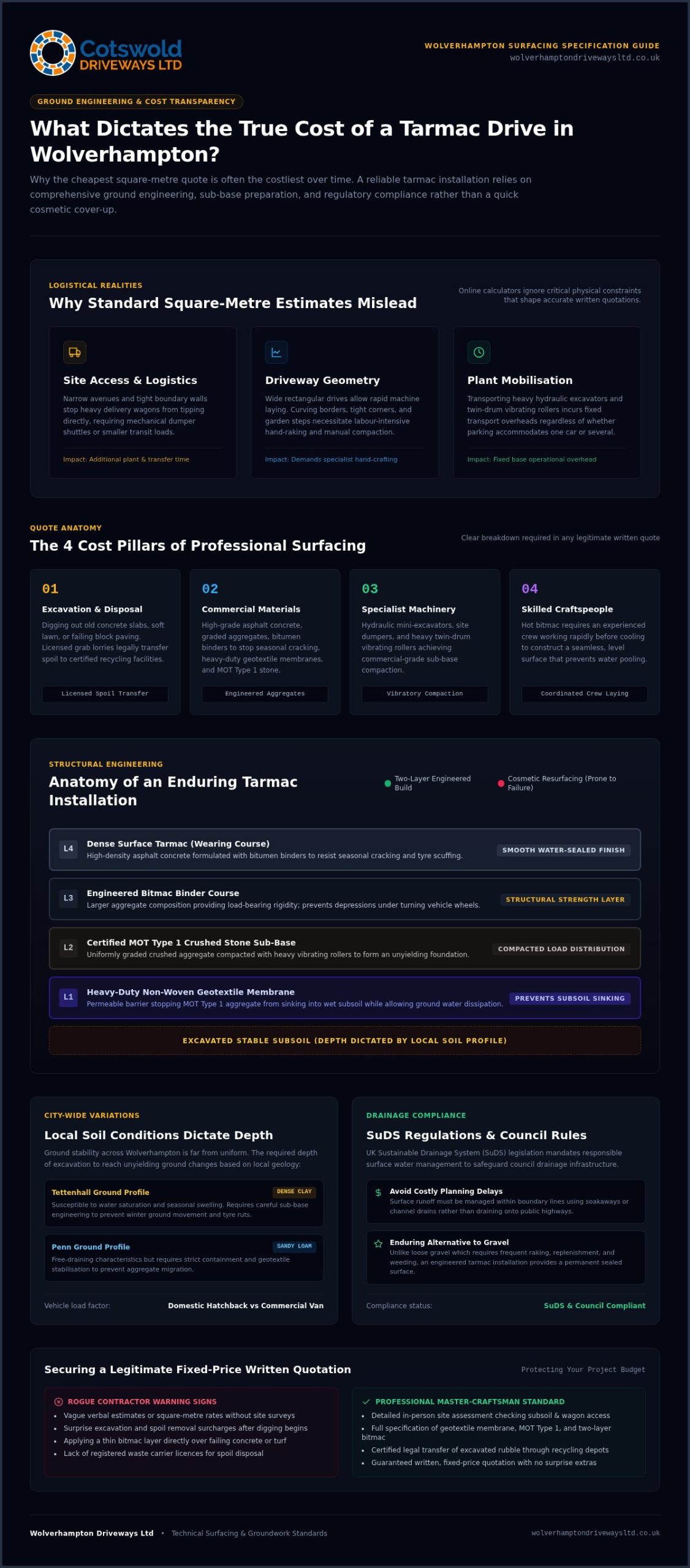
National directories love to quote simple rates per square metre, but no two residential plots across Wolverhampton share the same physical layout. Several practical factors immediately alter project logistics:
- Site access and wagon logistics: Narrow residential avenues or tight boundary walls can prevent heavy lorries from tipping directly onto the drive, requiring smaller transit loads or mechanical dumper shuttles.
- Driveway geometry: Wide, rectangular areas allow rapid mechanical laying. Curving borders, awkward corners, and steps require meticulous hand-raking and manual compaction, which increases specialist labour time.
- Plant mobilisation: Transporting heavy compaction rollers and excavators on-site involves fixed transport overheads, whether your drive holds one family hatchback or multiple vehicles.
The Essential Cost Components of Professional Surfacing
A transparent written quote separates the underlying build stages so you know exactly where your investment goes. A professional installation balances four primary elements:
- Excavation and certified disposal: Removing old concrete or saturated subsoil requires hydraulic diggers and registered waste carriers to legally transfer spoil to licensed facilities.
- Commercial-grade materials: Longevity depends on quality inputs, including non-woven geotextile membranes to stop aggregate sinking, crushed stone sub-bases, a dense binder course, and a protective wearing layer. Modern UK surfacing relies on high-grade asphalt concrete engineered with carefully graded aggregates and bitumen binders to resist seasonal cracking.
- Specialist plant machinery: Hydraulic excavators, power-driven dumpers, and heavy twin-drum vibrating rollers ensure the ground achieves commercial-grade compaction.
- Skilled local craftspeople: Laying hot bitmac demands an experienced, coordinated crew working quickly before the material cools. Casual labour cannot deliver the level, seamlessly sealed finish needed to prevent pooling.
Understanding these distinct elements clarifies how much for a new tarmac drive Wolverhampton properties truly require for lasting performance.
Key Groundwork Factors That Dictate Your Installation Investment
Surface tarmac is only as dependable as the ground beneath it. When calculating how much for a new tarmac drive Wolverhampton tradespeople must inspect what lies under your current parking area. Ground conditions vary across the city, from dense clay in Tettenhall to sandy loam around Penn, directly dictating how deep installers must dig to prevent future movement.
Existing Surface Removal and Excavation Depths
Digging out an old driveway is demanding physical work. Removing thick concrete slabs, failing blocks, or soft lawn turf requires mini-excavators and experienced operators. Standard domestic parking requires substantial excavation to reach stable subsoil, while properties accommodating heavier commercial vans demand even greater depth. Every tonne of excavated rubble must be cleared by licensed grab lorries and processed through registered recycling facilities to meet strict UK environmental legislation.
Sub-Base Quality and Geotextile Membrane Installation
Once excavated, the foundation takes shape. Cutting corners at this stage guarantees tyre ruts and depressions within months. A master-craftsman build relies on proven structural steps:
- Geotextile membranes: A heavy-duty, non-woven membrane separates the subsoil from the aggregate, stopping stone from sinking into soft ground over wet winters.
- Certified MOT Type 1 crushed stone: Premium aggregate creates an interlocking matrix capable of supporting vehicle weight without shifting.
- Vibratory compaction: Mechanical twin-drum vibrating rollers compact the stone in layers, eliminating voids and settling the base evenly.
Proper sub-base grading also safeguards natural fall lines, aligning with official government guidance on domestic ground management.
Comparing Resurfacing Overlays with Complete Excavations
Applying an overlay across an existing concrete base appears tempting, but it carries strict limitations. Resurfacing works only if the underlying concrete is structurally flawless, shows zero settlement, and sits comfortably below the damp proof course of your home. Any cracking in the original slab will inevitably mirror through the fresh bitmac. A complete dig-out remains the gold standard for long-term peace of mind. To evaluate whether your existing ground requires a full excavation or basic preparation, arrange a transparent site survey with Wolverhampton Driveways Ltd.
Tarmac Specifications, Decorative Edging, and Material Grades
Surface quality isn’t just about colour; it determines how well your front frontage handles heavy modern vehicles. When estimating how much for a new tarmac drive Wolverhampton homeowners need to consider the specific grades of bitumen and perimeter restraint required. A standard residential finish relies on a two-layer installation, combining an engineered base course that bears vehicle loads with a tight, close-graded wearing course on top.
Standard Bitumen Macadam vs Stone Mastic Asphalt (SMA)
Traditional dense bitumen macadam delivers a smooth, dependable surface suited to routine family use. However, modern Stone Mastic Asphalt (SMA) provides significant structural advantages for busy driveways. Formulated with polymer-modified binders and crushed stone skeletons, SMA delivers exceptional resistance against power-steering scuffs and hot summer softening. Selecting a distinctive red tarmac formulation introduces coloured pigments and clear binders, offering a striking alternative to classic deep black.
If you’re weighing up different textures and appearances across the region, you can compare these qualities against resin bound driveways in the West Midlands.
Decorative Block Paving Borders and Kerb Restraints
Edging provides vital structural support, not merely visual decoration. Without solid containment, the perimeter of any hot-laid surface will slowly crumble under vehicle tyre pressure. Key detailing elements include:
- Concrete-haunched kerbs: Sinking edge courses into wet concrete beds locks the tarmac in place, preventing lateral movement under load.
- Contrasting block borders: Incorporating charcoal or brindle paving sets frames the tarmac neatly, boosting visual kerb appeal while creating defined boundary lines. Homeowners often collaborate with expert block paving installers in Wolverhampton to design bespoke edge profiles.
- Integrated step details and recessed trays: Custom brick risers and inset inspection covers blend utilitarian utilities seamlessly into the surrounding surface.
Ensuring correct perimeter gradients also keeps your layout compliant with official government guidance on driveway planning permission, keeping surface run-off managed neatly within your property boundaries. Careful edging choices ultimately ensure that how much for a new tarmac drive Wolverhampton residents invest translates directly into lasting durability.
Drainage Regulations and Council Compliance in Wolverhampton
Water management isn’t an afterthought; it is a strict legal obligation. When assessing how much for a new tarmac drive Wolverhampton residents need to budget, drainage hardware and local council compliance represent essential considerations. Overlooking surface runoff risks water ingress, pavement pooling, and potential enforcement action from local authorities.
Meeting Sustainable Drainage Systems (SuDS) Standards
UK planning legislation mandates that any domestic driveway exceeding five square metres built with impermeable materials must incorporate Sustainable Drainage Systems (SuDS). Standard tarmac sheds water quickly rather than absorbing it. Allowing this water to spill freely onto the public highway or straight into municipal storm sewers is prohibited under national rules.
To keep the project compliant without submitting a full planning application, installers integrate self-contained drainage solutions within the boundary line:
- Linear channel drains: Discreet grated channels installed across the driveway entrance trap surface runoff before it reaches the public pavement.
- Underground soakaways: Gullies pipe runoff directly into buried attenuation crates or deep gravel pits located within garden borders for slow natural filtration.
- Cross-fall falls: Precision levelling ensures rainwater runs safely away from external house walls toward designated drainage points.
Wolverhampton City Council Dropped Kerb Requirements
Crossing the pavement to access private land requires an authorised vehicle crossing. Driving over a normal pedestrian kerb is illegal, as it damages underground utilities and footway surfaces. Homeowners must submit an application to the City of Wolverhampton Council Highways team before altering a kerb.
Under local authority rules, this specialised work must be completed by an accredited contractor holding substantial public liability insurance and streetworks licensing. Council approvals can take several weeks to process, so coordinating the kerb application alongside your surfacing timetable prevents unwanted delays. To ensure your layout satisfies every local regulation and avoids planning headaches, schedule your compliant site survey with Wolverhampton Driveways Ltd.
Choosing a Wolverhampton Contractor and Securing a Fixed Quote
A dependable contractor transforms a potentially stressful home improvement into a smooth, orderly project. When establishing how much for a new tarmac drive Wolverhampton homeowners should set aside, the integrity of your contractor matters just as much as the materials they supply. Securing a clear, itemised written agreement is the single best way to protect yourself against unexpected price hikes once work begins.
Red Flags and Tarmac Driveway Scams to Avoid
Unsolicited doorstep callers remain a persistent problem across the region. Knowing the warning signs protects your home and your wallet:
- “Leftover” tarmac claims: Cold-callers often claim they have spare asphalt from a council resurfacing scheme nearby. Hot bitmac must be laid at high temperatures to bind properly. Cold, discarded asphalt will crumble within months.
- Demands for large cash deposits: Reliable specialists do not ask for hefty upfront cash sums before excavators or materials arrive on your driveway.
- Verbal-only estimates: An informal price scribbled on a piece of paper provides zero legal protection and almost always leads to extra charges later.
What Must Be Included in a Professional Written Quotation
A legitimate surfacing firm provides complete transparency before a single shovel enters the ground. Your written quotation should function as an engineering specification, detailing every stage of the build:
- Groundwork depth: Exact excavation measurements and the guaranteed thickness of the compacted MOT Type 1 sub-base.
- Material specifications: Defined depths for both the structural binder course and the finished wearing layer, rather than a single generic tarmac depth.
- Drainage and edging: Itemised costs for SuDS-compliant channel drains, soakaway pits, and concrete-haunched kerb restraints.
- Waste and terms: Proof of Environment Agency waste carrier registration, fixed-price terms, staged payment milestones, and written workmanship guarantees.
Always verify local references, public liability insurance, and an authentic regional portfolio. When you want complete confidence in your ground preparation and a transparent, fixed-price agreement, arrange a thorough site survey with Wolverhampton Driveways Ltd.
Plan Your Wolverhampton Driveway Project with Complete Confidence
A durable, attractive driveway is built from the ground up. Meticulous excavation depths, heavily compacted sub-bases, and fully compliant SuDS drainage protect your investment long after the rollers depart. When evaluating how much for a new tarmac drive Wolverhampton residents quickly discover that genuine peace of mind comes from clear technical standards, not cut-corner guesswork.
Protecting your budget starts with choosing an honest, vetted specialist. As fully insured and licensed local master-craftsmen across the West Midlands, we take pride in delivering comprehensive written quotations with no hidden groundwork surprises. Backed by dozens of 5-star verified customer reviews throughout Wolverhampton and Dudley, we ensure your surfacing journey remains transparent, smooth, and stress-free from day one.
Ready to transform your home’s kerb appeal? Request your free, fixed-price driveway survey from Wolverhampton Driveways Ltd and start your project on solid, reliable foundations.
Frequently Asked Questions
How long does a professionally installed tarmac driveway usually last?
A professionally installed tarmac driveway typically lasts between 15 and 20 years. Longevity depends directly on sub-base preparation, proper compaction, and regular maintenance. Applying an occasional surface sealant and preventing oil spills from breaking down the bitumen binder will help you achieve maximum lifespan.
Can new tarmac be laid directly over my existing concrete driveway?
Yes, but only if the concrete is structurally sound and free from cracks or subsidence. If the original slab moves, those cracks will mirror through the new tarmac. An overlay must also sit at least 150mm below your home’s damp proof course to prevent moisture issues.
Do I need planning permission to install a tarmac driveway in Wolverhampton?
Planning permission is not required if your driveway directs surface water to a permeable area within your boundary. Traditional tarmac is impermeable. To stay compliant with UK SuDS legislation, you must install linear drainage channels or soakaways so rainwater cannot run onto public pavements.
What is the main difference between standard tarmac and asphalt?
Domestic tarmac, or bitmac, blends small aggregate stones with bitumen binder to create a smooth, durable finish. True asphalt contains a denser aggregate mix that provides higher resistance against heavy vehicle wear. Both terms are used interchangeably across the trade for domestic driveways.
How long must I wait before parking my car on new tarmac?
You can walk on fresh tarmac after 24 hours, but keep vehicles off for at least three full days. During warm summer months, bitmac takes longer to fully cure. Avoid turning power steering while stationary during the first few weeks to keep the surface pristine.
Why do two similar-sized driveways receive different installation quotes?
Site conditions dictate overall investment rather than square metres alone. When homeowners ask how much for a new tarmac drive Wolverhampton contractors must inspect excavation depths, boundary retaining edges, skip access, and required drainage. Irregular shapes requiring hand-laying also increase skilled labour hours compared to straightforward, open rectangles.
Will power steering cause scuff marks on a fresh tarmac surface?
Dry steering, which means turning vehicle wheels while parked stationary, can leave temporary scuff marks on new tarmac. Modern bitmac takes several weeks to harden completely in the sun. Drivers can protect fresh surfaces by turning wheels only while the vehicle is in motion.