
A small driveway isn’t just a smaller version of a large one; it’s a high-pressure zone that requires a completely different design strategy. You might feel that your front-of-house space is too cramped for anything stylish, or perhaps you’re worried that a bold pattern will make the area look even smaller. It’s a common concern for many homeowners. Choosing the right paving for small driveways is about more than just picking a colour you like. You need a surface that handles tight turning circles without shifting, while also making the most of every square inch available.
The good news is that with the right materials and a few clever layout tricks, you can turn a tight spot into a spacious, modern entrance that adds real value to your home. We’ll show you how to maximise your limited space using the best materials for 2026. We will look at durable options like resin bound and block paving that stand up to concentrated weight. You’ll also discover how to stay on the right side of the mandatory 2026 SuDS drainage regulations, ensuring your project is both beautiful and fully compliant with the latest standards.
Key Takeaways
- Understand why small driveways suffer from higher “point loading” and how to choose materials that withstand frequent turning in tight spaces.
- Discover how the “Diagonal Rule” and contrasting borders can trick the eye into seeing a more spacious and open front-of-house area.
- Learn about the 2026 SuDS regulations to ensure your new surface remains compliant and avoids the need for a planning application.
- Compare the benefits of resin bound, block paving, and tarmac to find the most durable and stylish paving for small driveways.
- See why professional installation is vital for achieving precise edges and a solid sub-base in irregular or compact plots.
The Unique Challenges of Paving for Small Driveways
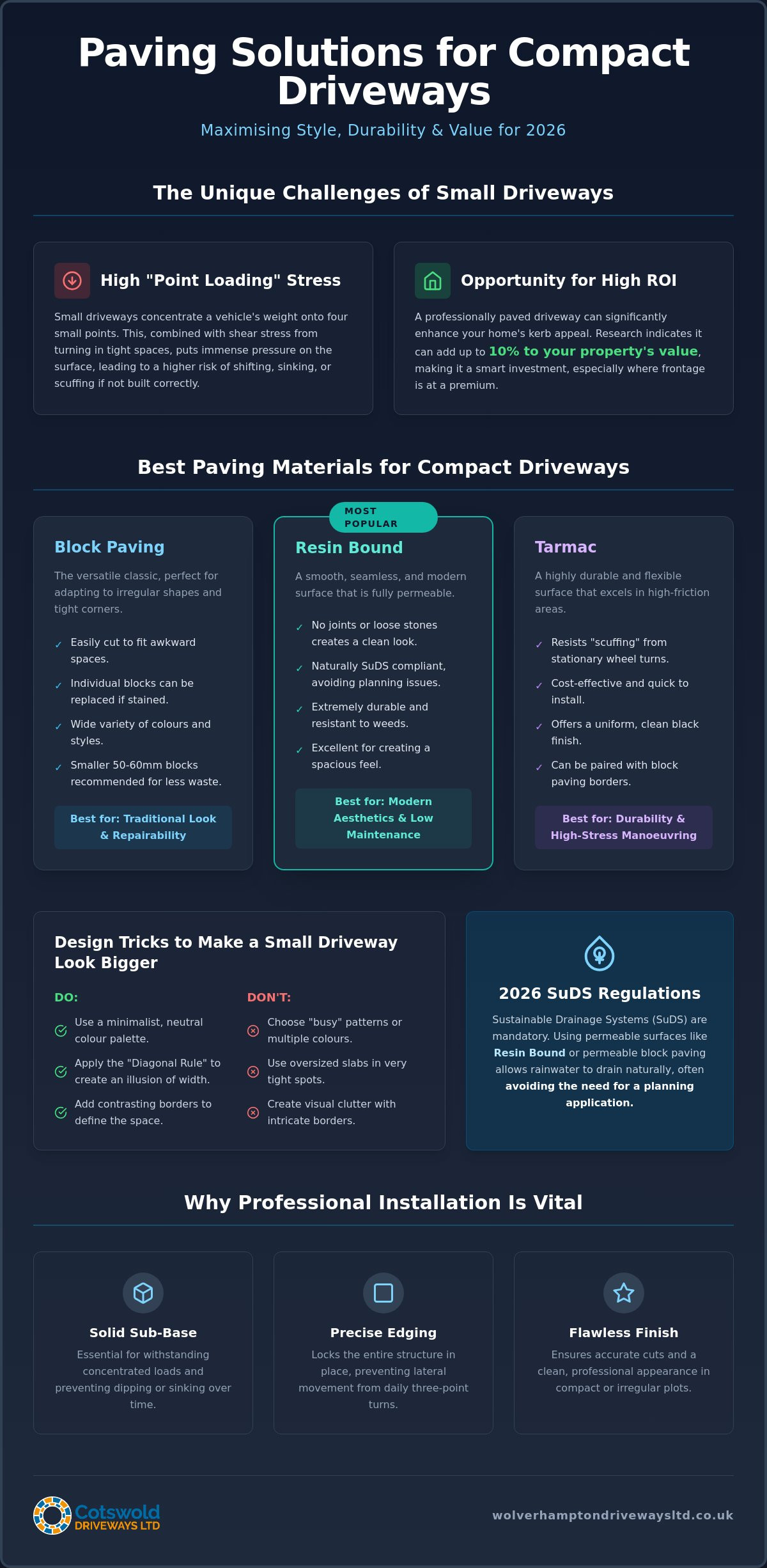
A small driveway isn’t just a smaller version of a large one. It’s a high-impact zone where every square inch is under constant pressure. Unlike a sprawling entrance where weight is distributed across a wide area, paving for small driveways faces intense “point loading.” Because you’re likely parking in the exact same spot every day, the weight of your vehicle is concentrated on four specific points. When you combine this with the shear stress caused by steering in a confined area, you have a surface that’s prone to shifting, sinking, or scuffing if it isn’t built correctly. Professional installation is vital here to ensure the sub-base can handle these repetitive stresses.
Investing in a quality finish is also a smart financial move for your home. Research from Rated People (July 2022) suggests that a new driveway can add up to 10% to your property’s value. For a terraced or semi-detached home, where space is at a premium, a tidy and professional front-of-house makes an immediate impression on potential buyers. It’s about making a small space work harder for you—and if you manage a tuition business or arts programme from home, you can explore Xperios for Music Services to ensure your administration is just as efficient. Ultimately, successful small driveway paving requires a precise balance between eye-catching aesthetics and the structural integrity needed to survive daily use.
Visual Clutter vs. Minimalist Design
One of the biggest mistakes homeowners make is choosing a pattern that’s too “busy” for the space. Complex designs with multiple colours or intricate borders can quickly make a compact frontage feel cluttered and claustrophobic. We often recommend a minimalist approach instead. Using a neutral colour palette helps the area feel airy and open, especially when coordinated with neighbouring properties. While traditional setts look charming, modern resin bound surfaces or simple block patterns often create a cleaner look. Avoid over-sized slabs in very tight spots. They’re tricky to cut into irregular corners, which often results in awkward, small pieces that look like an afterthought.
Structural Integrity in Tight Spaces
Because manoeuvring is limited, your wheels will likely turn while the car is stationary or moving slowly. This creates significant friction on the surface. Materials like Asphalt concrete, commonly known as tarmac, are popular because they offer a durable, flexible surface that resists this “scuffing” better than some loose aggregates. The secret to a long-lasting driveway lies beneath what you see. Sub-base preparation is critical in tight spaces where heavy loads are concentrated. Without a solid, well-compacted foundation, even the most expensive blocks will eventually dip. We always use professional edging to lock the entire structure in place. This prevents lateral movement, ensuring your driveway stays exactly where it was laid, even with the constant pressure of daily three-point turns.
Best Paving Materials for Compact Driveways
Choosing the right paving for small driveways is a balancing act. You need a surface that looks modern and spacious, yet it must be tough enough to handle the concentrated pressure of a vehicle in a limited area. In the West Midlands, our driveways face everything from heavy rain to winter frosts, so durability is non-negotiable. While smaller projects often have a slightly higher price-per-square-metre due to fixed costs like machinery transport and specialist labour, selecting the right material now saves money on repairs later.
The goal is to find a material that stays looking new even when subjected to high-traffic in the same few spots. It is also vital to consider government regulations for driveways regarding drainage. Choosing a permeable surface can often remove the need for a formal planning application, which is a major win for homeowners with limited time and budget.
Block Paving: The Versatile Classic
Block paving remains a favourite for smaller plots because of its sheer adaptability. We often recommend using smaller 50mm or 60mm blocks for these projects. They are much easier to “course” into irregular shapes and tight corners than larger slabs. This reduces the amount of waste and ensures a cleaner finish around the edges. A significant benefit for small, high-wear areas is the ability to replace individual blocks if they become stained or damaged. This keeps your entrance looking pristine without the cost of a full relay. If you want a traditional look that lasts, our block paving installers in Wolverhampton can help you design a layout that maximises your space.
Resin Bound: The Smooth, Modern Alternative
Resin bound surfaces offer a unique “seamless” advantage. Because there are no joints or grout lines, the eye isn’t interrupted by a grid pattern. This makes a compact area look like one continuous, larger surface. It’s an excellent choice for safety too. These systems provide high friction levels, which is particularly useful for narrow or sloped driveways common in Dudley and Wolverhampton. Because it’s naturally permeable, it handles heavy downpours without puddling. You can explore more about these durable, stylish finishes through our guide to resin bound driveways in the West Midlands.
Tarmac: Durable and Cost-Effective
Modern tarmac has come a long way. We now use Stone Mastic Asphalt (SMA), which is far superior to the old-fashioned tarmac of decades ago. It contains added fibres that make the surface more resistant to the scuffing caused by stationary steering. For a small driveway, the dark, uniform colour is incredibly practical. it hides tyre marks and oil drips much better than lighter stones. It provides a clean, professional backdrop that lets your home’s architecture stand out. For a reliable and budget-friendly finish, check out our options for tarmac driveways in Wolverhampton.
If you aren’t sure which material best suits your property, you can always request a free quote from our local team to see what’s possible for your specific space.
Design Tricks to Make a Small Driveway Look Bigger
You don’t need a massive plot to create an impressive entrance. When space is limited, the way you arrange your materials is just as important as the materials themselves. Clever design can “stretch” a compact frontage, making it feel far more open than the tape measure suggests. Successful paving for small driveways relies on visual expansion techniques that draw the eye toward the widest points of the property rather than focusing on the boundaries.
The “Diagonal Rule” is one of the most effective tools in our kit. By laying blocks or setts at a 45-degree angle to the house, you lead the eye toward the corners of the plot. This creates an illusion of depth that straight, parallel lines simply can’t match. To enhance this effect, we often use contrasting borders. A darker charcoal edge against a lighter main body defines the space clearly without “boxing it in.” Regarding colour, whilst dark tarmac is practical, lighter shades like silver greys or golden buffs reflect more light. This brightness makes the entire area feel less cramped, especially during the overcast months we often see in the West Midlands.
The Power of Patterns
Pattern choice directly impacts both looks and longevity. For block paving, a 45-degree herringbone pattern is the gold standard. It provides superior interlocking strength, which is essential for resisting the shifting forces caused by cars turning in tight circles. Stretcher bond patterns are simpler but can sometimes look too “busy” if the blocks are small. We generally advise against circular features in compact plots. These designs tend to truncate the corners visually, which actually makes the driveway look smaller. Instead, use linear patterns to “lengthen” a short drive by running the main lines toward the front door.
Lighting and Landscaping Integration
Small details make a big difference in tight spaces. Integrating “hidden” drainage, such as slim slot drains, keeps the surface looking clean and uncluttered. At night, you can add significant depth by installing recessed LED “puck” lights along the edges. These cast light across the surface, emphasizing the texture and making the boundaries feel further away. Every inch counts in a narrow drive, so consider your boundaries carefully. Switching from bulky brick walls to durable garden fences can save you several centimetres of width. Over the length of a driveway, that extra space makes getting in and out of your car much easier.
Planning Permission and Drainage (SUDS) for Small Plots
Navigating the legal side of paving for small driveways can feel like a minefield. You want a fresh, modern look, but you don’t want a letter from the council. In urban areas like Dudley, Cannock, and Wolverhampton, local authorities are increasingly strict about surface water runoff. This is because small, paved frontages contribute significantly to local flooding when water has nowhere to go but the street. Under the 2026 Sustainable Drainage Systems (SuDS) regulations, managing surface water on your own property is now a mandatory requirement for most new projects. These rules are part of a wider effort to reduce the pressure on our ageing Victorian sewer systems.
The good news is that you generally do not need planning permission for a new or replacement driveway of any size if the surface is permeable. This includes materials like gravel, permeable block paving, or porous resin bound systems. If you choose an impermeable surface, such as traditional tarmac, you won’t need permission as long as the area is less than five square metres or if the water is directed to a lawn or border to soak away naturally. However, for most small driveways that exceed this size, staying compliant means choosing the right materials or installing a professional soakaway system.
Permeable Paving Solutions
Permeable block paving is a brilliant solution for compact plots. These blocks are designed with slightly wider joints that are filled with grit rather than sand. This allows water to flow directly into the sub-base and back into the ground. It’s a highly effective way to eliminate the need for a planning application. Resin bound surfaces are also naturally SuDS compliant because they are porous by design. Whilst tarmac is a durable favourite, it’s usually impermeable. To make tarmac compliant, we have to install specialist drainage channels or use a porous asphalt mix. Keeping permeable joints clear of weeds and debris is a simple maintenance task that ensures your system stays functional for decades.
Working with Local Authorities
Converting a small front garden into a parking space almost always requires a dropped kerb. Even if your paving project falls under “permitted development,” you must get separate permission from your local council to lower the pavement for vehicle access. This is a common pitfall in West Midlands applications. Each council has its own specific criteria regarding the distance from junctions and the width of the opening. The application process involves a fee and often requires the work to be carried out by council-approved contractors. We handle the technical side of these requirements to ensure your project is fully legal. If you’re worried about the red tape, you can request a free consultation with our local team to discuss your specific plot.
Why Professional Installation Matters for Compact Spaces
It might be tempting to view a small driveway as a simple weekend project, but compact spaces are often the most technically demanding. Every mistake is magnified when the area is small. Precision is everything, particularly when it comes to “cutting in” blocks or setts around tight, irregular corners. A professional finish relies on seamless edges that don’t shift over time. Without the right specialist tools, DIY attempts often result in jagged lines or loose pieces that undermine the entire look. Successful paving for small driveways requires a level of craftsmanship that ensures every single block is perfectly seated and locked in place.
The most common reason for failure in paving for small driveways is poor sub-base compaction. In the West Midlands, we often deal with heavy clay soils that expand and contract with the changing weather. Professional teams use industrial-grade vibrating plates to ensure the foundation is rock-solid. A hand-tamped base simply won’t withstand the constant three-point turns required in a narrow space. Over time, poor compaction leads to the dreaded dipping and puddling that ruins your investment. We also organise our small-scale projects with maximum efficiency, ensuring we manage logistics tightly so your street remains clear and your neighbours aren’t inconvenienced. For projects with particularly tight access, you can learn more about Bewlake Lift & Haul Ltd and their specialist lifting solutions.
The Wolverhampton Driveways Ltd Difference
We take a straight-talking approach to every project, regardless of its size. We understand that a small driveway is a significant investment for your home, so we prioritise transparency in our costs and timelines. Our local teams are fully insured and licensed, providing the peace of mind that comes from hiring seasoned experts who value their community reputation. We’ve transformed countless compact frontages across Telford and Walsall, turning awkward, muddy patches into durable, modern entrances. Our experience with local soil types and drainage needs means we get the job done right the first time, avoiding the costly mistakes often seen in less experienced installations.
Next Steps for Your Small Driveway
Preparing for a site visit is straightforward. Think about how many vehicles you need to fit and whether you have specific concerns about drainage or turning space. During your initial consultation, ask your paving specialist about the depth of the sub-base they recommend and how they plan to handle the “cutting in” for your specific plot. A true professional will be happy to explain their process in plain English and provide a clear, no-obligation quote. If you’re ready to transform your home’s entrance into a spacious and modern asset, you can book your free small driveway consultation with Wolverhampton Driveways Ltd today.
Transform Your Home’s Entrance for 2026
Maximising a compact frontage is entirely possible when you combine the right design theory with durable materials. You’ve seen how the Diagonal Rule can visually expand a tight area and why modern SMA tarmac or resin bound systems are ideal for handling concentrated vehicle weight. Staying compliant with 2026 SuDS regulations doesn’t have to be a headache if you choose permeable options that allow water to drain naturally. These small changes not only make your daily life easier but can also add significant value to your property.
Choosing the right paving for small driveways requires a partner who understands the specific challenges of West Midlands soil and urban drainage needs. Our expert West Midlands installers are fully insured and licensed specialists who take pride in delivering precise, high-quality finishes. We are specialists in SUDS-compliant drainage, ensuring your project is built to last and meets all legal requirements. If you’re ready to turn your cramped driveway into a modern, spacious entrance, we’re here to help.
Get a Free Quote for Your Small Driveway Project
We look forward to helping you make the most of your space with a professional installation that stands the test of time.
Frequently Asked Questions
Do I need planning permission for a small driveway in the UK?
You usually don’t need planning permission for a small driveway if you use a permeable surface like gravel, permeable block paving, or resin bound systems. For impermeable materials like traditional tarmac, permission isn’t required if the area is less than five square metres or if the water drains into a permeable area on your property. These rules fall under permitted development rights, but it’s always wise to check with your local council before starting.
What is the cheapest paving for a small driveway?
Gravel is the most budget-friendly option for those looking at paving for small driveways, though it does require regular raking and weed maintenance. Tarmac is the next most cost-effective choice, providing a durable and smooth finish for a relatively low upfront cost. While some materials are cheaper initially, we often advise homeowners to consider long-term durability and maintenance needs to ensure the best overall value for their property.
How can I make my tiny driveway look more expensive?
You can elevate the look of a compact area by adding contrasting borders or integrated LED “puck” lighting along the edges. Using high-quality resin bound materials in a neutral colour palette creates a sleek, high-end finish that mimics expensive natural stone. Even small details, like using premium 60mm blocks in a herringbone pattern with a crisp, professional edge, can make a modest space look significantly more sophisticated and well-designed.
Is resin bound or block paving better for small areas with tight turns?
Resin bound is often superior for very tight turns because it’s a single, seamless surface with no joints to shift or loosen. Block paving is also an excellent choice, provided it’s laid in a 45-degree herringbone pattern to maximise interlocking strength. If your driveway involves constant stationary steering in a confined space, a resin bound system offers high friction and durability without the risk of individual blocks popping out over time.
Can I use porcelain paving for my driveway if it’s small?
You can use porcelain paving for a small driveway, but it must be specifically rated for vehicle use, usually with a thickness of at least 20mm. Standard patio porcelain is too thin and will likely crack under the weight of a car. Professional installation is essential for porcelain, as it requires a full mortar bed and a specialist priming slurry to ensure a permanent, solid bond with the sub-base.
How long does it take to pave a small driveway in Wolverhampton?
A typical small driveway project in Wolverhampton or Dudley usually takes between three to five working days to complete. This timeframe includes the excavation of the old surface, the installation of a solid sub-base, and the final laying of your chosen material. We aim to work efficiently to minimise disruption to your home and neighbours, ensuring your new entrance is ready for use as quickly as possible.
What is the best way to clean paving in a small, enclosed space?
The best way to clean paving in a small space is using a professional-grade pressure washer with a rotary patio cleaner attachment. This prevents water and debris from splashing onto your house walls or neighbouring fences. Regular sweeping to remove organic matter also prevents moss and weed growth. For stubborn stains, a simple solution of soapy water is often safer than harsh chemicals in enclosed or poorly ventilated areas.
How much does a dropped kerb cost for a small driveway?
The cost of a dropped kerb is determined by your local authority and varies between councils across the West Midlands. You’ll need to pay an application fee to the council for the licence, followed by the cost of the actual construction by an approved contractor. We recommend contacting Wolverhampton City Council or your specific local authority directly to get an accurate figure for their current inspection and licensing fees.