
What if your driveway wasn’t just a place to park, but a structural asset that actually paid for itself over time? Most homeowners in Wolverhampton know the frustration of seeing a beautiful entrance slowly overtaken by persistent weeds or slippery algae after a damp West Midlands winter. Investing in professional driveway sealing and cleaning is the most effective way to stop this cycle. It’s a common problem, but you shouldn’t have to spend every weekend scrubbing oil stains or pulling moss from block paving joints just to keep your home looking respectable.
In this 2026 restoration guide, you’ll discover how a high quality finish can shield your paving from the elements and restore its original kerb appeal. We promise to show you how these treatments reduce your maintenance for up to five years whilst significantly increasing your property’s value. We’ll explore the latest sustainable materials and expert techniques used to transform tired tarmac and stone into a surface that looks brand new.
Key Takeaways
- Learn how a professional seal prevents structural damage caused by water ingress and the harsh West Midlands freeze-thaw cycle.
- Understand why different materials like block paving and tarmac require tailored sealing techniques to ensure long-lasting stability.
- Discover why professional driveway sealing and cleaning avoids the common DIY pitfalls of surface etching and moisture-trapping “white bloom”.
- Find out the best time of year to organise your restoration and how the 3-5 year rule minimises your future maintenance efforts.
Why Driveway Sealing and Cleaning is Essential for West Midlands Homes
A clean driveway changes the look of your house instantly. However, cleaning alone is usually a temporary fix that only addresses surface aesthetics. Professional driveway sealing and cleaning involves more than just a quick blast with a high-pressure hose; it’s about creating a durable shield for your property. Pavement sealing is a standard industry practice that provides a protective coating to prevent water, oils, and UV rays from damaging the substrate. Without this barrier, your driveway remains porous and vulnerable to the unpredictable West Midlands weather.
The structural integrity of your drive is under constant threat from water ingress. During a typical British winter, water seeps into the tiny pores of tarmac or the joints of block paving. When temperatures drop, this water freezes and expands, causing “freeze-thaw” cracking. It’s a silent process that eventually leads to crumbling edges and deep potholes. Sealing keeps the water out and the structure intact. It also protects the vibrant colour of your stone from UV fading and prevents stubborn oil spillages from leaving permanent, unsightly marks.
If you live in areas like Stafford or Cannock, you’ve likely seen moss, lichen, and liverwort thrive in the damp joints of your paving. These organic growths don’t just look untidy. They hold moisture against the surface, accelerating decay and creating a slip hazard. Professional sealants contain specific inhibitors that make it much harder for these plants to take root, keeping your entrance safe and clear.
The Impact of the UK Climate on Your Driveway
High rainfall in the West Midlands is particularly hard on block paving. Constant rain washes away the kiln-dried sand that holds the blocks in place, leading to joint erosion and shifting stones. Many homeowners find that a simple DIY wash actually makes the problem worse by flushing out even more sand and providing the perfect damp environment for weeds. By 2026, we’ve seen more intense and frequent rain patterns. This shift requires the use of robust, high-solids sealants that are specifically designed to withstand these heavier cycles of saturation and drying.
Restoring Kerb Appeal and Property Value
First impressions are vital for your home’s valuation. A well-maintained driveway suggests a property that has been cared for inside and out. You can choose between a “wet look” finish to make the natural colours of the stone pop or a “natural matt” finish for a subtle, clean appearance. This isn’t just about looks; it’s a savvy financial move. By maintaining the surface now, you avoid the massive expense of a full driveway replacement. Regular sealing can extend the life of your paving by years, ensuring your investment remains protected against the elements.
The Professional Restoration Process: From Pressure Washing to Sealing
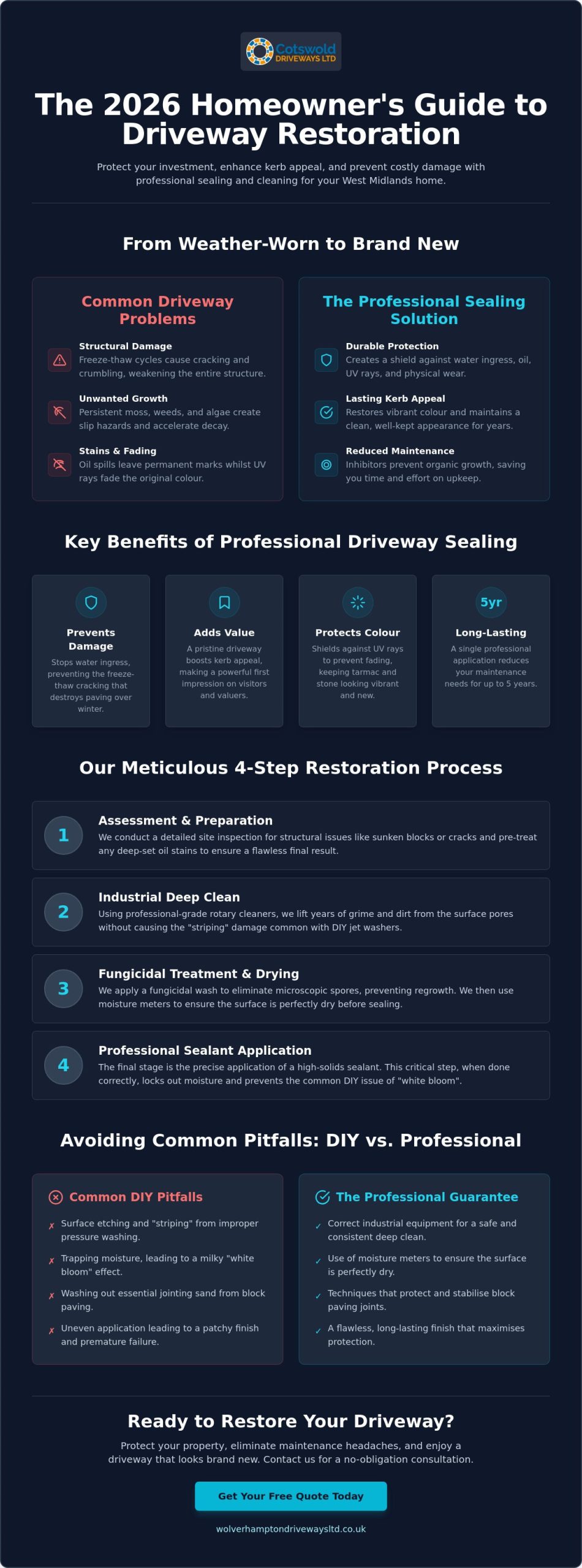
A professional restoration is a methodical, multi-stage project. It doesn’t start with a hose; it starts with a detailed site assessment. We inspect your driveway for structural issues, such as sunken blocks or hairline cracks, and identify deep oil stains that require specialist pre-treatment. This stage ensures that we don’t just cover up problems but actually solve them. Skipping this step often leads to the sealant failing prematurely because the underlying surface wasn’t properly prepared.
Once the assessment is complete, we move to the cleaning phase. This isn’t a standard domestic chore. We use industrial-grade equipment to lift years of grime. Proper cleaning also helps manage the runoff of harmful pollutants like motor oil and heavy metals, preventing them from entering the local Wolverhampton water system. Following the deep clean, we apply a professional fungicidal wash. This treatment is vital because it kills microscopic spores. Without it, moss and algae will simply grow back underneath your new sealant.
The most critical and often overlooked stage is the drying phase. We never apply sealant to a damp driveway. We use moisture meters to check the substrate levels because trapped moisture is the primary cause of “white bloom” or peeling. If your surface requires structural attention before this process begins, our team also provides comprehensive driveway repairs to ensure a perfectly level and stable base.
Step 1: Deep Cleaning and Stain Removal
We use industrial rotary cleaners that provide a consistent, deep clean without the “striping” effect caused by domestic lances. These machines use high-flow water to lift dirt from the pores of the stone. For stubborn tyre marks or rust spots, we apply targeted chemical treatments that break down the bond between the stain and the surface without damaging the driveway material itself.
Step 2: Re-Sanding and Joint Stabilisation
For block paving, we replace the sand lost during the cleaning process with high-quality kiln-dried sand. This sand is essential for the structural integrity of the driveway as it provides the friction needed to keep blocks from shifting. By sealing the sand joints, we create a hard, bonded surface that makes it nearly impossible for weed seeds to take root in the future.
Step 3: Precision Sealing Application
We apply premium-grade sealants using professional spraying or rolling techniques, depending on the material and weather conditions. We focus on reaching the saturation point to ensure maximum protection. During application, we take great care to protect your garden walls and decorative borders. Most surfaces are safe to walk on after four hours, though we recommend keeping vehicles off the driveway for 24 to 48 hours to allow the sealant to cure fully.
Material-Specific Care: Sealing Block Paving, Tarmac, and Resin
Every driveway in Wolverhampton has its own set of requirements. A concrete drive doesn’t behave like a tarmac one, and block paving has entirely different needs compared to resin. Successful driveway sealing and cleaning depends on tailoring the chemicals and techniques to the specific substrate. Using the wrong sealant can lead to peeling or, in the case of resin, a complete loss of drainage. We don’t believe in a “one size fits all” approach because it simply doesn’t last in our climate.
Block Paving Restoration
Block paving is beautiful but high-maintenance. It’s the most susceptible material to weed infestation because every joint is a potential home for seeds. Before we start the process, we check for “sinking” blocks. We lift and reset these areas first to ensure the surface is level before the cleaning begins. If you have significant structural issues such as sunken or shifting stones, our guide to block paving repairs in Wolverhampton explains how targeted professional repairs can restore your surface without the cost of a full replacement. Once the stones are clean and dry, we apply a joint-stabilising sealant. This doesn’t just protect the stone; it bonds the sand together to prevent blocks from shifting under the weight of vehicles. For those looking to maintain their drive between professional visits, you can read our guide on how to clean block paving. If you’re also battling persistent plant growth between your stones, our detailed breakdown of weed free driveway solutions separates the marketing myths from the technical realities of long-term weed resistance.
Tarmac and Asphalt Resurfacing
Tarmac driveways often lose their deep black finish after a few years of West Midlands sun and rain. This happens because the natural oils and resins evaporate, leaving the surface brittle and grey. We see this often in older drives across Dudley, where “fretting” or stone loss begins to occur. We don’t just paint the surface. We use specialised bitu-seal products that penetrate the tarmac to replace these lost binders. This process restores the flexibility of the drive and prevents it from cracking or crumbling. If you’re considering a new installation, check out our insights on tarmac driveways Wolverhampton.
Resin Bound and Pattern Imprinted Concrete
Resin bound driveways are popular for their permeability, but they require a gentle touch. We use low-pressure cleaning techniques to ensure we don’t damage the aggregate bond. Our sealants for resin include UV protection to prevent the yellowing or “shading” that occurs when lower-quality resins are exposed to sunlight. For pattern imprinted concrete, we focus on safety. These surfaces can become incredibly slippery when wet. We always include anti-slip additives in our concrete sealants to provide a textured grip whilst maintaining the clean aesthetic you desire. This ensures your driveway is safe for your family throughout the damp winter months.
Professional Driveway Sealing vs. DIY: Avoiding Common Pitfalls
It’s tempting to think that a weekend spent with a rented pressure washer will yield the same results as a professional crew. Many homeowners in Wolverhampton attempt this to save on costs, but the reality often involves expensive repairs later. Professional driveway sealing and cleaning is a technical task that requires more than just water pressure. It involves an understanding of chemical bonds, surface porosity, and local weather conditions that a domestic DIY kit simply cannot match. Hiring a local contractor is often more efficient than the hidden costs of equipment hire and the time spent correcting amateur mistakes.
One of the biggest advantages of hiring a specialist is access to trade-strength sealants. The products you find in high-street DIY stores are often diluted to make them safer for amateur application. While they might look good for a few weeks, they often lack the high-solids content needed for long-term protection. We use industrial-grade polymers that create a much tougher barrier against the West Midlands climate. These professional-grade formulas ensure your investment stays protected for years rather than months. If you want to avoid the risks of DIY and ensure a flawless finish, it’s always safer to choose professional driveway services from an experienced local team.
Why Domestic Jet Washers Often Cause Damage
A standard domestic pressure washer uses a high-pressure lance that focuses water into a tiny, aggressive point. This often leads to “etching,” where the water literally carves lines into the surface of your paving. You might also see “tiger striping,” which is a series of permanent, unsightly zig-zag marks that are impossible to remove. Professional rotary cleaners distribute pressure evenly across a wider area. This protects the stone whilst providing a much deeper clean. DIY washing also tends to blow out too much jointing sand without replacing it correctly, which leaves your blocks loose and prone to shifting.
The Science of Sealer Failure
Applying sealant is all about timing and environment. Professionals monitor the dew point and surface temperature before they even open a tin of sealer. If the surface is too cold or slightly damp, the sealant won’t bond. This leads to “white bloom,” a milky, opaque clouding trapped under the surface. It’s incredibly difficult to fix once it happens. Cheap, DIY sealants are also prone to peeling and flaking within a single season. By choosing a professional, you get a guarantee of quality. This provides peace of mind for homeowners in Telford and Cannock who want a job done right the first time.
Investing in Your Property: Timing, Maintenance, and Local Expertise
Your driveway isn’t just a functional space; it’s a significant part of your property’s market value. To keep it in top condition, you need to understand the correct timing for maintenance. Professional driveway sealing and cleaning isn’t a one-off task; it’s a cycle of care that protects your investment for years. Most high-quality sealants applied by experts last between three and five years. This timeframe depends on the volume of vehicle traffic and the level of exposure to the elements. Following this 3-5 year rule ensures the substrate never becomes fully exposed to the damp West Midlands climate.
The Best Season for Driveway Restoration
Timing is everything when it comes to a flawless finish. Spring and autumn are the peak seasons for professional restoration projects. During these months, temperatures are usually stable enough for the sealant to cure correctly without the risk of extreme summer heat or winter frost. We manage our schedule carefully around the unpredictable West Midlands rain to ensure a dry window for application. Interestingly, a sealed driveway is much easier to manage in winter. The non-porous surface prevents ice from bonding to the stone or tarmac, making snow removal a simple task for any homeowner.
Post-Sealing Aftercare
Once the work is done, simple maintenance extends the life of the finish significantly. You should keep the surface clear of fallen leaves and organic debris. If left to rot, these can cause tannin staining that is difficult to remove even with professional tools. We recommend a “soft wash” approach for your annual cleaning. A gentle rinse with a garden hose is usually enough to remove surface dust without stripping the protective sealant. You’ll know it’s time for a professional top-up when the water stops “beading” on the surface or when the colour begins to look slightly flat again.
Work with Wolverhampton Driveways Ltd
Choosing a local specialist means working with people who understand the specific challenges of our region. Our team is committed to high-quality workmanship across Wolverhampton, Dudley, and Stafford. We are fully insured and licensed local professionals who take pride in every project we undertake. We focus on being a stress-free partner for our clients, ensuring the job is done right the first time. If you’re ready to restore your home’s kerb appeal and protect your paving for the future, contact us today for a free, no-obligation quote for driveway sealing and cleaning.
Protect Your Driveway for the Years Ahead
Your driveway is more than just a place to park; it’s a valuable part of your home’s exterior that deserves professional protection. By choosing a high-quality seal, you aren’t just improving aesthetics. You’re actively preventing structural damage caused by the West Midlands freeze-thaw cycle and stopping the frustrating return of weeds and moss. Whether you have block paving, tarmac, or resin, a material-specific approach is the only way to ensure your surface remains durable and safe for the next three to five years.
We understand that your property is a significant investment. As fully insured and licensed West Midlands contractors with over a decade of local experience in Wolverhampton and Telford, we take pride in delivering results that last. We are specialists in block paving, tarmac, and resin restoration, using only trade-strength products to guarantee excellence. Professional driveway sealing and cleaning is the most cost-effective way to preserve your entrance. Don’t let another damp winter damage your paving.
Request your free driveway cleaning and sealing quote from our local experts today. We look forward to helping you transform your home’s entrance into a surface you can be proud of.
Frequently Asked Questions
How long does driveway sealing actually last?
A professional application typically lasts between three and five years. This duration depends on factors like the volume of vehicle traffic and the level of exposure to the West Midlands weather. We recommend a regular maintenance check every few years to ensure the protective barrier remains intact. High-quality trade sealants offer much better longevity than standard DIY products found in high-street shops.
Will sealing my driveway make it slippery when it rains?
Sealing does not have to make your surface slippery if the correct additives are used. For pattern imprinted concrete or smooth stone, we always include anti-slip kiln-dried sand or specialised polymer beads. These provide a textured grip that ensures your driveway remains safe for pedestrians even during a heavy West Midlands downpour. It’s a vital safety step for any professional restoration project.
Can you seal a driveway that was recently installed?
You should generally wait at least three months before sealing a brand-new driveway. This period allows any natural salts, known as efflorescence, to rise to the surface and wash away. If you seal the surface too early, you risk trapping these white marks permanently under the coating. We always assess the age and condition of the paving during our initial site visit to Wolverhampton homes.
How long do I need to stay off the driveway after it has been sealed?
Most sealants are safe to walk on after approximately four hours. However, you should wait 24 to 48 hours before parking any vehicles on the surface. This time allows the chemicals to cure fully and reach their maximum hardness. We provide specific guidance based on the material used and the current weather conditions on the day of application to ensure you don’t damage the finish.
Does sealing really stop weeds from growing in the joints?
Professional driveway sealing and cleaning significantly inhibits weed growth by hardening the jointing sand. This creates a solid barrier that makes it nearly impossible for airborne seeds to take root in the joints. Whilst it won’t stop weeds from growing on top of surface dirt, regular maintenance and a sealed base will keep your driveway clear of deep-rooted infestations for years. For a deeper understanding of what actually works against persistent plant growth, our guide on weed free driveway solutions for West Midlands homeowners explains the myths and realities behind long-term weed prevention.
Can oil stains be completely removed before sealing?
Most oil stains can be successfully removed using industrial-strength degreasers and hot-water pressure washing. If a stain has been left for many years, it may leave a slight shadow in the stone substrate. We treat these areas specifically before the sealing process begins to ensure the best possible aesthetic result. It’s important to treat leaks early to prevent permanent damage to the material.
What is the difference between a matt and a gloss sealer finish?
A matt finish provides a natural look that protects the stone without changing its appearance. In contrast, a gloss or wet-look sealer enhances the natural colours of the material and leaves a slight sheen on the surface. Both options offer the same level of structural protection against the elements. We can show you samples of both finishes to help you decide which look best suits your property.
Is it possible to seal a driveway in the winter months?
It is rarely possible to perform driveway sealing and cleaning during a typical West Midlands winter. The process requires a perfectly dry surface and a minimum temperature of 5°C for the sealant to bond correctly. We monitor local weather forecasts closely and usually recommend scheduling your restoration between March and October. This ensures the best results and a finish that won’t peel or flake.