
What if the driveway that looks the most modern today actually becomes your biggest maintenance headache by next summer? Deciding between resin bound vs block paving is one of the most important choices you’ll make for your home’s exterior, especially with the 2026 National SuDS Standards now in full effect. You want a surface that adds genuine value to your property without leaving you trapped in a cycle of weeding or worrying about drainage compliance.
It’s a common frustration for homeowners who feel torn between the sleek, seamless look of resin and the timeless, rugged appeal of traditional blocks. We understand that you need a driveway that works as hard as you do, remaining durable against the British weather whilst staying completely permeable. In this guide, we’ll compare the two surfaces across every category that matters to you, from long-term maintenance needs to how they handle heavy traffic.
We’ll look at the specific benefits of each material to help you choose a finish that suits your lifestyle. Whether you’re prioritising a weed-free finish or a surface that’s easy to repair, you’ll find the clear, straight-talking advice you need to make a confident investment in your home’s kerb appeal.
Key Takeaways
- Understand how the 2026 National SuDS Standards affect your project and why choosing a permeable surface can save you the hassle of seeking planning permission.
- Get a clear comparison of resin bound vs block paving to determine which material offers the best balance of modern style and long-term load-bearing strength.
- Learn the reality of driveway upkeep, including which surface is truly better at preventing weeds from taking hold over the years.
- Discover why the ability to easily lift and relay individual sections makes one of these options a smarter choice for homes with aging underground utilities.
- Identify the perfect finish for your property by weighing the seamless, contemporary look of resin against the classic, customisable patterns of traditional blocks.
Resin Bound vs Block Paving: Understanding the Core Differences
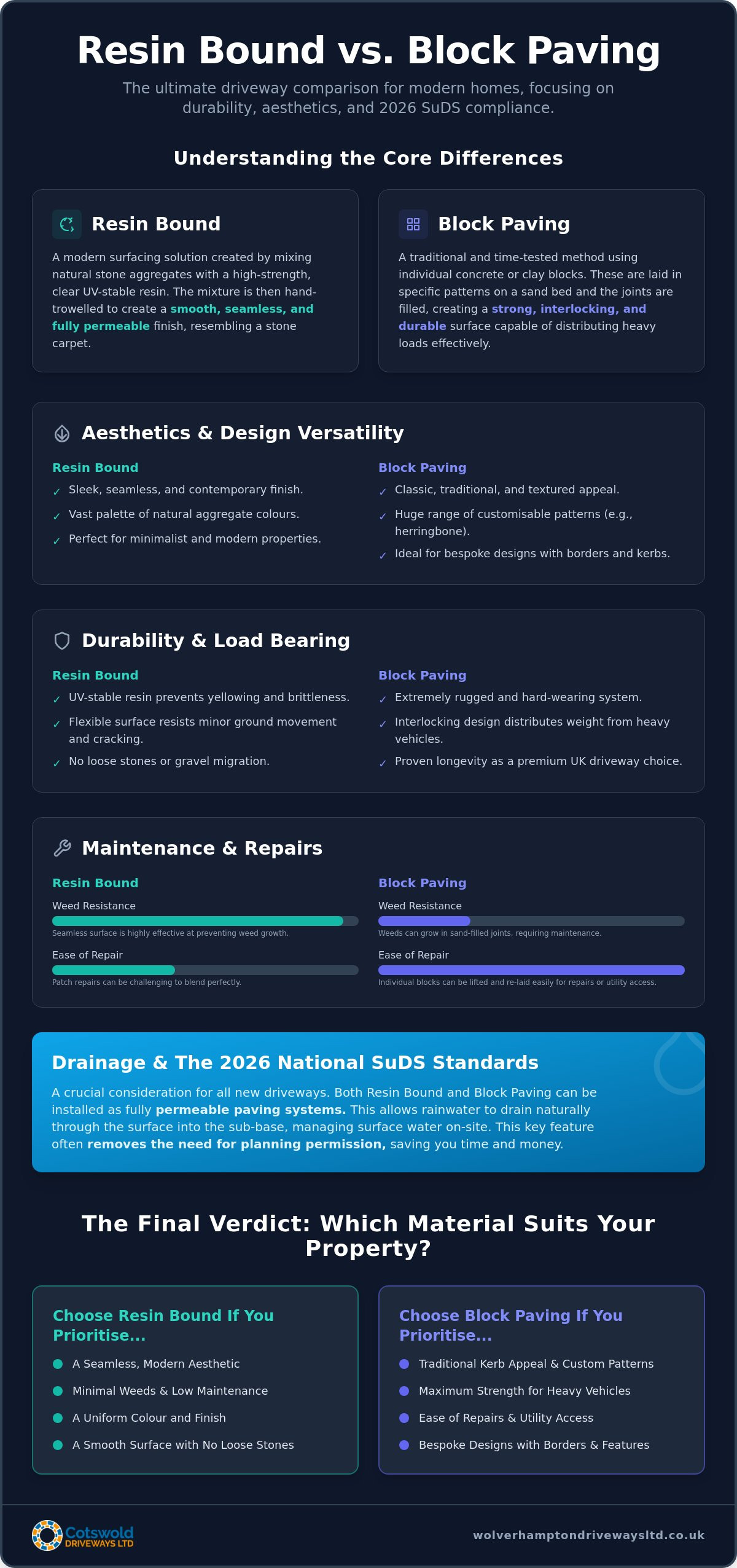
Choosing the right surface for your home is about more than just picking a colour. For many homeowners in the West Midlands, the debate between resin bound vs block paving comes down to a choice between modern innovation and time-tested tradition. Both systems are incredibly popular because they offer excellent kerb appeal and can be designed to meet strict UK drainage laws. However, the way they are constructed and how they behave under your car tyres is fundamentally different.
A resin bound surface is created by mixing natural stone aggregates with a high-strength, clear resin before it is laid. This results in a smooth, porous finish. Block paving, on the other hand, consists of individual bricks or blocks. These are laid in specific patterns on a bed of grit sand, with the joints filled with kiln-dried sand to create a rigid, interlocking surface. Whilst both options provide a premium look, understanding their physical properties is the first step in deciding which one belongs on your property.
What is Resin Bound Surfacing?
It is easy to get confused by industry terminology, particularly the difference between “bound” and “bonded” systems. We only install resin bound surfaces because they are superior in every way. In a bound system, the stone and resin are mixed together in a forced-action mixer before being trowelled onto the base. This encapsulates every stone in resin, creating a seamless, “carpet-like” finish. Because the stones are physically tied together, you won’t have to deal with loose gravel migrating into your hallway or onto the pavement.
To ensure your driveway looks as good in five years as it does on day one, we prioritise the use of UV-stable resins. Standard resins can yellow or become brittle when exposed to sunlight, leading to a patchy appearance. A UV-stable resin maintains its clarity, protecting the natural colour of the stone aggregates and ensuring the surface remains flexible enough to resist minor ground movement without cracking.
The Traditional Appeal of Block Paving
Block paving has earned its spot as the most popular premium driveway choice in the UK. Its versatility is unmatched, offering a huge range of materials from cost-effective concrete to high-end natural clay blocks. The real strength of this system lies in its interlocking nature. As vehicles move across the surface, the weight is distributed across the entire “mat” of blocks, making it a rugged solution for households with multiple heavy cars or vans.
The aesthetic flexibility is another major draw. You aren’t limited to a single colour or texture. You can choose bespoke geometric patterns, such as the classic 45-degree herringbone, and finish the look with contrasting borders or integrated kerbstones. This allows you to create a design that perfectly complements the architectural style of your home, whether it is a modern new-build or a traditional Victorian terrace.
Both of these methods can be installed as Permeable paving systems. This is a crucial consideration for modern homeowners. By allowing water to filter through the surface and into the sub-base, these driveways help manage surface water on-site. This keeps your home compliant with local drainage regulations and often removes the need for expensive additional drainage or formal planning permission.
Aesthetics and Durability: Comparing Style and Longevity
When weighing up resin bound vs block paving, the decision often starts with your home’s personality. Resin offers a sleek, minimalist aesthetic that feels like a seamless extension of a modern property. In contrast, block paving provides a textured, heritage feel that grounds more traditional homes. Living in Wolverhampton means your driveway must endure specific local challenges, particularly the damp frost cycles that test a surface’s endurance. Both materials handle these conditions well, but they do so in very different ways.
Design Versatility and Kerb Appeal
The visual impact of your driveway is the first thing visitors notice. With resin, you have access to a vast palette of modern resin driveway colours, allowing you to match the aggregate perfectly to your house brickwork or window frames. This creates a uniform, contemporary look that is difficult to achieve with other materials. Block paving relies on the artistry of the layout. Patterns like herringbone or basketweave offer a classic charm that has remained popular for decades. Opting for a lighter stone blend or block colour can trick the eye into seeing a small frontage as a much larger space.
Coordinating your driveway with high-quality glazing is a popular way to achieve this uniform look. To complement a premium driveway finish, Ashe Windows offers a range of high-quality windows and composite doors that help create a cohesive and modern exterior aesthetic.
Structural Integrity and Heavy Loads
For multi-car households or those with heavy work vans, structural strength is a priority. Block paving is exceptionally rugged. Because it’s made of individual units, it distributes weight across a wide area, making it ideal for frequent turning or heavy loads. Resin bound surfacing is also durable, but its strength depends entirely on the sub-base. It remains flexible enough to resist minor ground movement, which helps prevent the surface from cracking during temperature shifts. However, if the ground beneath it shifts significantly, resin cannot be easily “patched” like blocks can.
Longevity is where the two materials diverge. A professionally installed resin driveway is expected to last between 15 and 20 years. Block paving often has a longer lifespan, frequently reaching 25 to 30 years with reasonable upkeep. This durability is why blocks remain the most popular premium choice in the UK. Both systems must also comply with the National SUDS standards to ensure water doesn’t pool on the surface or overwhelm local drains. If you’re feeling stuck between the two, our team can help you compare block paving and resin bound samples to see which matches your property’s character best.
Frost cycles in the West Midlands can cause water trapped in joints to expand. In block paving, this might lead to slight shifting over many years, but the blocks themselves rarely fail. Resin’s porous nature allows water to drain through instantly, which actually reduces the risk of ice forming on the surface. This makes resin a slightly safer, “anti-slip” option during our colder months.
Maintenance and Repairs: Which is Easier to Manage?
A common misconception in the driveway industry is that modern surfaces are completely maintenance-free. We prefer to be honest with our customers. Whether you choose resin bound vs block paving, your investment will require a basic level of care to stay in top condition. Ignoring a driveway for years leads to moss, algae, and eventual structural issues. However, the type of maintenance each surface requires is very different, and this often dictates which material is right for your lifestyle.
The Battle Against Weeds and Moss
Weeds don’t actually grow from beneath your driveway; they start from airborne seeds that land on the surface. In block paving, these seeds find a home in the sand joints. If these joints aren’t regularly swept or treated with a sealant, weeds can quickly take hold. Resin bound surfacing has a distinct advantage here. Because it is a solid, continuous sheet without sand-filled gaps, there is nowhere for seeds to root. This makes resin naturally more weed-resistant, though moss can still form on the surface if it sits in a shaded, damp area for too long.
We recommend a simple biannual cleaning schedule for both materials. A stiff brush and a splash of soapy water are usually enough to keep resin looking new. For block paving, you might need to top up the kiln-dried sand every few years after a deep clean to ensure the blocks remain locked tightly together. Avoid using a high-pressure power washer too close to block joints, as this can blast away the sand that provides the driveway’s structural strength. For a full breakdown of safe cleaning methods and seasonal upkeep tasks, our resin driveway maintenance checklist covers everything you need to protect your surface year-round.
Repairability: Fixing Damage and Accessing Utilities
This is where block paving truly shines. If you ever need to access underground utilities, such as a burst water pipe or a new cable, individual blocks can be lifted and relaid without leaving a trace. It’s a modular system designed for flexibility. Resin, however, presents a “patching” problem. Because resin is mixed in batches on the day of installation, it’s incredibly difficult to match the exact stone colour and texture of an existing driveway later on. A repair in a resin surface will almost always leave a visible “scar” where the new material meets the old.
Professional installation is the best way to avoid these headaches. A correctly prepared sub-base prevents the sinking or cracking that leads to most repair calls. It also ensures your project remains compliant with the UK government planning rules for driveways. These regulations are strict about how water must be managed on your property. Whilst resin is inherently porous, block paving requires specific permeable aggregates in the joints to meet these same standards. Keeping your driveway clean isn’t just about looks; it ensures these drainage channels stay clear and functional for decades.
Drainage and Planning: Navigating UK SUDS Regulations
Planning a new driveway involves more than just selecting a beautiful finish. You also need to consider how your property handles rainwater. Sustainable Urban Drainage Systems, or SUDS, is a set of regulations designed to prevent local flooding by managing water where it falls. When comparing resin bound vs block paving, understanding these rules is vital. If your driveway doesn’t allow water to soak away naturally, you could be facing a complicated and expensive planning application before work even begins.
Resin bound surfacing is widely considered the gold standard for natural water infiltration. Because the stones are coated in resin but not completely sealed together, tiny voids remain throughout the surface. This allows rain to vanish almost instantly. Block paving can also meet these standards, but it requires a specific approach. Instead of traditional blocks, we use “permeable” or “flow” blocks. These bricks have slightly larger nibs on the sides to create wider joints. These gaps are then filled with a specific 6mm grit rather than sand, allowing water to pass freely between the stones.
Permeability in the West Midlands Climate
Homeowners in Wolverhampton are no strangers to heavy, sudden storms that can leave gardens waterlogged. A non-permeable driveway acts like a slide, sending all that water toward your garage or into the public highway. This is where expert permeable driveway installers in Wolverhampton make the difference. We ensure the entire system works together, starting with the sub-base.
A truly permeable system relies on a “Type 3” sub-base. Unlike the standard Type 1 used for roads, Type 3 is an open-graded aggregate that contains no “fines” or dust. This creates a hidden reservoir beneath your driveway that can hold thousands of litres of water during a storm, letting it soak into the water table slowly. Without this specific base, even the most porous resin surface will eventually cause puddling or “ponding” as the water has nowhere to go once it passes through the top layer.
Planning Permission: What You Need to Know
The UK government is very clear about front garden improvements. If you are surfacing an area larger than 5 square metres with a non-permeable material, you will likely need formal planning permission. This process can take months and involves extra fees. However, by choosing a resin bound system or permeable block paving, you bypass this requirement entirely. These surfaces are “permitted developments” because they solve drainage issues at the source.
Ultimately, SUDS is a simple way to prevent local flooding and protect the community’s drainage infrastructure. It’s a sensible law that encourages better building practices. If you’re unsure whether your current plans meet these legal requirements, get a professional drainage assessment from our team to ensure your project is fully compliant and built to last.
The Final Verdict: Which Material Suits Your Property?
Choosing between resin bound vs block paving ultimately depends on your priorities for the next two decades. Both surfaces offer a significant upgrade to any West Midlands home, but they serve different needs. Resin is the ideal choice if you value a sleek, contemporary aesthetic and want to spend your weekends relaxing rather than pulling weeds from sand joints. Block paving remains the “forever” driveway for many because of its unmatched structural repairability and classic heritage appeal. It’s about finding the right balance between the look you love and the level of upkeep you’re prepared to do.
For homes in Wolverhampton, the cost vs value proposition is a major factor. Whilst resin systems often require a higher initial investment for a full dig-out, the speed of installation and the lack of future weeding costs make it a very attractive long-term option. Block paving has a lower entry point for materials but requires more intensive labour to lay every individual brick by hand. Both options add genuine value to your property by ensuring full compliance with the 2026 SuDS drainage standards, protecting you from future legal or environmental headaches.
While you are investing in your home’s future value, it is also a wise time to ensure your estate is fully protected through professional services. For those looking to secure their assets for future generations, Aiker Wills and Trusts provides dedicated support in creating comprehensive wills and trusts.
Decision Matrix: Resin or Block Paving?
To make your choice easier, we’ve summarised the best use-cases based on our years of local experience. You should choose Resin Bound if you have a modern property, want a completely seamless finish, and require an anti-slip surface that handles heavy rain instantly. It’s the best option for those who want a “set and forget” driveway that stays looking fresh with just a simple wash.
You should choose Block Paving if you own a traditional or period home where a herringbone pattern adds essential character. It’s also the smarter choice if you anticipate needing to dig up your driveway for pipework or cable repairs in the future, as blocks can be lifted and relaid perfectly. A growing trend amongst our customers is combining the two. Using a block paving border to frame a resin bound centre gives you the best of both worlds: structural definition with a low-maintenance, modern core.
Next Steps for Your Driveway Project
Every home is unique, and the best way to get a clear picture of the work required is to speak with a local specialist. We can help you navigate the technical details of sub-bases and drainage levels to ensure your new surface lasts for its full expected lifespan. If you’re ready to start planning, you can get accurate resin driveway quotes tailored to your specific project requirements.
For more detailed information on styles and technical specifications, feel free to explore our full Resin Bound Driveways in the West Midlands guide. We take pride in our “no-nonsense” approach and are here to ensure you get a driveway that stands the test of time. Get a free, no-obligation quote from Wolverhampton Driveways Ltd today and take the first step toward transforming your home’s kerb appeal.
Start Your Driveway Transformation with Confidence
The choice between resin bound vs block paving ultimately comes down to your personal style and how much time you want to spend on maintenance. Whether you prefer the modern, seamless finish of resin or the classic, repairable nature of traditional blocks, the most important factor is the quality of the installation beneath the surface. A professional sub-base ensures your driveway remains durable, looks stunning, and stays fully compliant with UK drainage laws for years to come.
As a fully insured and licensed West Midlands team, we take pride in our reputation for excellence. We are specialists in both resin and traditional block paving, backed by dozens of 5-star local reviews from satisfied homeowners in Wolverhampton and Dudley. We understand that every property is unique, and we’re here to provide the honest, expert advice you need to make the right investment for your home’s kerb appeal.
Ready to see the difference a professional finish can make? Book your free site survey and quote with Wolverhampton’s paving experts. We look forward to helping you create a driveway that you’ll be proud of for decades.
Frequently Asked Questions
Is resin bound cheaper than block paving?
The total cost of resin bound vs block paving depends heavily on whether your project requires a full excavation or just an overlay. While a resin overlay on a sound existing base can be more cost-effective, a full dig-out installation is often comparable in price to high-quality block paving. Resin materials have seen price increases recently, so we always provide a detailed site assessment to help you determine which option offers the best value for your specific budget.
Can you lay resin bound over existing block paving?
You should generally avoid laying resin bound directly over an old block paved surface. Because blocks are individual units that can shift or “rock” over time, they don’t provide the stable, monolithic base that resin requires to prevent surface cracking. For a long-lasting finish, it’s best to install resin over a solid, porous macadam or concrete sub-base. This ensures the surface remains seamless and handles vehicle weights without moving.
Does block paving add more value to a house than resin?
Both materials add significant value to your home by improving kerb appeal and ensuring drainage compliance. Block paving is a traditional favourite that many buyers associate with premium quality and long-term durability. Resin bound is rapidly gaining popularity for its modern, “weed-free” reputation and sleek appearance. Ultimately, a professionally installed driveway of either material will increase your property’s marketability as long as it complements the architectural style of the house.
How long does a resin driveway take to install compared to blocks?
A resin bound surface is typically much faster to lay than block paving once the sub-base is ready. Our team can often trowel down a standard-sized resin driveway in a single day, whereas laying individual blocks by hand for the same area can take several days of intensive labour. If you want to minimise the time your home is a construction site, resin is often the more efficient choice for a quick transformation.
Which driveway surface is less slippery in the winter?
Resin bound surfacing is often safer in the winter because its porous nature allows water to drain away instantly, reducing the risk of ice patches forming. We also have the option to broadcast a fine crushed glass or sand over the surface during the curing process to provide extra grip. While block paving is also a safe surface, the sand-filled joints can sometimes hold moisture that turns to ice in shaded areas during colder spells.
Do I need a skip for a new resin or block paving driveway?
You will almost certainly need a skip if your project involves a full dig-out of your existing driveway. Removing several tonnes of old tarmac, concrete, or soil is a standard part of the preparation process for both materials. We manage the delivery and collection of skips as part of our service. This keeps your property tidy and ensures all waste materials are taken to local West Midlands recycling centres for responsible disposal.
Can I park a heavy van on a resin bound driveway?
You can safely park a heavy commercial van on a resin bound driveway provided the sub-base has been specifically designed for that load. The resin surface itself is remarkably strong, but it relies on the strength of the ground beneath it to prevent sinking or cracking. If you have a multi-car household with heavy vehicles, we simply increase the depth of the sub-base during installation to ensure the driveway handles the daily pressure without issue.